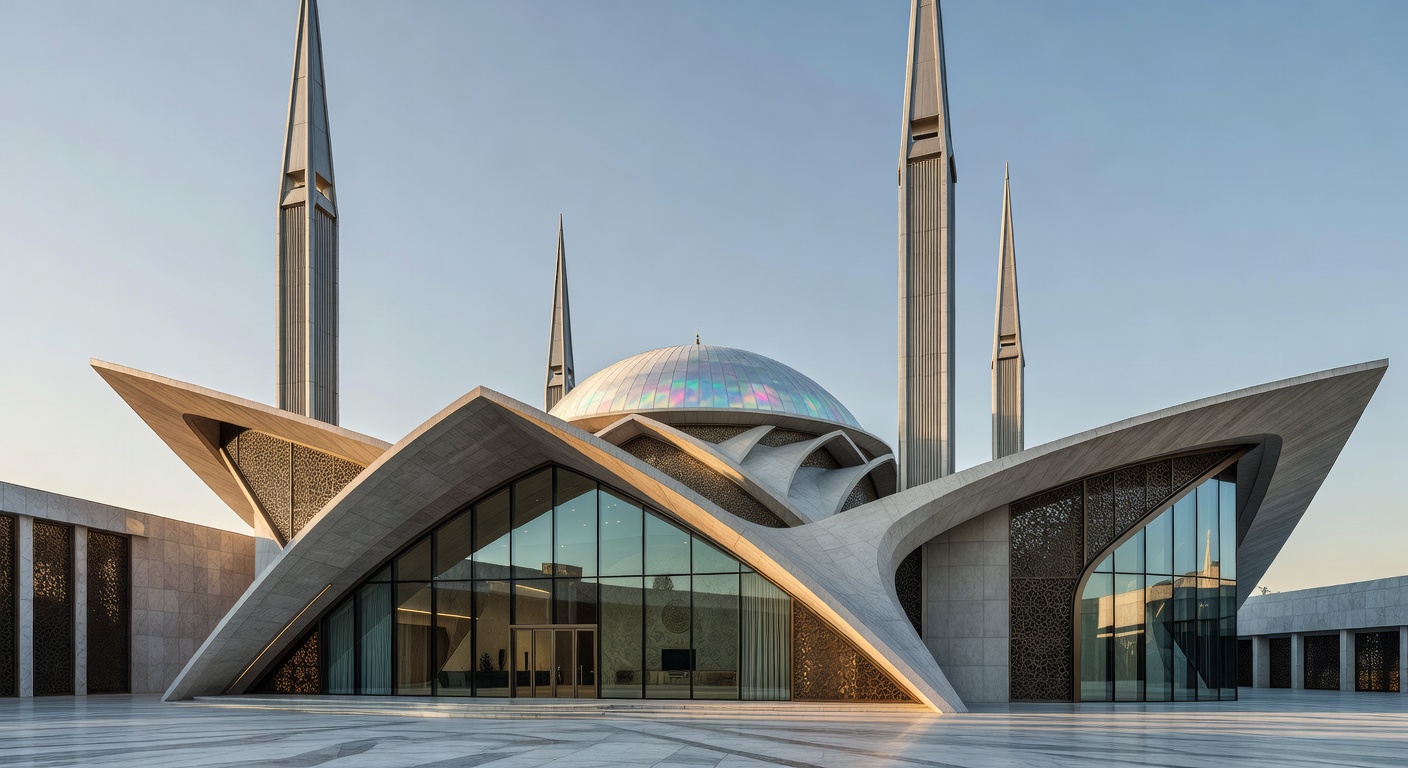
In the heart of bustling cities and serene deserts, modern mosques stand as bold testaments to faith’s enduring evolution. These structures transcend their role as places of prayer, blending cutting-edge design with spiritual depth to create sanctuaries that resonate in the 21st century.
Consider the Sheikh Zayed Grand Mosque in Abu Dhabi, completed in 2007. This colossal edifice sprawls across 12 acres, accommodating up to 40,000 worshippers. Its most striking feature is the world’s largest carpet, hand-knotted by Iranian artisans with 35 million stitches, and four minarets soaring 107 meters high, symbolizing the four pillars of Islam. Clad in gleaming white marble sourced from over 28 countries, the mosque shimmers under the sun, its courtyards lined with 1,000 pillars inlaid with gold, silver, and semiprecious stones. At night, LED lights embedded in the stone pulse through 82 domes, evoking the starry skies that once guided ancient pilgrims. Funded by the UAE’s late president Sheikh Zayed bin Sultan Al Nahyan, it embodies Gulf prosperity post-oil boom, welcoming non-Muslims and fostering interfaith dialogue.
Across continents, the Hassan II Mosque in Casablanca, Morocco, opened in 1993, pushes engineering boundaries. Perched on the Atlantic edge, its 210-meter minaret—the tallest in the world—is a laser beacon pointing toward Mecca. A retractable roof over the prayer hall allows ocean breezes and natural light to flood the space, while glass floors reveal the sea below, merging divine creation with human ingenuity. Designed by French architect Michel Pinseau, it revives Islamic motifs like zellij tilework and muqarnas vaulting, but with hydraulic systems and earthquake-resistant foundations. Built to honor King Hassan II’s vision, it cost $800 million and employed 6,000 craftsmen, symbolizing Morocco’s post-colonial resurgence.
In Europe, the Central Mosque in Cologne, Germany (2008), fuses Ottoman grandeur with contemporary minimalism. Architecturally, its six minarets and massive dome recall Istanbul’s Blue Mosque, yet it’s constructed with light-permeable glass and steel, allowing daylight to dance across interiors adorned with Lebanese cedar and Turkish onyx. Spanning 5,000 square meters, it serves 35,000 Muslims in a diverse diaspora community, promoting integration amid debates on immigration.
These mosques matter today because they bridge tradition and innovation. In an era of rapid urbanization, they offer oases of tranquility with sustainable features like solar panels at the Grand Mosque of Rome (1995) and rainwater harvesting in Kuala Lumpur’s Crystal Mosque (2008), made of steel and glass for a crystalline glow. Historically, mosques evolved from Prophet Muhammad’s simple Medina house in 622 CE to Ottoman masterpieces; modern ones adapt to globalization, using BIM technology and eco-materials to combat climate change while preserving rituals like the adhan call to prayer amplified through speakers.
Ultimately, sacred modern mosques affirm Islam’s vitality, inviting reflection on unity, stewardship, and beauty. They remind us that spirituality thrives not in isolation but in harmony with the contemporary world, drawing millions to experience transcendence amid steel and stone.
Comments are closed