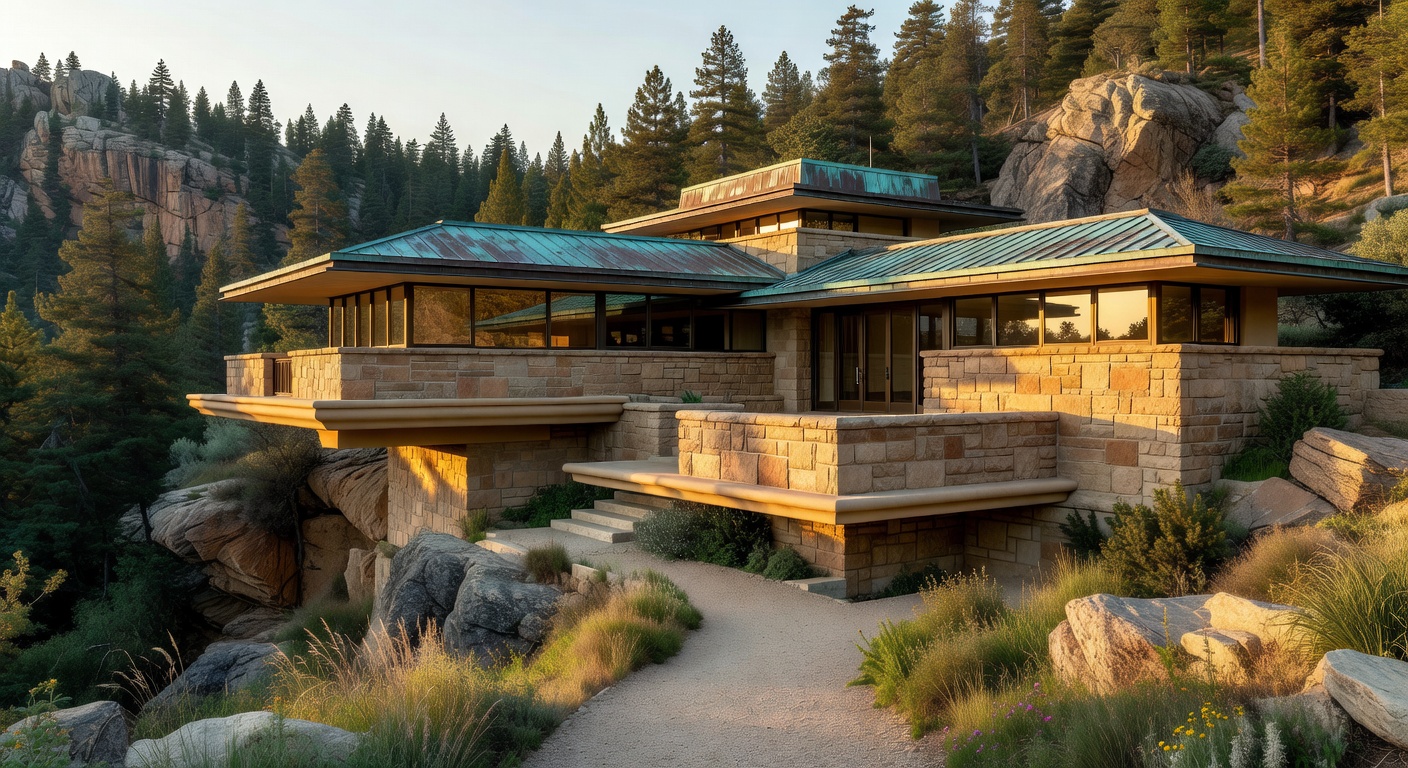
Frank Lloyd Wright treated architecture as an act of listening to the land rather than imposing on it. Born in 1867 during America’s rapid industrialization, he turned away from the heavy ornament and rigid boxes that defined the period. Growing up on Wisconsin prairies and apprenticing under Louis Sullivan, who insisted that form must follow function, Wright developed a philosophy he called organic architecture—an approach that treated every building as an extension of its site, materials, and climate.
The core idea was simple: a structure should feel as though it belongs exactly where it stands. Wright favored local stone, timber, and brick so the finished work appeared native to its setting. Long, low rooflines echoed the flat horizon of the Midwest, while deep overhangs and continuous bands of windows blurred the line between rooms and the outdoors. At Fallingwater in Pennsylvania, completed in 1935, the house doesn’t overlook the waterfall—it sits directly above it, so the sound of water moves through living spaces and terraces. The Guggenheim Museum in New York, finished in 1959, coils upward like a shell, letting visitors experience both art and movement in one continuous path.
His early work pushed against European modernism and Victorian habits alike. The 1906 Robie House in Chicago stretched wide eaves over open porches and removed most interior walls, creating flowing spaces that suited a less formal American lifestyle. Later, in the 1930s, Wright proposed Broadacre City, a vision of low-density communities where each household had room to garden and cars connected scattered homes to working farmland—an explicit rejection of dense industrial cities.
Today those same principles shape sustainable practice. Firms such as Olson Kundig in Seattle integrate solar arrays and reclaimed timber so homes settle into forests without visual disruption. The ongoing restoration of the Darwin D. Martin House in Buffalo shows how Wright’s buildings can accept modern energy upgrades while keeping their original character. In an era of rapid development and climate pressure, his insistence on durable, site-specific design offers practical advantages: lower long-term energy use, reduced material waste, and spaces that measurably ease stress for occupants.
Wright’s work remains relevant because it prioritizes relationship over spectacle. Rather than fighting the environment, his buildings cooperate with it, proving that thoughtful architecture can still feel fresh a century later.
Comments are closed