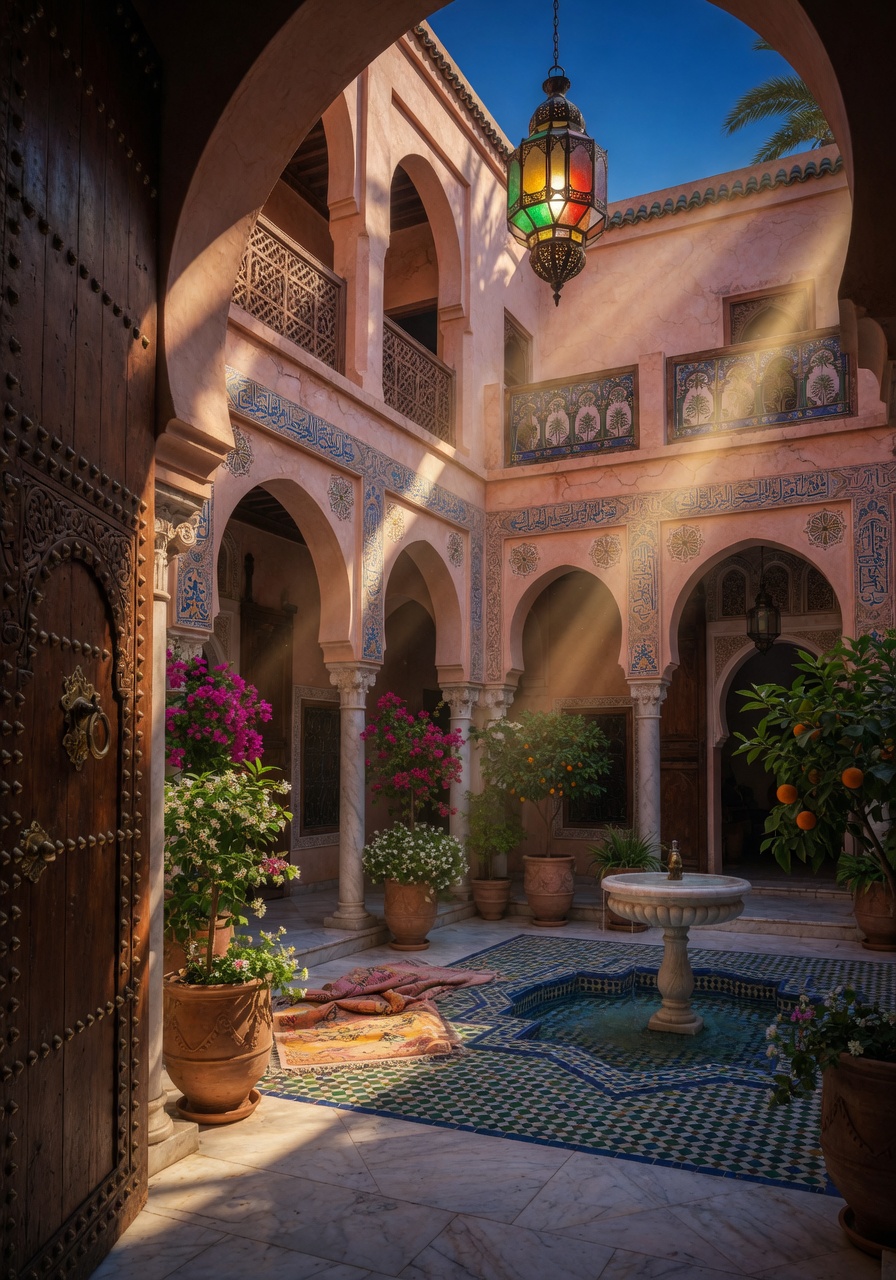
Morocco’s riad courtyards have long solved a tricky urban puzzle: how to carve private green havens out of dense, sun-baked cities without relying on modern technology. These compact spaces sit at the center of traditional homes, pulling together Islamic geometry, local materials, and smart climate responses that still feel relevant today.
The layout follows a simple yet precise pattern. A square or rectangular open-air court anchors everything, ringed by living quarters on all sides. At the middle sits a shallow basin or fountain whose slow trickle drops the surrounding temperature through basic evaporation. Floors and walls wear intricate zellij mosaics in deep blues, saffron yellows, and greens that bounce light around the space. Arched openings and slender columns create rhythm, while cedar ceilings or lattice screens overhead soften the midday glare. Orange trees, jasmine, and palms add fragrance and a touch of shade, turning the whole area into a self-contained microclimate built for places where summer heat regularly tops 40°C.
These designs trace back to the Almoravid era in the 11th century and reached their height under the Saadian rulers. Early builders drew from both Andalusian and Persian traditions, placing privacy at the heart of the plan so family life stayed shielded from street noise and strangers. Wealthy traders constructed thick earthen walls finished in lime plaster, then layered on carved stucco and painted woodwork that echoed descriptions of paradise gardens. By the late 20th century many riads had fallen into neglect as families moved to newer suburbs, yet a wave of careful restorations has since turned hundreds into small hotels that keep the original craft traditions alive.
Current examples show how the old principles adapt without losing their core. In Fez, Riad Kniza runs its fountains on solar power and uses reclaimed timber for seating while growing herbs on the roof. Along the coast in Essaouira, properties like Dar Ness channel sea breezes through their courts. The same passive techniques—groundwater misters, plant buffers, and strategic shade—offer practical lessons for architects facing rising temperatures and tighter energy budgets. At the same time, the work supports local tile makers and wood carvers, keeping skills that might otherwise fade.
In the end, riad courtyards prove that thoughtful limits can produce lasting comfort. Their small scale encourages shared moments rather than isolation, and the balance of light, water, and greenery creates a quiet kind of luxury that lingers long after you leave.
Comments are closed