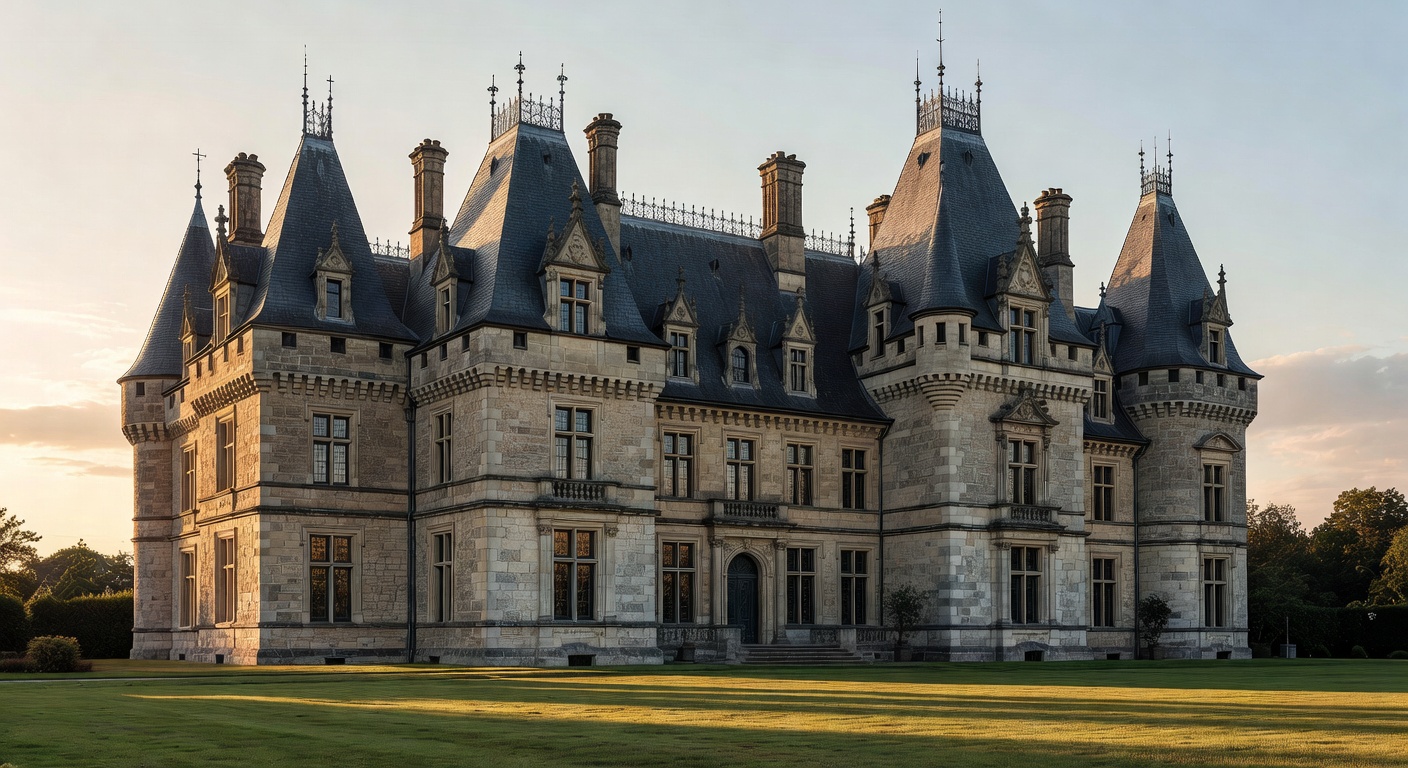
Perched atop grand estates like jeweled helmets, chateauesque roofs capture the eye with their audacious slopes and intricate silhouettes. This architectural style, born from French Renaissance châteaux, blends medieval grandeur with playful excess, turning rooftops into statement pieces that dominate skylines. Far from mere shelter, these roofs embody a fusion of history, engineering, and artistry that still inspires today’s builders.
The hallmark of chateauesque design is its steeply pitched rooflines, often exceeding 60 degrees, which evoke the towering spires of Loire Valley castles like Chambord or Chenonceau. Key features include multiple dormers—protruding windows framed by gables—that punctuate the vast slate or tile surfaces, creating a rhythmic texture. Tall chimneys, clustered in dramatic stacks, pierce the sky like minarets, while corner turrets and conical spires add whimsical asymmetry. French-inspired details abound: fish-scale shingles, ornate cresting along ridges, and copper flashing that weathers to vibrant patinas. These elements aren’t just decorative; the steep pitch sheds heavy snow and rain, a practical nod to northern climates, while the multi-level structure maximizes attic space in sprawling homes.
Historically, chateauesque emerged in 19th-century America during the Gilded Age, when wealthy industrialists sought Old World opulence amid rapid urbanization. Architects like Richard Morris Hunt imported the style directly from France, designing icons such as the Biltmore Estate in North Carolina (1895), whose 178,926-square-foot mansion boasts a chateauesque roof sprawling over 24,000 square feet. Hunt, fresh from École des Beaux-Arts training, championed this “French château revival” to symbolize refined taste and boundless fortune. The style peaked around the 1893 Chicago World’s Fair, influencing public buildings and private retreats alike, before fading with modernism’s rise. Yet its roots trace deeper, to 16th-century France, where kings like François I commissioned roofs that flaunted engineering feats—interlocking trusses supporting vast spans without interior walls.
Today, chateauesque roofs thrive in modern adaptations, blending heritage with innovation. In Quebec, heritage restorations on Boulevard René-Lévesque preserve these roofs against harsh winters, using synthetic slate for durability. Luxury developers in California and Florida incorporate scaled-down versions in gated communities, pairing them with sustainable tech like solar-integrated tiles from companies like Tesla. A standout example is the OHEKA Castle in New York, a 1919 chateauesque masterpiece now a wedding venue, its restored roof gleaming with period authenticity. Even in new builds, firms like McAlpine design boutique hotels with chateauesque elements, using lightweight composites to mimic slate at lower cost.
Why does this matter now? In an era of flat-roofed minimalism, chateauesque roofs remind us of architecture’s power to uplift spirits. They foster verticality, drawing eyes upward to foster a sense of aspiration and permanence. Amid climate challenges, their steep profiles promote natural drainage and resilience, aligning with green building standards. Culturally, they preserve narratives of ambition and craftsmanship, countering homogenization. Whether crowning a historic gem or a contemporary villa, these roofs prove that bold silhouettes endure, inviting us to dream big under their soaring eaves.
Comments are closed