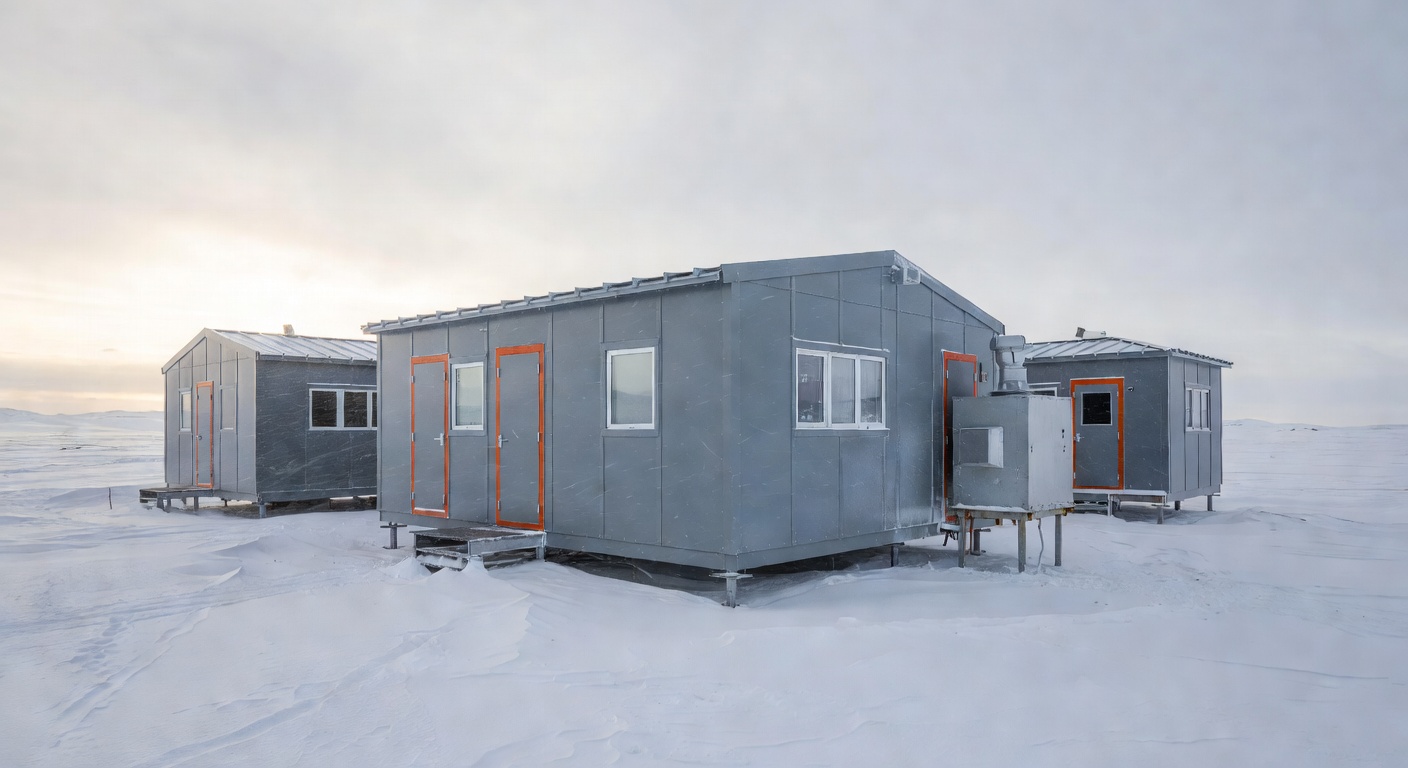
Deep in the polar night, where temperatures plummet to minus 50 Celsius and winds howl like ancient spirits, human ingenuity has long carved out havens from the frozen void. Arctic insulated structures aren’t just shelters; they’re masterful adaptations to one of Earth’s harshest environments, blending natural materials with clever engineering to trap heat and defy the cold.
The Inuit igloo stands as the iconic pioneer of this tradition. Constructed from blocks of compacted snow, these domes form in hours using only a snow knife and precise knowledge of wind-packed drifts. Snow’s low thermal conductivity—about 0.1 to 0.5 W/m·K—acts as superb insulation, while the igloo’s curved shape sheds wind and distributes weight evenly on unstable sea ice. Inside, a small seal-oil lamp raises temperatures to a cozy 15-20°C, even as blizzards rage outside. Historical accounts from 19th-century explorers like Knud Rasmussen document how Inuit hunters built these in minutes during caribou hunts, sleeping soundly amid -40°C gales. Not permanent homes but expeditionary pods, igloos highlight a profound understanding of microclimates: the entrance tunnel blocks cold air, and a raised sleeping platform captures rising warmth.
Other indigenous designs expand this legacy. The Yukon First Nations’ sod-roofed pit houses, dug into permafrost and topped with driftwood frames insulated by moss and turf, maintained stable interiors year-round. Aleut semi-subterranean barabaras used whalebone, grass, and sod for walls up to 60 cm thick, their earth-bermed design mimicking a natural heat sink. These structures, dating back over 2,000 years, relied on local bounty—reindeer hides, whale blubber, peat—proving that insulation isn’t about high-tech but harmony with the land.
Fast-forward to today, and these principles fuel cutting-edge innovation. In Svalbard, Norway, the Global Seed Vault’s Arctic World Archive employs triple-layered insulation with concrete, steel, and air gaps to safeguard data against doomsday scenarios. Modern Arctic research stations, like Canada’s PEARL on Ellesmere Island, use spray-foam panels with R-values exceeding 40, passive solar design, and geothermal heat pumps to slash energy use by 70%. Expeditionary tents from brands like Hilleberg now mimic igloo aerodynamics with silicone-coated fabrics and inflatable struts, while 3D-printed habitats tested by NASA for Mars draw directly from igloo geometry for radiation shielding and thermal stability.
Why does this matter now? Climate change is unraveling the Arctic faster than anywhere else, with sea ice shrinking 13% per decade and permafrost thaw releasing methane. Indigenous communities face housing crises as traditional materials dwindle and extreme weather intensifies. Meanwhile, polar tourism booms, and resource extraction pushes infrastructure northward. Versatile, low-impact insulated structures offer resilience: they cut fossil fuel dependence, preserve cultural knowledge, and model sustainable building for a warming world. From Greenland’s eco-villages experimenting with turf-igloo hybrids to military outposts in Alaska deploying aerogel-insulated modules, these designs prove that the Arctic’s lessons can insulate humanity’s future. In a world racing toward colder extremes amid hotter averages, rediscovering these frozen fortresses isn’t nostalgia—it’s necessity.
Comments are closed