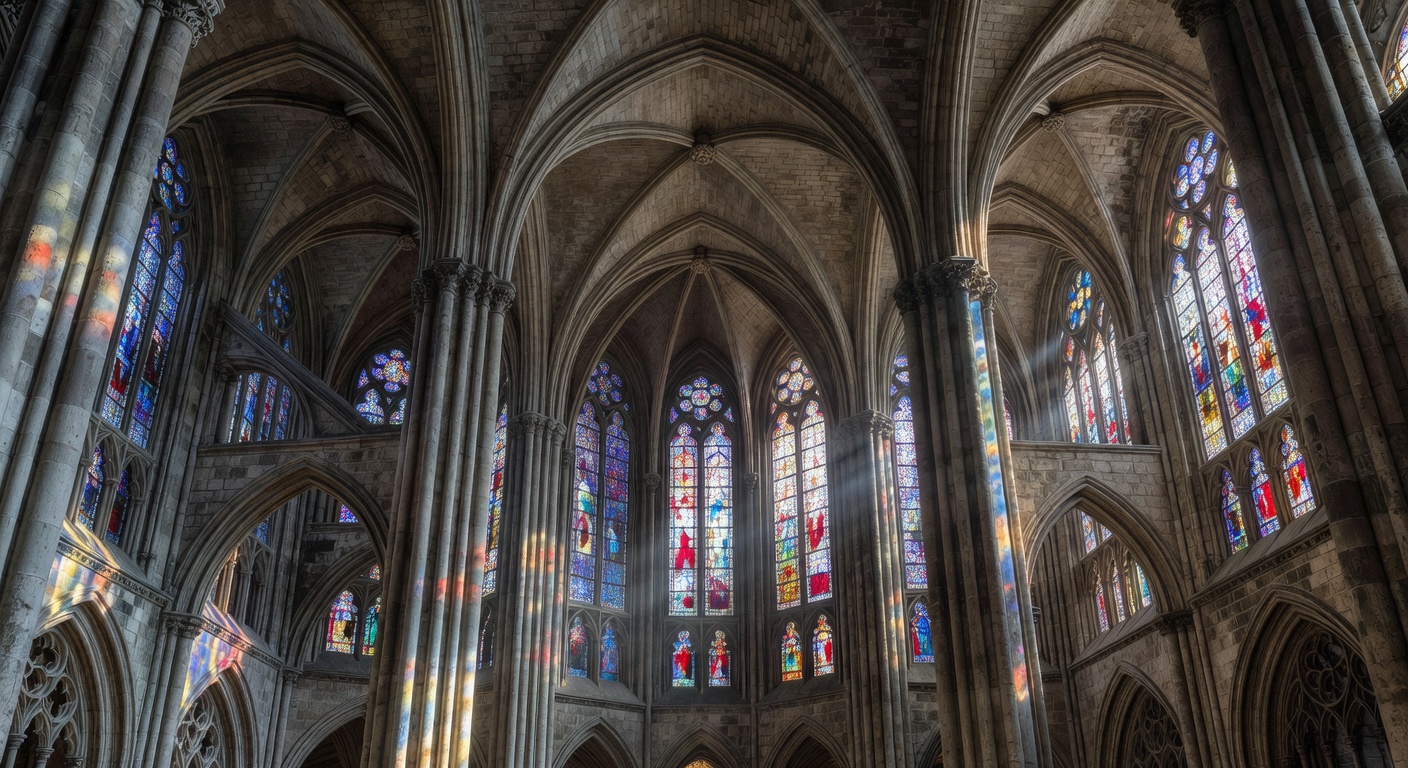
Gothic cathedrals stand as testaments to medieval ingenuity, their skeletal spires piercing the sky like frozen lightning. Built primarily between the 12th and 16th centuries across Europe, these structures redefined architecture through bold engineering that balanced faith, physics, and artistry. Far from mere places of worship, they were feats of structural wizardry, pushing the limits of stone, light, and height in ways that still captivate engineers today.
At the heart of Gothic design lies the pointed arch, a game-changer borrowed from Islamic architecture but refined by Western builders. Unlike the rounded Roman arches that distributed weight broadly, pointed arches channeled forces vertically, allowing thinner walls and taller vaults. This innovation enabled ribbed vaults—intricate networks of stone ribs that spread the ceiling’s load evenly across piers and columns. Flying buttresses, those external arched supports, were the real stars: they braced walls against outward thrust from the vaults, freeing up interior space for massive stained-glass windows. Chartres Cathedral in France exemplifies this, its 115-foot nave height achieved with flying buttresses that hug the exterior like protective arms.
Historical context reveals the era’s fervor. The Gothic style exploded amid the High Middle Ages, fueled by economic booms, Crusades-inspired cultural exchange, and the Church’s quest for grandeur to inspire awe. Notre-Dame de Paris, begun in 1163, showcased early pointed arches and flying buttresses, while later masterpieces like Reims Cathedral (13th century) added tracery—delicate stone lattices framing rose windows that flooded naves with jewel-toned light. Construction was a multi-generational marathon, often spanning centuries, with master masons like Villard de Honnecourt sketching designs in illuminated manuscripts. These weren’t just buildings; they were communal endeavors, blending carpentry for timber centering (temporary scaffolds) and precise quarrying of limestone.
Modern examples echo this legacy. The 20th-century Sagrada Família in Barcelona, Antoni Gaudí’s unfinished basilica, fuses Gothic elements like pointed arches and vaults with organic curves, its towers now rivaling the Eiffel Tower at over 550 feet. Contemporary engineers study Gothic techniques for sustainable design—flying buttresses inspire earthquake-resistant bracing, while ribbed vaults inform lightweight tensile structures like Norman Foster’s 30 St Mary Axe in London. Digital tools like finite element analysis even simulate medieval stress loads, proving these cathedrals’ remarkable stability.
Why does this matter today? Gothic engineering underscores human potential to harmonize beauty and function without steel or computers. In an age of rapid, resource-heavy construction, these enduring icons—withstanding wars, fires, and time—teach lessons in durability and minimalism. Notre-Dame’s 2019 fire highlighted restoration challenges, yet its survival via iron ties added in the 19th century shows adaptive genius. As climate pressures demand resilient architecture, Gothic principles offer blueprints for tall, light-filled buildings that honor the past while shaping a sustainable future. These cathedrals aren’t relics; they’re blueprints etched in stone, reminding us that true innovation endures.
Comments are closed