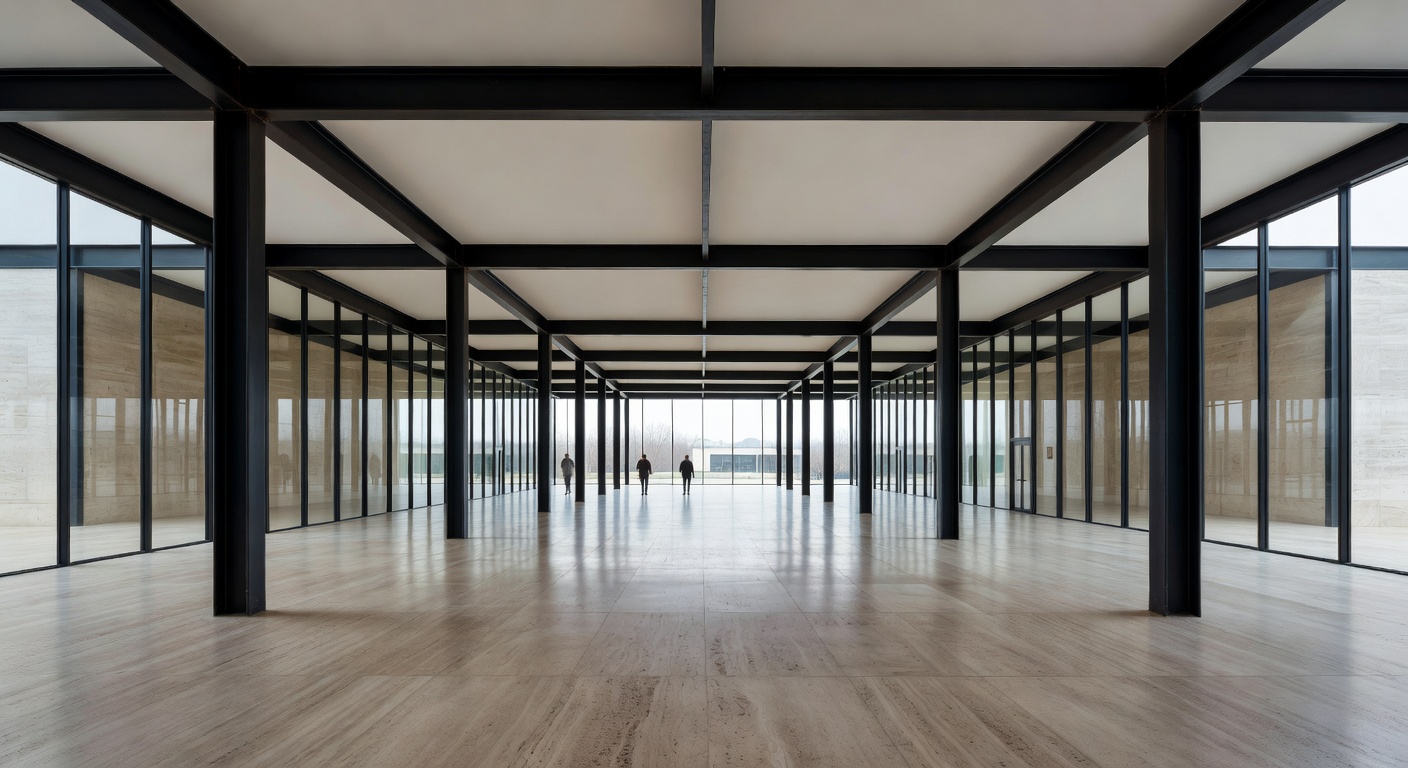
Ludwig Mies van der Rohe didn’t just design buildings; he redefined how we inhabit space. Born in 1886 in Germany, the architect behind the iconic Barcelona Chair and the Seagram Building distilled architecture to its essence with his mantra, “Less is more.” This philosophy of minimalism stripped away ornamentation, embracing clarity, functionality, and structural honesty. In a world bloated with excess, Mies’s approach feels like a breath of fresh air—or rather, a wide-open glass wall.
Minimalism under Mies wasn’t about stark deprivation but precision. Key features include the use of industrial materials like steel, glass, and concrete, exposed without disguise. Think expansive glass facades that blur indoor and outdoor boundaries, creating fluid, universal spaces. His buildings prioritize open floor plans, free from load-bearing walls, allowing light to flood in and inhabitants to adapt layouts freely. Symmetry and proportion ruled: columns aligned in rhythmic grids, surfaces flush and unadorned. No fussy cornices or decorative flourishes—just the pure expression of a building’s skeleton. This “skin and bones” aesthetic extended to furniture, like the flat-pack Barcelona Chair with its leather straps and chrome frame, a sleek throne for the modernist elite.
Historically, Mies emerged amid Europe’s interwar turmoil. A protégé of Peter Behrens, he absorbed Bauhaus ideals after leading the avant-garde November Group. Appointed Bauhaus director in 1930, he navigated Nazi suppression before fleeing to the U.S. in 1937. There, his 1945 IIT campus in Chicago became minimalism’s laboratory—pavilions of glass and steel amid urban grit. The 1958 Seagram Building in New York epitomized corporate minimalism: a bronze-and-glass tower on Park Avenue, its plaza a public gift amid skyscraper density. These weren’t mere structures; they embodied Enlightenment rationality clashing with 20th-century chaos, influencing the International Style that swept postwar reconstruction.
Today, Mies’s legacy pulses in modern design. Apple’s Stores echo his glass-box transparency, with iPhone displays floating like Miesian cantilevers. SANAA’s Rolex Learning Center in Switzerland deploys vast, column-free slabs of glass and concrete, nodding to IIT’s rigor. Even residential trends—think Scandi-noir homes with white walls, oak floors, and multifunctional furniture—owe a debt to his ethos. Luxury brands like Aesop strip retail to concrete and steel, channeling Mies’s industrial chic.
Why does it matter now? In an era of fast fashion and digital clutter, Miesian minimalism champions sustainability and mental clarity. Fewer materials mean less waste; open plans foster community over isolation. It counters consumerism’s noise, reminding us that elegance arises from restraint. As climate crises demand efficiency, his honest structures—built to last—offer timeless lessons. Mies didn’t invent empty rooms; he crafted spaces that amplify life within them. Dive into his world, and you’ll see minimalism not as absence, but as the ultimate presence.
Comments are closed