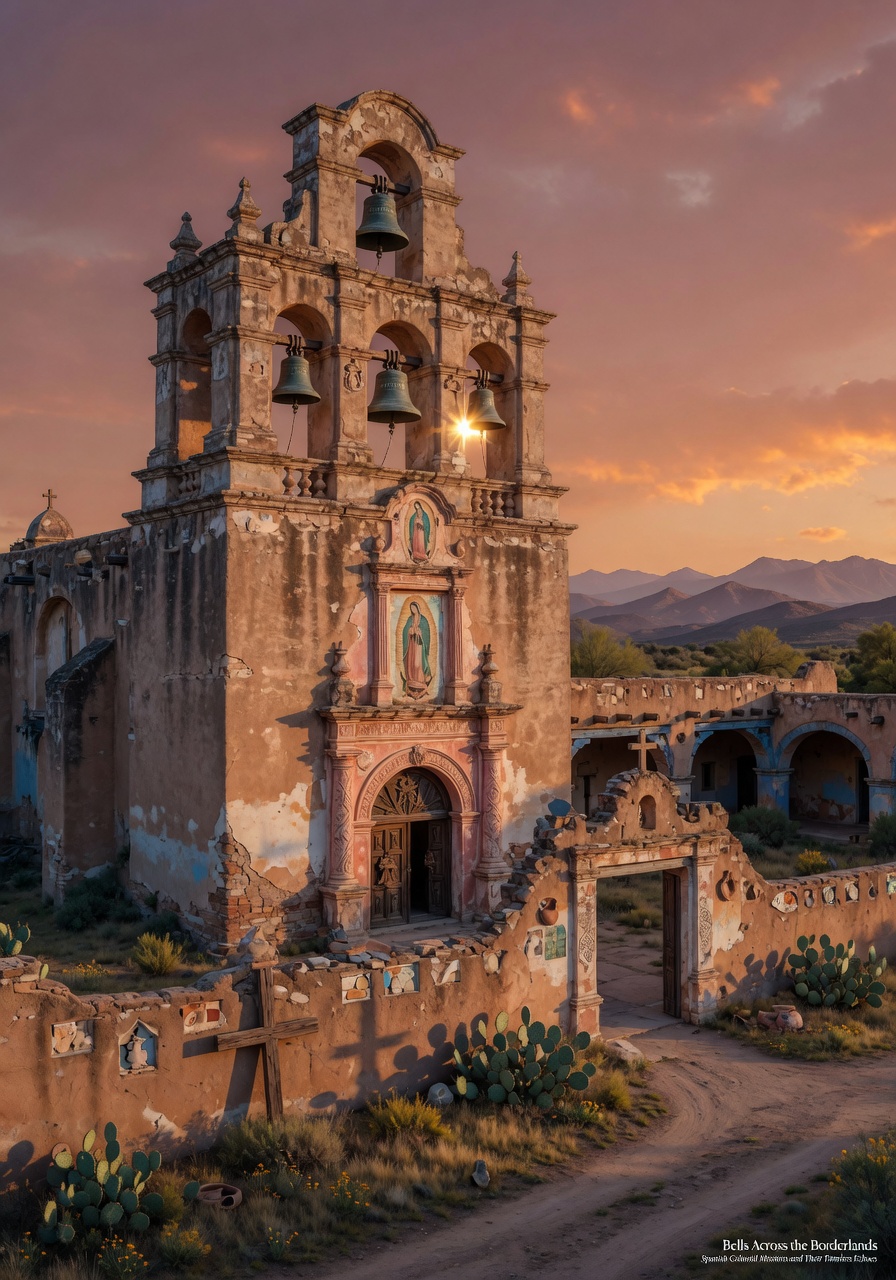
From the sunbaked hills of California to the remote river valleys of Paraguay, the scattered remains of Spanish colonial missions still mark the ground where empire and religion once pushed forward together. These outposts were never simple churches. They functioned as hybrid compounds—part fortress, part workshop, part sanctuary—built to anchor Spanish influence in unfamiliar territory while reshaping the lives of the people already living there.
Construction relied on whatever materials lay close at hand. Thick adobe walls and heavy timber roofs created buildings that could withstand both earthquakes and sudden raids. Inside the compound walls, a central church with carved altars stood surrounded by living quarters, kitchens, workshops, and livestock pens. Irrigation channels called acequias brought water to fields where wheat, olives, and citrus grew alongside native maize. Mission artisans turned out leather goods, woven textiles, and religious art, often weaving local symbols into Christian imagery so the new faith felt less foreign. Children attended daily lessons in reading, writing, and Catholic doctrine, while adults followed regimented schedules of prayer, farming, and craftwork.
The first missions appeared in the mid-1500s as Spanish explorers and friars moved into Florida and the Caribbean. Over the following three centuries the network expanded dramatically. In Alta California, Father Junipero Serra’s twenty-one missions formed a coastal corridor meant to secure Spanish claims against Russian and British rivals. Indigenous communities gained access to new tools and crops, yet they also faced forced labor, strict oversight, and waves of European diseases that cut populations by thousands. Demographic maps of the period show entire regions transformed in a single generation.
Today the sites draw steady visitors. At Mission San Juan Capistrano, the annual return of the swallows still coincides with spring festivals amid restored gardens and crumbling stone. In Texas, the San Antonio missions—including the Alamo—operate as a national historical park where guided walks and archaeological displays reconstruct daily routines from two centuries ago. Farther south, the Jesuit reductions of Paraguay and Argentina survive as open-air parks; their baroque facades, carved by Indigenous hands, continue to attract both scholars and travelers.
These places now sit at the center of ongoing debates about colonial legacies. They document genuine ingenuity in agriculture and architecture, yet they also record displacement and cultural suppression. Modern preservation projects increasingly include descendant communities in decisions about interpretation and ceremony. In that sense the missions remain active ground—physical reminders that history is never finished and that understanding it requires holding both achievement and loss in the same view.
Comments are closed