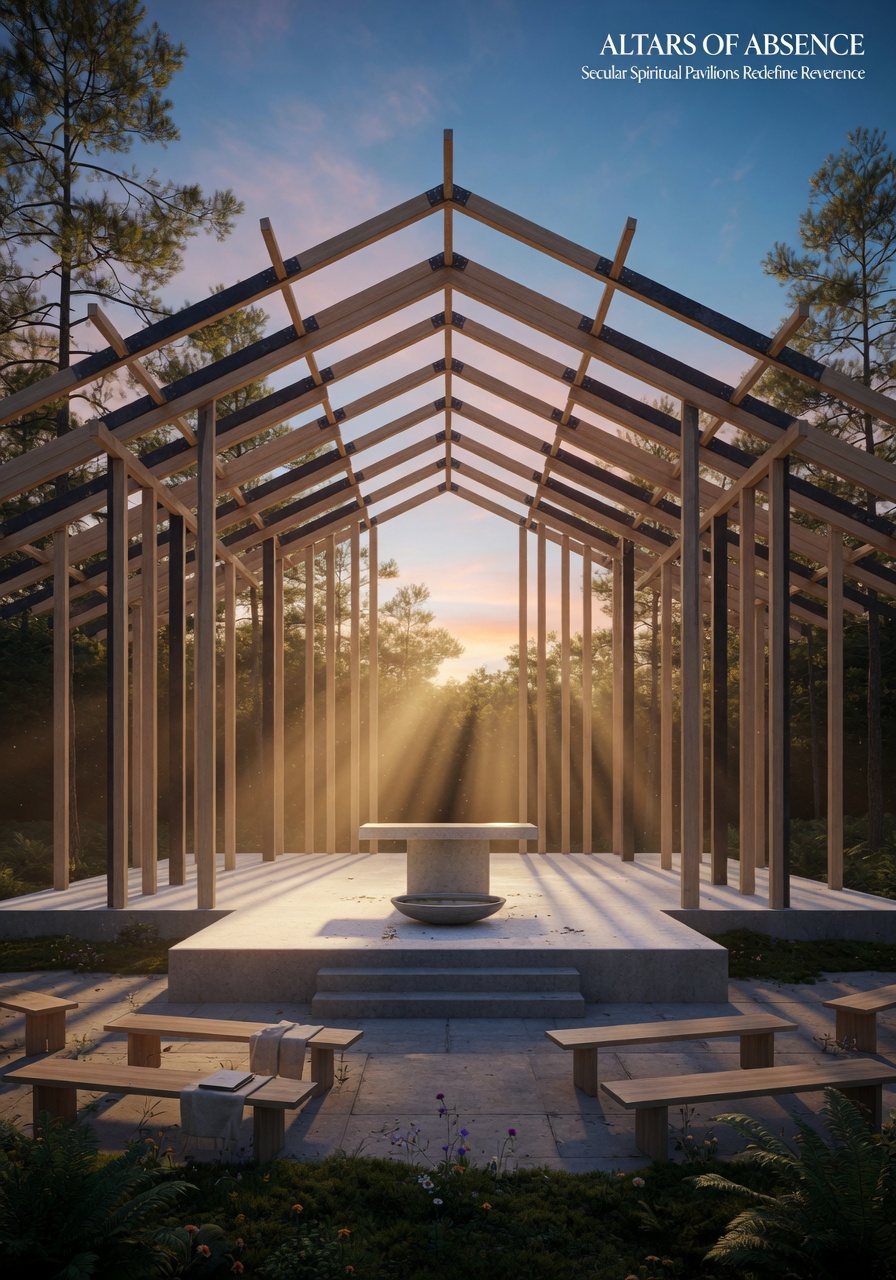
A lattice of weathered timber catches the breeze along a Norwegian fjord, turning gusts into low, shifting tones that settle over anyone who pauses beneath it. These secular pavilions work the same way everywhere they appear: they create a pause without handing anyone a script. No altars, no mandated postures, just enough structure to let thoughts stretch out. People arrive carrying whatever questions or fatigue they have, and the space itself stays neutral.
Design choices keep the focus on openness rather than instruction. Clean lines and generous daylight keep the eye moving toward the horizon or sky. Walls often stop short of full enclosure so air and sound move through freely. Benches form loose circles or disappear altogether, leaving visitors free to stand, sit, or wander. Local stone, rough-sawn wood, and still pools of water ground the experience in the immediate surroundings instead of some abstract elsewhere. The result feels less like a finished room and more like an unfinished sentence that each person can complete.
Earlier attempts at this kind of space show up at surprising moments. During the French Revolution, civic planners raised Temples of Reason where crowds gathered to honor knowledge and mutual obligation rather than saints or scripture. Mid-century modernists later placed spare chapels on college grounds and hospital campuses, removing crosses and stained glass so the rooms could serve patients or students of any background. The same impulse now surfaces in city parks and along coastlines. Houston’s Rothko Chapel, once tied to a single artist’s vision, draws daily visitors who come simply to sit in quiet. Outside Oslo, the lattice pavilion mentioned earlier filters wind into soft harmonics. Temporary labyrinths laid out in downtown plazas let commuters trace a slow path without any accompanying doctrine.
These places answer a steady need that secular life has not erased. Loneliness and climate worry keep rising, yet few public settings offer room to register either feeling without turning it into a transaction or a slogan. A pavilion can host sunrise stillness at dawn, a support circle by midday, and an open-air talk on constellations after dark. Because it withholds any required belief, it lets different people occupy the same square meters on their own terms. In that sense the structures treat wonder as something held in common rather than something dispensed from above—an ordinary public good that stays available to anyone who steps inside empty-handed.
Comments are closed