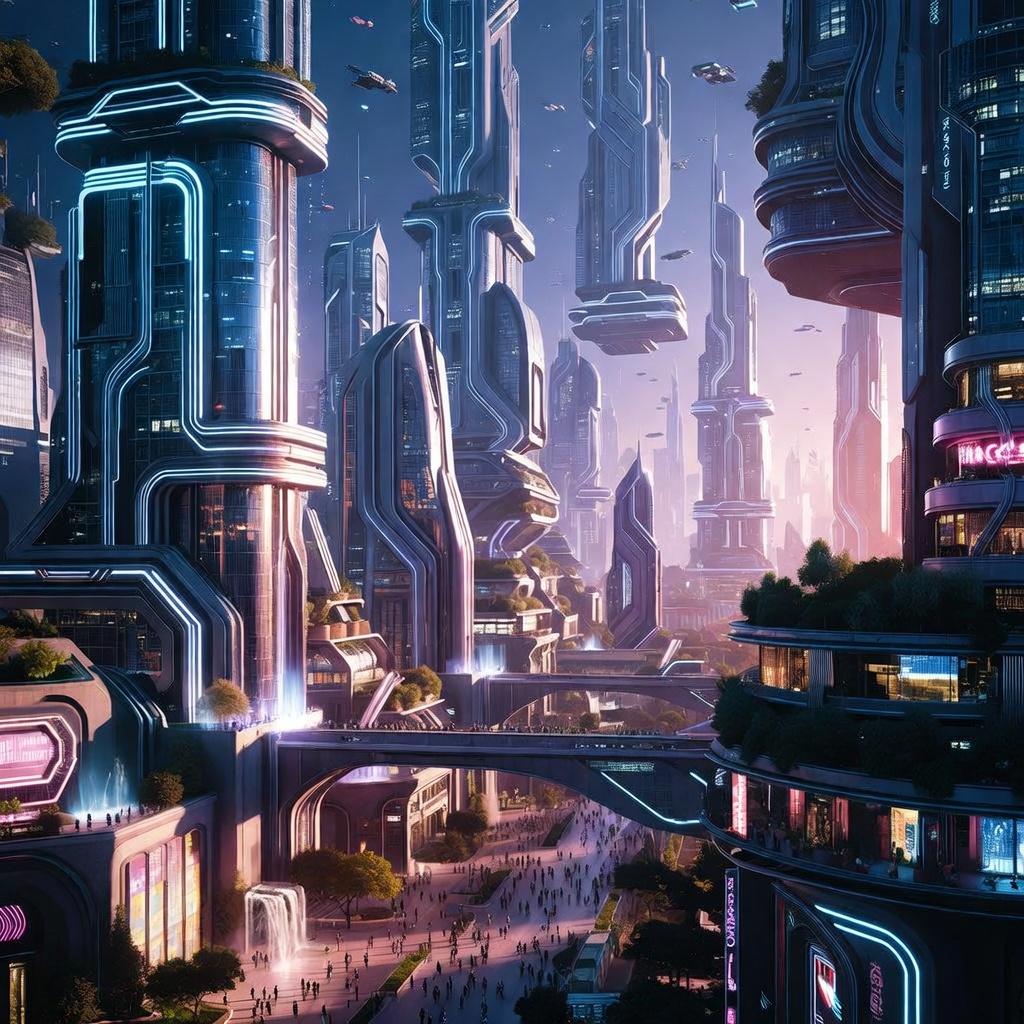
The push toward neo-futurist cities stems from a mix of old ideas and fresh pressures. Early 20th-century Futurists celebrated machinery and motion, yet today’s versions confront climate shifts, rapid AI growth, and materials that can adapt in real time. Architects such as Santiago Calatrava and Zaha Hadid first explored flowing lines and movement in buildings; current designers extend those ideas into entire districts that aim for zero waste and constant connection.
NEOM in Saudi Arabia shows the scale. This $500 billion linear city runs on solar and wind alone, with mirrored towers that bounce heat away while feeding power back to the grid. Masdar City in Abu Dhabi takes a different route: no private cars, just autonomous pods gliding under shaded walkways that already cut emissions by roughly 40 percent. Both projects treat the city as a closed system rather than an endless spread of concrete.
Height and integration with living systems define the approach. Singapore’s Jewel Changi Airport packs an indoor waterfall and layered gardens into what used to be a transit hub, hinting at how future districts might stack housing, offices, and food production in one structure. Proposals for floating platforms off Tokyo Bay use tension-leg moorings to ride rising seas without flooding. Dubai’s Museum of the Future already demonstrates cantilevered forms that house AI research labs above ground level.
Daily movement and resource loops rely on new tools. Drone taxis and hyperloop lines could shrink a Brooklyn-to-Manhattan trip to minutes. Kinetic skins on buildings harvest wind and rain, while blockchain-tracked grids aim to balance supply so no neighborhood gets left short. Vertical farms inside towers, modeled on Milan’s Vertical Forest with its 900 trees, produce far more food per square meter than traditional plots. AR glasses turn blank walls into live data surfaces or seasonal gardens on demand.
Skeptics point out real risks. Large projects like NEOM have already displaced communities, and heavy tech dependence could leave some residents behind. Supporters argue that shared design files and local makerspaces, similar to those in Shenzhen, let smaller cities adapt the same ideas without massive budgets.
China’s Xiong’an New Area combines maglev lines with restored wetlands and plans for 25 million residents by 2035. Europe’s Skytrain Network tests elevated pods between major cities. These efforts treat urban growth as an engineering challenge that can still leave room for daylight, clean air, and public access. The result is a set of working models that test whether dense, responsive cities can handle both population growth and environmental limits at once.
Comments are closed