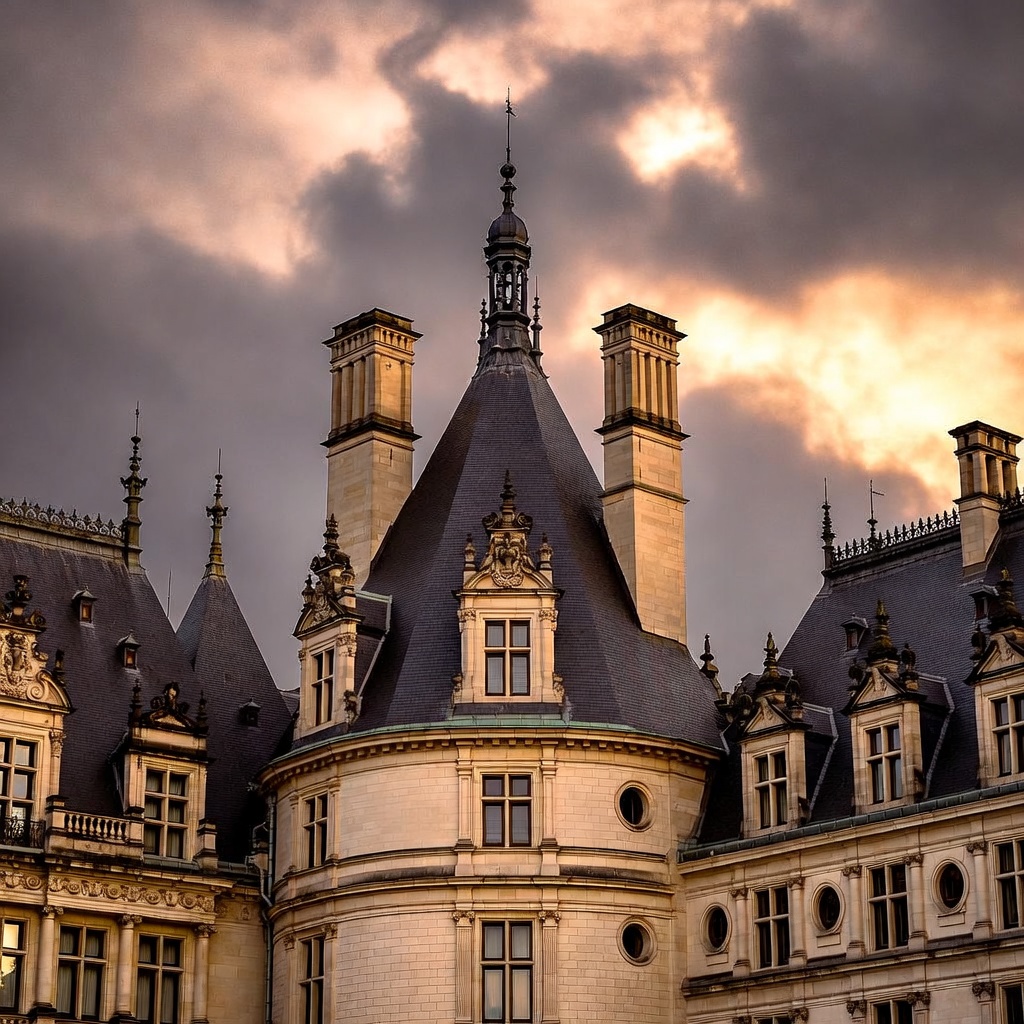
Chateauesque roofs rise with such theatrical sweep that they turn even modest skylines into something theatrical. These steeply angled forms trace back to the grand estates of France’s Loire Valley, where Renaissance builders first perfected their mix of drama and utility. What sets them apart is an unapologetic verticality that still feels fresh centuries later.
The signature element is the mansard roof, a double-pitched surface that drops almost vertically before easing into a shallower upper slope. This clever geometry creates generous attic space while shedding heavy snow or rain with ease. Rows of dormers break up the plane, their ornate frames—pediments, scrolls, or carved stone—pulling daylight deep into upper floors and adding rhythmic punctuation to the façade. At the corners, slender turrets and conical spires pierce upward, echoing the silhouette of medieval keeps. Below them, patterned slate—often laid in fish-scale or diamond motifs—creates a textured, weather-tight surface that catches shifting light. Tall chimneys and delicate iron cresting along the ridges finish the profile, giving the entire roofline a sculptural presence that feels more like jewelry than construction.
The style took hold in the nineteenth century, when architects and patrons alike looked to the past for inspiration amid rapid industrialization. French restorer Eugène Viollet-le-Duc helped revive interest by working on actual châteaux, and the look soon traveled across the Atlantic. In the United States, Richard Morris Hunt translated it for Gilded Age clients; his 1895 design for The Breakers in Newport gave the Vanderbilt family a mansion whose roofline directly echoed Chambord and Chenonceau. North of the border, Thomas Fuller used similar massing for Ottawa’s Parliament buildings and Quebec City’s Château Frontenac, establishing the style as a civic emblem that still defines those horizons.
Contemporary projects keep the vocabulary alive without literal reproduction. Restorations at Biltmore Estate now pair original slate with durable, recycled substitutes that meet modern performance standards. New luxury homes in wine country or the Hudson Valley adopt composite mansards that mimic the old textures while incorporating thick insulation and solar-ready detailing. Even downtown infill condos sometimes lift a single turreted penthouse above glass towers, nodding to the tradition without overwhelming it.
In a time dominated by flat, low-slung roofs, these steep profiles deliver vertical interest and a sense of place. They handle weather efficiently, age gracefully, and give buildings an unmistakable identity that draws the eye. Rather than relics of another era, Chateauesque roofs continue to offer a practical way to add character, turning functional shelter into something that feels both rooted and aspirational.
Comments are closed