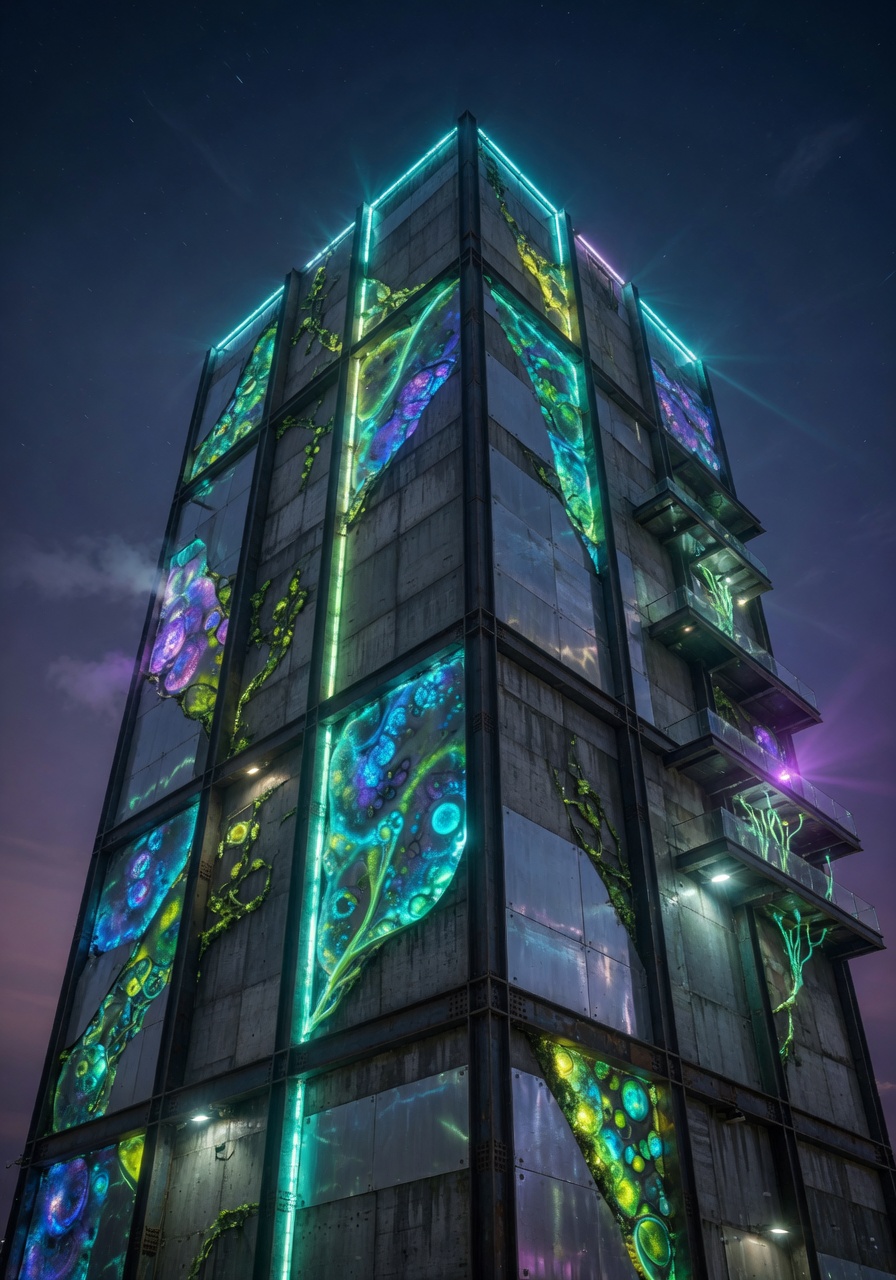
Picture a city skyline where towers pulse with a gentle blue-green radiance, their surfaces alive with the same light that dances across ocean waves at midnight.
This vision is moving from laboratory curiosity to built reality as architects and materials scientists explore bioluminescent building materials. These living or bio-inspired composites harness the natural chemistry of organisms such as bacteria, fungi, and dinoflagellates to produce light without electricity. The result is architecture that glows from within, reshaping how we think about nighttime presence, energy use, and the relationship between buildings and their surroundings.
The core mechanism relies on luciferase enzymes acting on luciferin substrates in the presence of oxygen. When embedded in translucent concrete panels, biopolymer coatings, or living algal façades, the reaction emits a soft, continuous glow. Early prototypes from European research groups have already produced meter-scale panels that maintain visible luminescence for several hours after dusk, powered only by the metabolic activity of the organisms within.
Architects are drawn to these materials for reasons that extend beyond spectacle. A bioluminescent façade can reduce the need for conventional exterior lighting, lowering both energy demand and light pollution. In dense urban cores, where dark skies are rare, the gentle, diffuse light preserves nocturnal character while still meeting basic wayfinding needs. Interiors benefit too: thin bioluminescent partitions or ceiling membranes can provide ambient illumination in corridors and atria, cutting daytime electricity loads and creating spaces that feel connected to natural rhythms.
Integration with existing design languages requires careful calibration. The light intensity remains modest, so these surfaces work best as complementary elements rather than primary sources. Pairing them with high-performance glazing or perforated metal screens allows designers to modulate brightness and pattern. Some practices are testing modular tiles that can be swapped as the living cultures age, treating maintenance as part of the building’s seasonal cycle rather than a hidden utility.
Challenges remain. Temperature swings, desiccation, and ultraviolet exposure can stress the biological agents, demanding protective matrices that still permit gas exchange. Scaling production while maintaining consistent luminescence also requires advances in synthetic biology and material engineering. Yet the trajectory is clear: as these hurdles are addressed, bioluminescent components will move from experimental pavilions into civic and commercial projects.
The deeper promise lies in how such materials shift architectural intent. Instead of imposing light upon the night, buildings begin to participate in it. A library wing that echoes firefly rhythms or a waterfront promenade whose railings mirror harbor plankton creates moments of quiet wonder. In an era of urgent decarbonization, these living surfaces offer more than technical efficiency; they restore a measure of poetic reciprocity between human structures and the living world.
Daily architecture insight generated automatically.