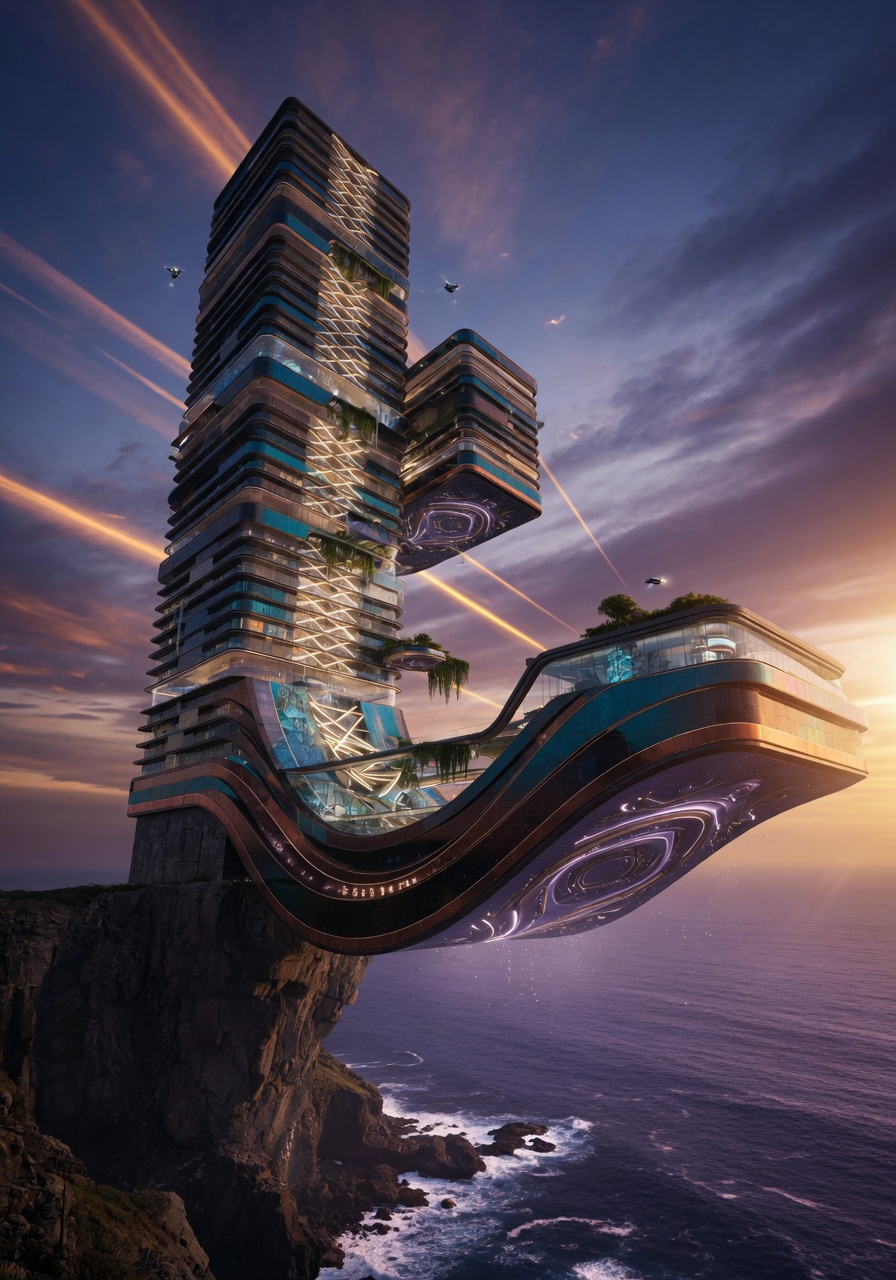
 What if the weight of a building no longer anchored it to the ground? Emerging antigravity concepts invite architects to treat levitation as a core design principle rather than a structural afterthought. These ideas move beyond conventional foundations and open fresh conversations about space, movement, and the relationship between structure and site.
Magnetic levitation forms the most discussed starting point. Superconducting materials cooled to critical temperatures could generate powerful repulsive fields capable of suspending entire floor plates. Early models suggest that a modest residential tower might hover several meters above grade, its undercroft left open for pedestrian paths, gardens, or even seasonal flooding. The absence of traditional footings frees the ground plane for public use while eliminating many seismic vulnerabilities.
Aerostatic systems offer another route. Large helium or vacuum chambers embedded in structural cores could provide constant upward thrust calibrated to the building’s mass. Architects exploring this method envision slender vertical volumes that drift gently within fixed guide rails, allowing the structure to adjust height in response to wind loads or urban events. The result is a responsive silhouette that changes profile without mechanical motors at every floor.
Such freedom transforms interior planning. With no columns rooted in the earth, floor plates can be reconfigured seasonally or even daily. Movable partitions slide along magnetic tracks, and daylight penetrates deeper because perimeter walls need not carry heavy loads downward. The architectural language shifts from compression to tension and from mass to calibrated balance.
Energy remains the central practical question. Continuous power is required to maintain levitation fields, yet designers counter that photovoltaic skins and piezoelectric materials woven into façades could offset much of the demand. Surplus energy might even feed adjacent districts, turning each floating structure into a micro-utility.
Safety protocols are advancing alongside the technology. Redundant electromagnetic coils, mechanical tethers for extreme events, and automated descent systems already appear in research proposals. Regulatory bodies are beginning to draft guidelines that treat these buildings as hybrid machines rather than static objects.
The cultural implications are equally compelling. Cities could reclaim valuable ground-level real estate while preserving views and airflow. Neighborhoods might evolve into layered networks where circulation occurs both beneath and between hovering volumes. The familiar hierarchy of street, lobby, and roof dissolves into a more fluid spatial experience.
Ultimately these concepts remind practitioners that gravity has always been architecture’s silent collaborator. By questioning its dominance, designers open possibilities for lighter footprints, adaptable programs, and urban forms that feel as much like choreography as construction. The conversation is no longer whether such buildings can exist, but how thoughtfully they will shape the places we inhabit.
Daily architecture insight generated automatically.