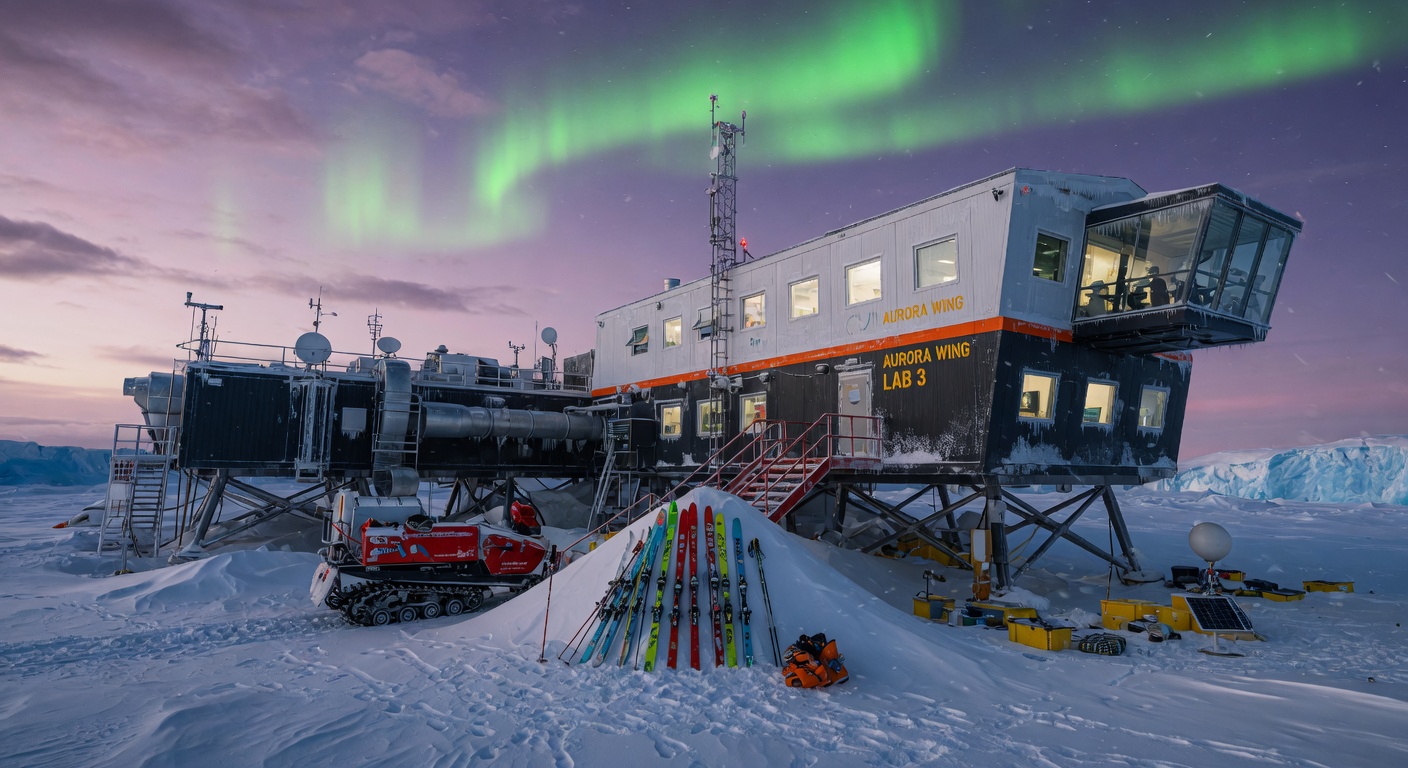
On the Brunt Ice Shelf the wind arrives without interruption, carving low ridges in the snow and driving fine crystals against any surface that interrupts its path. Halley VI stands clear of this accumulation on four pairs of hydraulic legs fitted with broad skis. Each of the eight modules can be decoupled, towed a few hundred metres, and reconnected when the ice shelf threatens to calve. The station therefore moves rather than resists.
Inside the blue-painted shells, temperatures remain steady near 20 °C while the air outside drops below –40 °C. Triple-glazed windows, small and deeply recessed, admit a low, horizontal light that lengthens every interior shadow. Walkways between modules are short enclosed bridges; their floors transmit the faint vibration of generators housed in a separate, quieter unit. Residents describe the sound as a continuous low note beneath conversation.
Materials were chosen for both thermal performance and transport weight. The outer cladding is a composite sandwich panel with vacuum-insulated cores; the steel frame uses high-strength, low-alloy sections that reduce overall mass by nearly a third compared with earlier timber-and-steel designs. All components arrived by ship and were assembled on site in a single austral summer. Joints were sealed with ethylene-propylene gaskets formulated to remain flexible at extreme cold; these remain the only visible concession to the climate once the modules are closed.
At Concordia Station, 1 200 kilometres inland, the approach differs. Two cylindrical towers sit on a steel platform raised three metres above the snow. The cylinders are linked by an unheated service corridor whose walls accumulate a thin rime of frost each winter. Inside the living cylinder, corridors are lined with cork pinboards where photographs and route maps accumulate. The cork, harvested in Portugal and shipped via Hobart, softens the acoustic hardness of the metal partitions and records the slow accumulation of daily traces.
Both stations treat daylight as a limited resource. At Halley, summer brings twenty-four-hour sun filtered through translucent roof panels above the galley; in winter the same panels are covered with insulated shutters. Lighting shifts to warmer spectra after the evening meal, an adjustment made not for energy savings but to mark the passage of time when the external sky offers none.
The architecture therefore registers movement, temperature gradient, and the scarcity of natural cues. Its forms arise from the need to keep an interior intact while the ground itself is in slow flight.