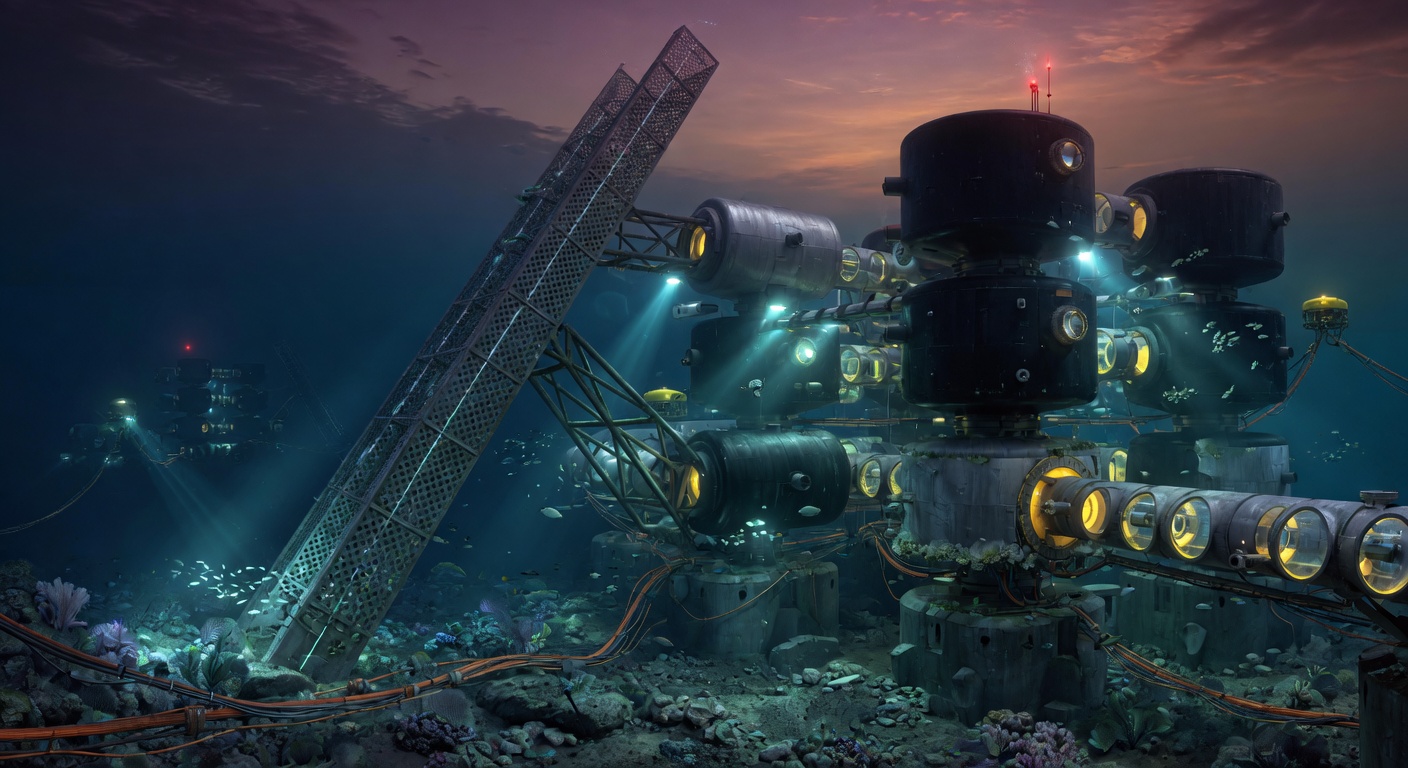
A maintenance diver first registers the structure not as a building but as a faint vibration rising through the water, the low thrum of pumps moving chilled seawater across server racks housed inside.
The forms themselves are simple: long steel cylinders, each roughly the length of a coastal freighter, laid in parallel rows on prepared gravel beds. Their walls are thick enough to resist the pressure at forty meters, yet thin enough that interior temperatures stay near eight degrees Celsius without mechanical refrigeration. External fins, cast in the same alloy, increase surface area for heat exchange while also breaking up laminar flow so that sediment does not accumulate against the hull. Inside, the arrangement follows the logic of any well-tempered archive: racks aligned perpendicular to the long axis so that technicians in small tracked vehicles can move between them without turning. The only concession to human presence is a narrow gallery running the length of each cylinder, its floor plates perforated to let stray droplets fall into sumps rather than pool.
Light reaches these galleries through circular ports fitted with laminated acrylic lenses. At midday the water above carries a pale green cast that shifts toward slate as clouds pass; at night the ports become black mirrors except where service lamps cast small pools of white on the racks. Sound is almost entirely absent except for the steady pulse of the circulation system and the occasional metallic click of a valve seating. Divers report that after an hour the body begins to move in time with that pulse, the same way a mason learns the rhythm of a compressor on land.
One installation off the Norwegian coast uses a cluster of six cylinders connected by short transfer tubes. The joint between tube and cylinder is sealed with a compression gasket rather than welds, allowing individual units to be detached and towed to shore for upgrades. The seabed around the cluster has been left largely undisturbed; only narrow trenches for power cables were cut, and these have already been recolonized by brittle stars. Technicians note that the constant low temperature reduces the need for dehumidification, so interior finishes remain minimal: sealed concrete floors, stainless handrails, and cable trays mounted clear of the deck so that any condensation drips away.
The architecture is therefore reduced to the precise calibration of thickness, surface, and connection. Every detail serves the same end: to keep silicon at a stable temperature while allowing periodic human access beneath several atmospheres of water.