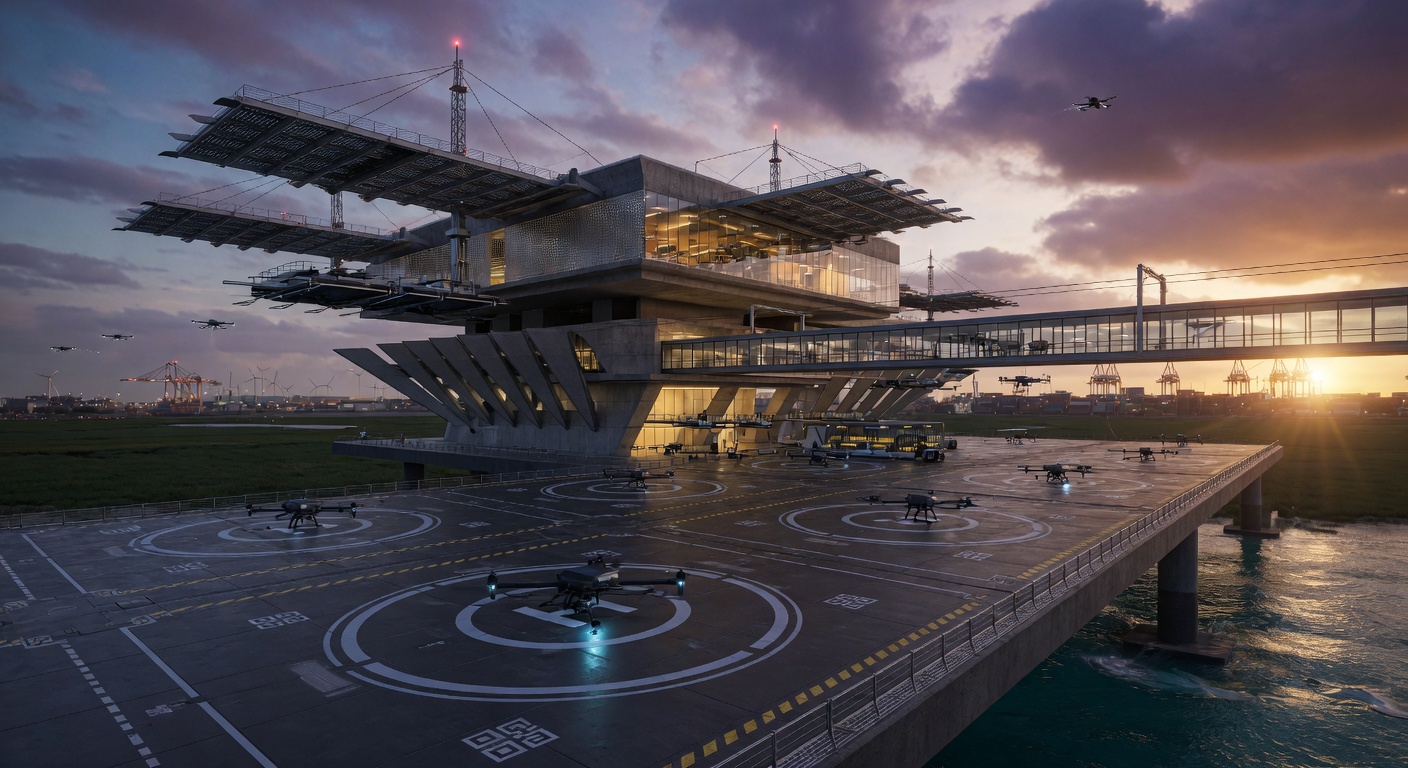
A drone port terminal begins not with an entrance but with a flat plane set just above the earth, its surface etched with landing markers that catch the morning light like faint scars. These structures occupy an odd middle ground between runway and nest. Their forms respond to the physics of descent rather than the rituals of human movement.
Consider the coastal facility near Bodega Bay, where four elevated pads rest on slender steel legs driven into compacted sand. Each pad is a composite sandwich of aluminum honeycomb and basalt fiber, chosen for its resistance to salt and its ability to shed rainwater quickly. Beneath the pads, a low service level houses battery swaps and sensor calibration bays. Light reaches this level through narrow slits cut into the platform edges, creating shifting bands that move with the sun and the tide. The effect is quiet and almost accidental, yet it allows technicians to work without supplemental lamps for most of the day.
Further inland, a different approach appears on the flat roof of a former agricultural warehouse. Here the terminal is reduced to a single raised deck surrounded by a perforated wind screen of folded zinc. The perforations are sized to break the turbulence created by rotor wash while still permitting views across the surrounding fields. At dusk the screen glows from within as indicator LEDs trace the perimeter, their light diffused through the metal so that the entire structure seems to hover rather than stand. The sound of arriving drones is softened by the screen’s geometry, turning the sharp mechanical whine into a lower, steadier note that travels less far across open land.
Materials matter at every scale. Carbon-fiber tension ties hold the wind screens in slight curves that resist buckling under gusts, while the landing surfaces themselves incorporate embedded micro-textures that increase friction without collecting debris. These textures are invisible from above yet produce a faint tactile resistance underfoot when maintenance crews walk the pads at night. The choice of finishes also acknowledges weather rather than denying it; matte coatings prevent glare that could interfere with optical landing systems, and the same coatings shed dust more readily than polished alternatives.
Human presence remains peripheral. Small control rooms sit at the edge of each site, their windows oriented away from the pads so that operators watch arrivals through screens rather than directly. The architecture therefore privileges the drone’s approach path over any internal sequence of rooms or corridors. What remains is a landscape of precise horizontality, shaped by the need for unobstructed air and stable ground rather than by conventional ideas of shelter or monument.