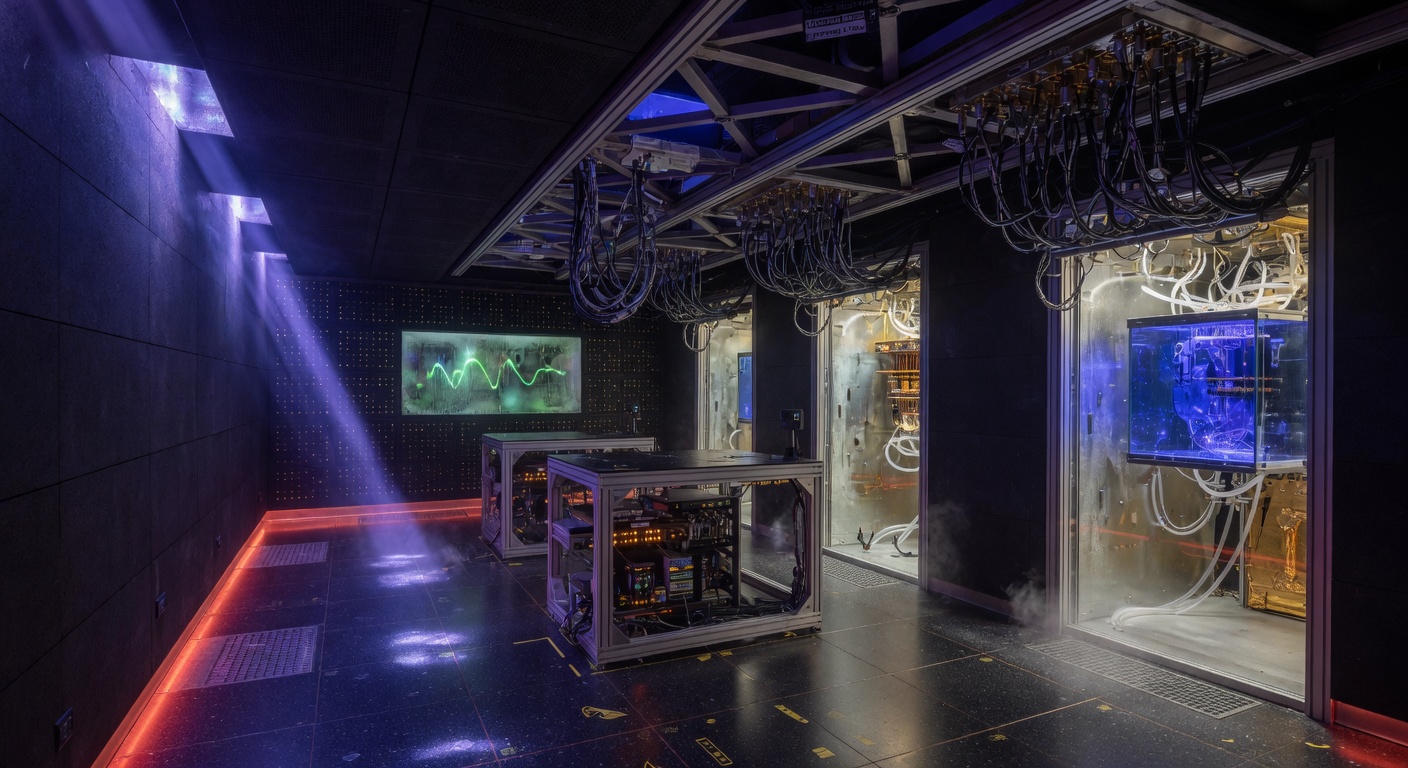
In quantum computing laboratories the building itself becomes an instrument of restraint. The floor cannot simply carry weight; it must prevent the smallest shift from reaching the qubits, whose coherence lasts only as long as external motion stays below a few nanometers per second. Architects therefore begin not with program or circulation but with the physics of stillness.
Thick slabs of mass-tuned concrete rest on pneumatic isolators that sense and counter vibration in real time. These bases sit inside pits lined with dense granular fill, so that footsteps from adjacent corridors never translate into measurable acceleration. Above them rise rooms whose walls contain successive layers of mu-metal and copper mesh, each joint welded rather than fastened so that electromagnetic seams remain continuous. The copper itself is burnished to a soft matte finish; its reflective warmth offsets the clinical chill of the dilution refrigerators that dominate the center of each chamber.
Light reaches these spaces only through filtered clerestories set high on the north wall. Direct sunlight would introduce both heat and stray photons, so the glass is laminated with infrared-reflective interlayers and the reveals are deep enough to keep any ray from striking the equipment. Researchers move along raised walkways whose steel grates are decoupled from the primary slab; their steps register as faint pressure changes rather than audible impact. Temperature and humidity are held within tight bands not by visible ducts but by low-velocity displacement ventilation that enters through perforated limestone panels, their pale surface absorbing sound while releasing conditioned air at floor level.
Even the service corridors are shaped by these constraints. Cable trays run inside shielded trenches beneath the main floor, accessible only from outside the sensitive zone so that maintenance crews never cross the isolation boundary. Doors are unusually heavy, their seals compressed by hydraulic closers that operate without the usual metallic click. The result is an interior whose acoustics feel oddly weighted, as though sound itself has been asked to settle.
Such buildings do not announce their precision. Their exteriors are often plain concrete or brick, indistinguishable from neighboring research halls until one steps inside and senses how deliberately every surface has been asked to remain quiet.