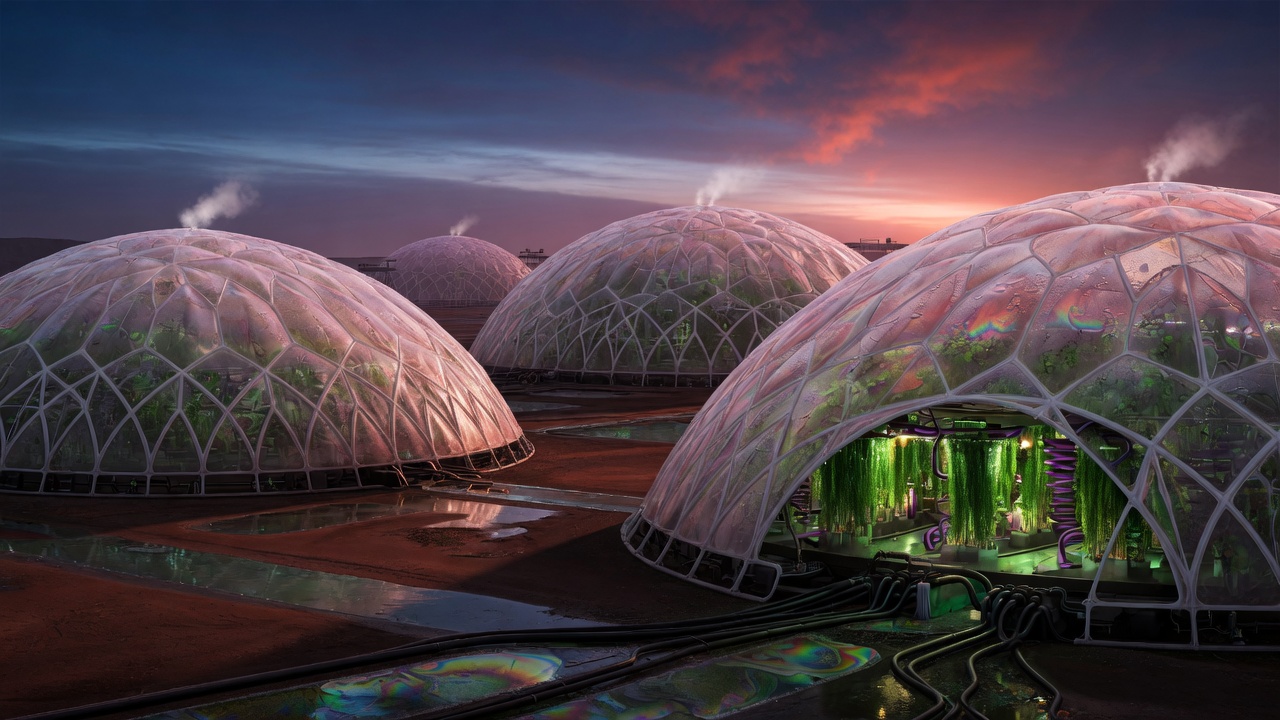
In a remote valley outside Basel, a cultivation dome rises in low arcs whose surfaces shift from translucent to faintly veined as the day lengthens. The structure does not rely on conventional glazing. Instead, its panels consist of layered biopolymer films seeded with synthetic strains that metabolize carbon dioxide and release measured traces of oxygen, altering both the interior atmosphere and the quality of light that reaches the worktables below.
Visitors notice first the scent: a clean, mineral sharpness that comes from the engineered microbes rather than from soil or machinery. The air feels slightly heavier near the curved walls, where the living membranes draw warmth from the sun and release it slowly after dusk. Walkways are set a few centimeters above the floor so that technicians can observe root-like filaments threading through the lower panels without disturbing the delicate balance of moisture and nutrients the strains require.
The geometry itself has been adjusted to these biological rhythms. Where older conservatories used rigid ribs to hold glass, these domes employ flexible lattices printed from mycelium composites that expand or contract with changes in internal humidity. Light enters not as a uniform wash but as soft gradients, filtered through regions where the synthetic tissue has thickened in response to seasonal light levels. Researchers record these shifts daily, noting how certain strains produce a pale iridescence when they reach peak metabolic activity.
One older technician keeps a notebook of the dome’s changing appearance. On overcast mornings the membranes appear almost milky; under strong afternoon sun they develop faint blue-green streaks that mark the paths of active colonies. These observations guide adjustments to nutrient feeds and light schedules, turning the building into an instrument whose readings are taken as much by eye as by sensor.
The same approach appears in smaller installations elsewhere. In Singapore, a pair of low domes shelters research into salt-tolerant bacteria that strengthen the membrane against tropical storms. In the Atacama, a single shallow vault tests strains that concentrate scarce moisture at night. Each project refines the relationship between curvature, membrane thickness, and microbial response, producing enclosures whose performance cannot be separated from the living material that forms their skin.