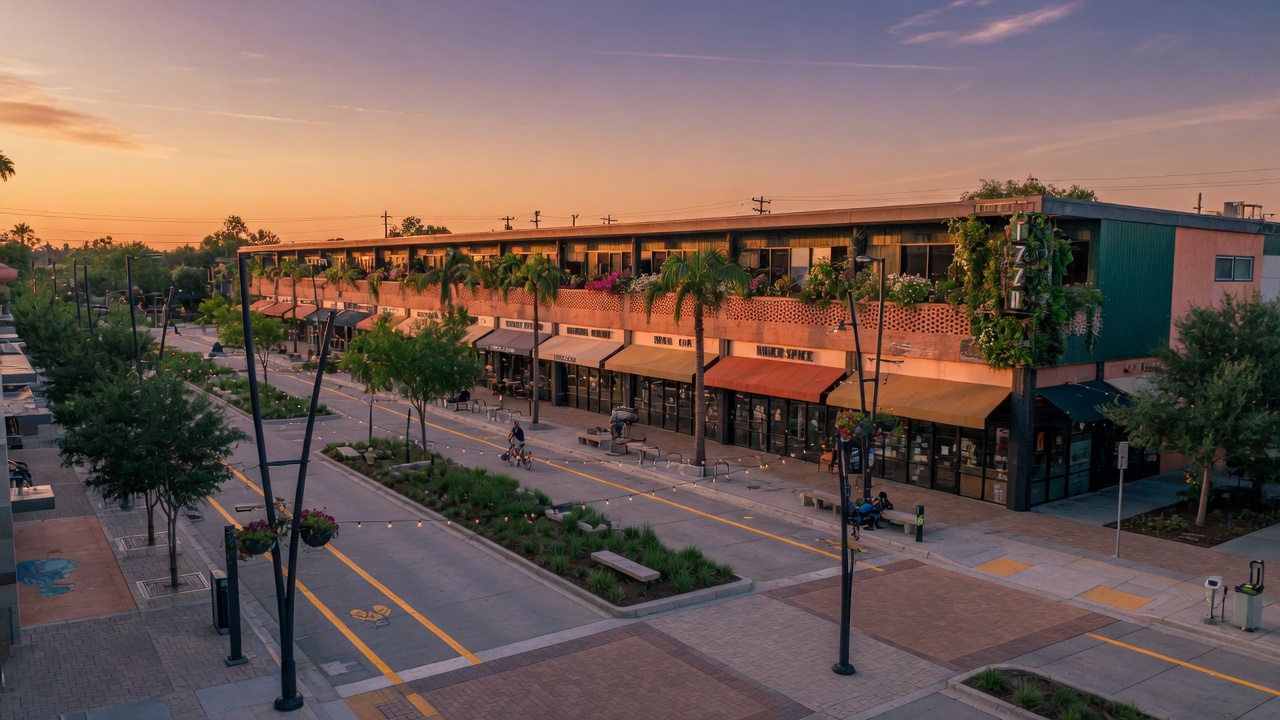
Along a stretch of cracked asphalt in suburban Phoenix, where once only taillights moved at dusk, a new sequence of low buildings now casts shadows across what used to be parking rows. The change began not with demolition but with a simple narrowing of drive lanes and the insertion of continuous sidewalks that link the original storefronts to fresh infill structures set back only a few feet from the curb.
These added volumes use the same concrete masonry units found in the older retail shells, though their surfaces have been lightly sandblasted to reveal the aggregate and to catch the low western light. Between them, narrow courts open onto the sidewalk, each one planted with mesquite and palo verde so that the scent of resin drifts into the passage even in midday heat. Benches made from salvaged road barriers sit beneath the trees, their steel plates still bearing faint yellow lane markings.
Inside the courts, small apartments sit above ground-floor workshops. Their windows are shaded by deep overhangs of corrugated metal that echo the original strip’s signage canopies. Residents cross the same pavement that once served delivery trucks; only now the surface has been scored with shallow grooves that direct stormwater toward planted strips rather than storm drains. The sound of footsteps replaces the idle thrum of idling engines.
Farther along the corridor, a former big-box footprint has been divided by a single pedestrian lane wide enough for two people to pass with ease. On one side the lane is lined with the original loading dock, now fitted with new doors of weathered steel; on the other, a row of one-story live-work units steps down to meet the pavement. At noon the lane gathers reflected light from both walls, turning the space into a bright slot of warmth between the heavier masses.
Evening brings a different register. The original sodium lamps have been replaced by lower fixtures mounted on the new buildings, casting pools of amber that stop at the edge of each court. People linger in these pools, their conversations carrying across the reduced width of pavement. The old strip remains legible in its long, low silhouette, yet the ground plane has been rewritten so that movement on foot feels continuous rather than interrupted.