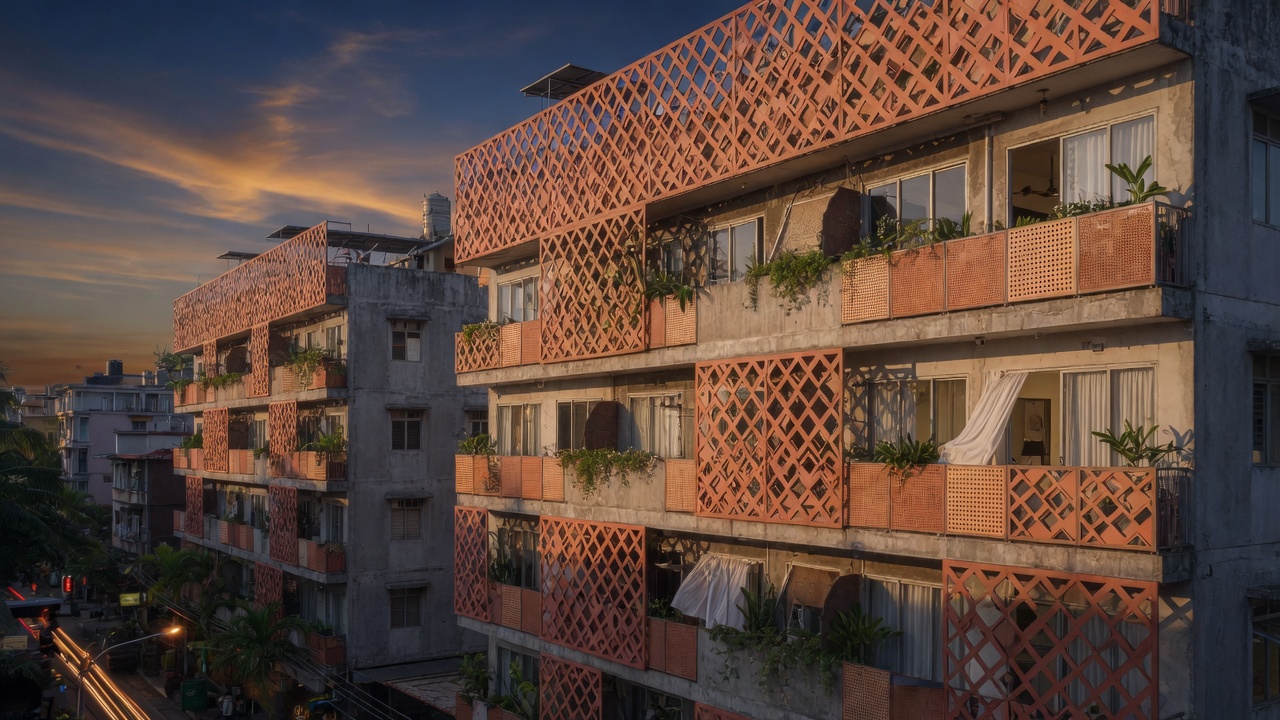
In the corridors of a 1960s housing estate, the air no longer moves as it once did through the original open grilles now covered for security. Residents have started to reopen these passages with new metal screens that filter light and dust while permitting the cooler night air to enter from the shaded side.
The screens sit a few centimeters proud of the original concrete. Their thin profiles catch the low evening light and throw fine shadows across bedroom walls. Inside, the temperature drops a degree or two within an hour of opening the inner windows, enough to make sleep possible without mechanical assistance. The steel warms slowly through the day, then releases its stored heat outward once the air begins to move.
A few floors up, another apartment has added a narrow vertical shaft behind the kitchen. The shaft begins at a low vent near the floor and rises through the ceiling slab to a hooded outlet on the roof. During the day the shaft remains closed. At dusk the lower vent is opened; warm air inside the shaft rises and draws cooler air from the shaded courtyard through the living rooms. The movement is quiet but steady, felt most clearly when a door is left slightly ajar.
Materials matter here. Where concrete was once covered with carpet or laminate, some residents have exposed the slab again, allowing it to absorb heat during the day and release it to the moving air at night. In other units, simple wooden shutters mounted outside the windows provide adjustable shading without blocking the breeze entirely. The shutters are hinged at the top so they can be propped open at different angles according to the angle of the sun and the direction of the wind.
In one block the residents coordinated across several units to align new vents with an existing service riser. The alignment created a continuous path from the ground-floor garden up through four stories. On still evenings the air rises slowly enough that a strip of tissue taped across the lower vent flutters only gently, yet the cumulative effect lowers indoor temperatures measurably by midnight.
These changes remain small in scale and reversible. They depend on careful observation of how each building already breathes—where the sun strikes longest, which corridors stay shaded, how the wind moves between neighboring towers. The work is quiet, carried out apartment by apartment, and measured by the simple fact that windows can stay open after dark without letting in the stored heat of the day.