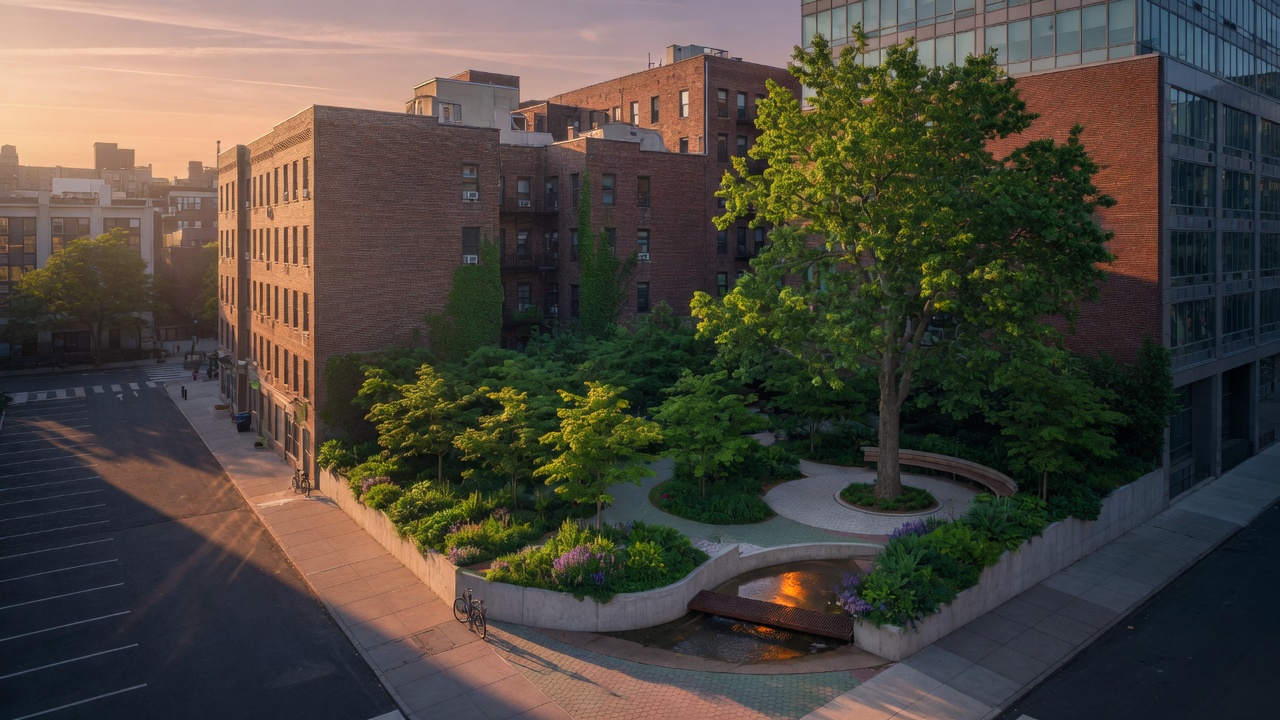
In the grid of midtown blocks, where exhaust and stone hold warmth past midnight, a pocket park no wider than a loading bay can cut local air temperature by two to four degrees through shade and evaporation alone. Designers achieve this not with grand gestures but with careful placement of canopy trees, permeable ground, and modest water features that draw heat away from bodies and surfaces.
Paley Park in New York demonstrates the effect plainly. Its north-facing wall of honey locusts filters sunlight into moving patches across benches while a thin sheet of water falls across the rear plane. The falling film increases humidity just enough to encourage evaporative cooling without creating the heavy air sometimes found near larger fountains. Visitors notice the shift first in the sound, then in the temperature against their forearms. Similar conditions appear in the smaller courts of Portland’s Green Street program, where native maples and gravel basins collect storm water that later returns moisture to the air during dry spells.
The materials matter as much as the planting. Light-colored permeable pavers reflect less heat than dark asphalt and allow roots to breathe. Timber seating, left unfinished, stays cooler to the touch than metal or stone. When deciduous species are chosen, winter sun reaches the ground while summer foliage intercepts radiation before it strikes pavement. Wind patterns also shift; even low hedges can channel cooler air from side streets into the park and outward again, extending the benefit a block or two beyond the property line.
These interventions remain modest in cost and footprint, yet they accumulate where larger parks cannot be inserted. In dense residential neighborhoods of Tokyo, dozens of such lots, each under two hundred square meters, now form a network that measurably reduces nighttime heat retention across entire districts. The effect is local, immediate, and tied directly to the daily experience of walking from sun-baked curb into filtered light and moving air.