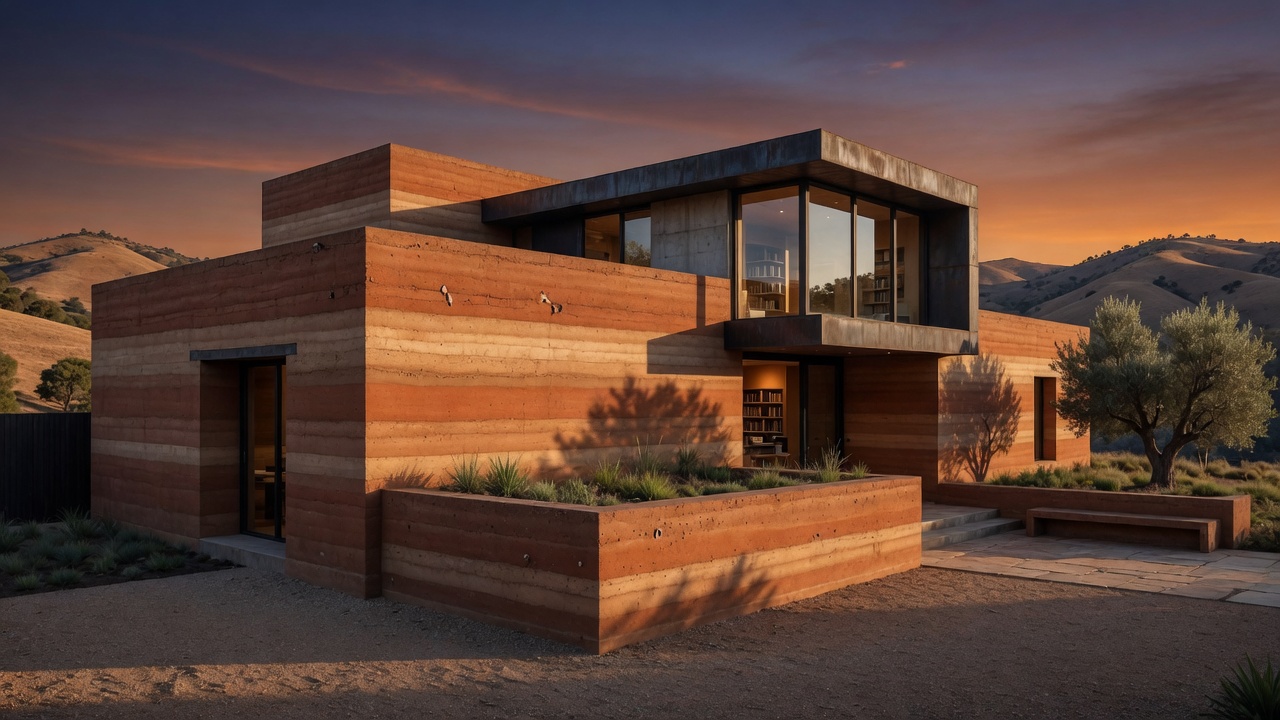
In the dry valleys outside Tucson, a pair of houses stand with walls that still carry the color of the arroyo from which their soil was taken. The material was not shipped across oceans but lifted from the site itself, moistened, and compacted in layers inside wooden forms. When the forms were removed, the walls revealed subtle horizontal striations, each one recording the rhythm of the laborers who worked the tampers.
These surfaces absorb light differently than concrete or plaster. Morning sun enters a room and seems to sink into the wall rather than bounce back, softening the edges of shadows. In the afternoon the same wall holds warmth long after the air has cooled, releasing it slowly through the night. Residents describe the touch as cool even in summer, yet never clammy, because the earth continues to exchange moisture with the room in small, steady amounts.
The construction process itself leaves traces that later inhabitants live with. Formwork joints sometimes remain visible as faint vertical lines, and occasional small stones or root fragments sit embedded near the surface. These irregularities do not read as defects; they mark the moment when the ground was rearranged into enclosure. Architects who choose rammed earth often leave the walls unfinished, accepting that a single coat of linseed oil is enough to protect against dusting while allowing the material to age.
One recent house in central Chile used soil mixed with a small percentage of lime to increase durability against coastal humidity. The builders tested batches on site until the cured cylinders met structural requirements, then proceeded without additional cladding. Inside, the dining space opens directly onto a courtyard whose paving reuses the same earth, now stabilized and compacted underfoot. The floor and walls share a single palette, so the eye moves across the boundary without interruption.
Such continuity between site and building alters how daily movement feels. Footsteps land on a surface that shares the same origin as the walls that contain them. Over time the slight variations in tone across different batches become familiar, like the grain in a wooden floor that records years of wear. The material does not promise permanence in the usual sense; it simply records, in compressed layers, the ground that was present before the house arrived.