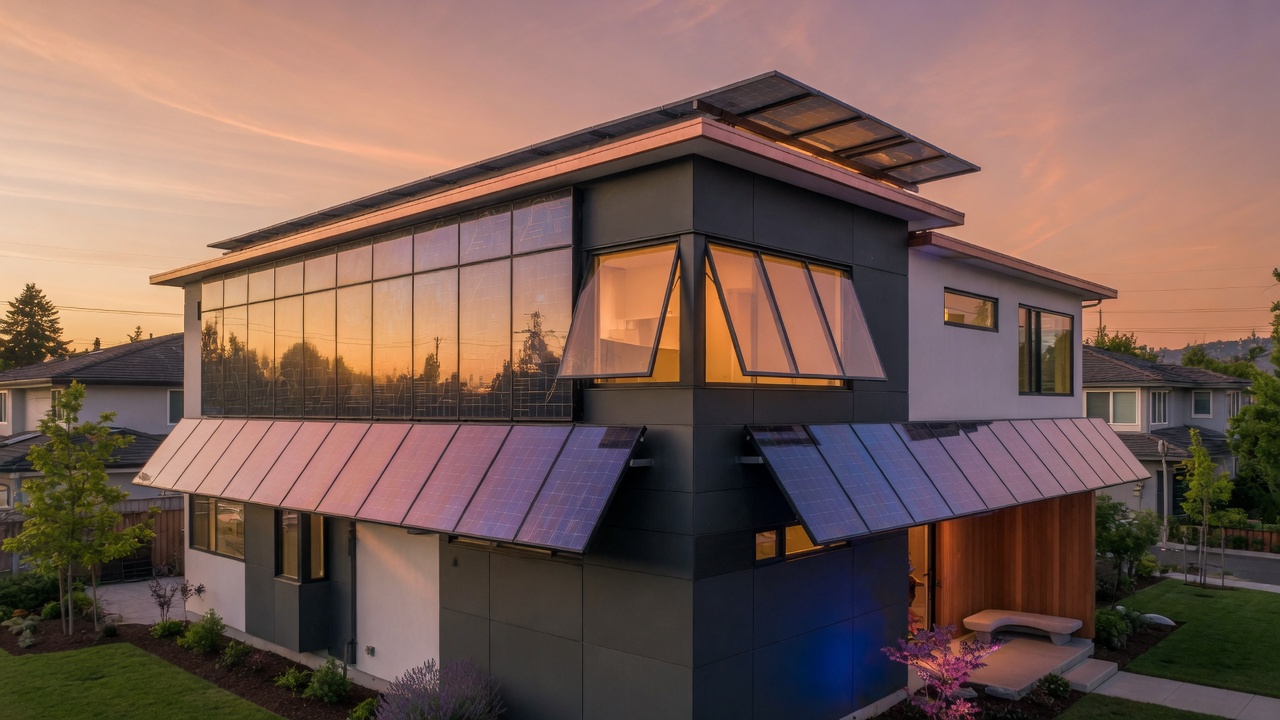
On certain afternoons the light strikes a suburban facade at an angle that makes the surface itself seem alive. What once read as ordinary cladding now holds a faint metallic sheen, its modules aligned not as an afterthought on the roof but as the wall itself.
These integrated panels replace conventional siding or rainscreen systems. Thin crystalline cells sit within aluminum cassettes finished to echo wood grain or fiber cement; the joints remain tight enough to shed water yet open enough for ventilation behind the array. Walking past at dusk, the eye registers a single plane rather than a patchwork of technologies. Inside, the same surface tempers the light that enters through adjacent windows, casting a cooler, more even wash across floors than the harsher reflections from white vinyl.
The shift matters most in neighborhoods where rooflines stay low and gabled. Traditional south-facing roofs often sit in shadow from mature trees or neighboring ridges. By moving the collector to the vertical plane, designers recover usable area without altering the silhouette residents expect. In one development outside Portland, a row of 1950s ramblers received new facades of dark-gray photovoltaic modules set in a running bond pattern. The houses kept their original overhangs and front porches; only the material changed. Utility meters now show midday production that once required a separate ground array in the backyard.
Material choices shape daily perception. Matte finishes reduce glare for drivers and neighbors, while the slight expansion gap between cassettes allows the wall to breathe and prevents the condensation that can appear on tightly sealed glass. Over time the surface weathers to a softer tone, its texture closer to slate than to polished metal. Homeowners describe the change less as an addition of equipment and more as a new kind of siding that happens to respond to sunlight.
The approach also alters maintenance rhythms. Because the array forms the weather barrier, inspection occurs during routine painting cycles rather than as a separate roof visit. Replacement of a single damaged module leaves the rest of the wall untouched, a practical advantage in subdivisions where access is limited by fences and plantings.
Such facades quietly revise the suburban contract between house and climate. They do not announce themselves as technological statements; they simply absorb the day’s energy where the wall already stands.