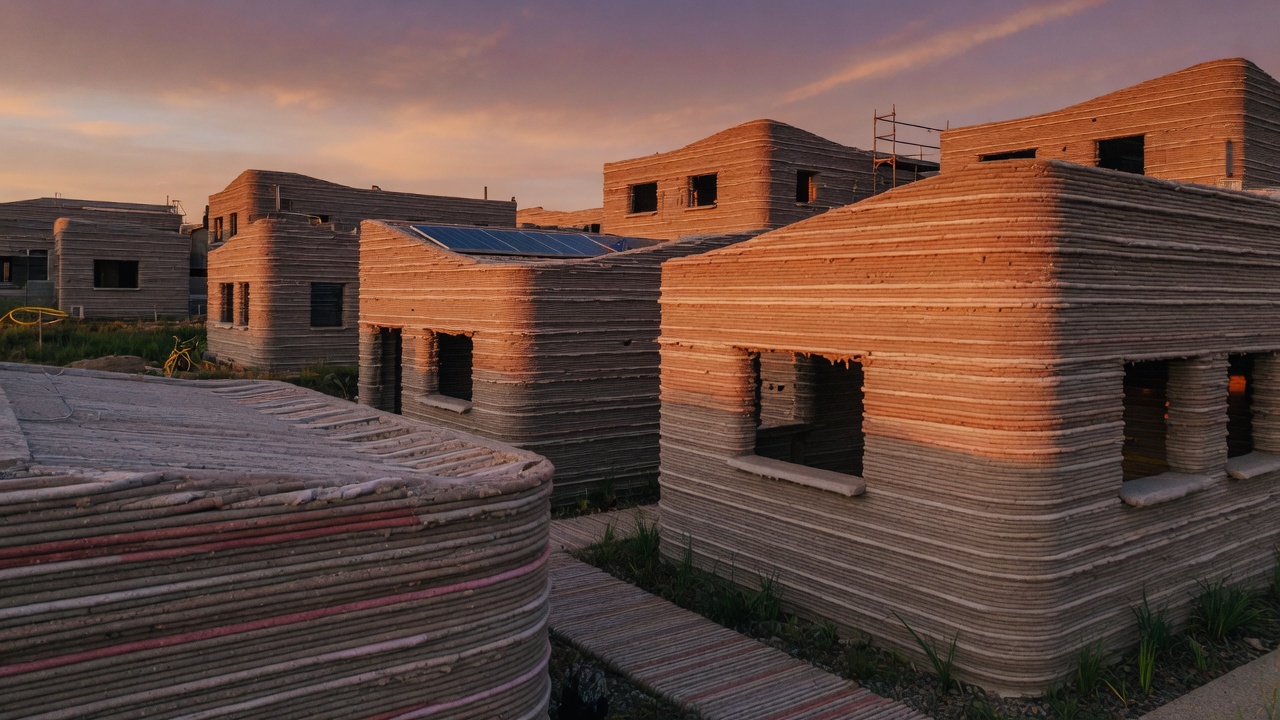
In the early light outside a small town in Texas, a steel gantry moves above bare ground and begins to lay down a continuous bead of earth-toned mixture. The material, a blend of local sand, clay, and a small percentage of Portland cement, leaves a visible seam every few inches as the nozzle passes. By the end of the second day the basic enclosure stands complete, its walls still damp and marked by the rhythm of the print.
These seams do more than record the machine’s path. They catch low sun and throw thin shadows that shift through the day, giving the surface a texture closer to rammed earth than to the flat planes of conventional block. Inside, the same ridges alter how sound moves; voices do not bounce as sharply as they would against gypsum board. Residents have noted that the slight undulations also provide places for a hand or a shoulder to rest without added trim.
The mix itself changes from site to site. In one project near the Rio Grande the printer used river sand screened only through a coarse mesh, producing walls with visible flecks of mica that glint when the light is right. In another, crushed limestone from a nearby quarry replaced part of the aggregate, shifting the finished color toward warm gray. Because the material travels only a few miles, the carbon cost of transport drops, yet the real economy appears in labor: two operators and a supervisor can raise the shell while conventional framing crews remain occupied elsewhere.
Thermal performance follows from the wall thickness rather than from added insulation. At roughly thirty centimeters deep, the printed mass stores daytime heat and releases it after sunset, a pattern familiar in older adobe construction but achieved here without hand-forming each block. Openings are left during printing or cut afterward; either method leaves a raw edge that can be finished with simple metal or timber frames rather than complex flashing details.
What remains unsettled is how these surfaces will weather over decades. Early examples show modest erosion at the base where rain splashes upward, yet the layered structure has so far resisted the deeper cracking seen in some thin-shell concrete. Families living in the first completed units speak less about the technology than about the quiet and the way morning light travels across the interior ridges, revealing the gradual rise of each successive pass.