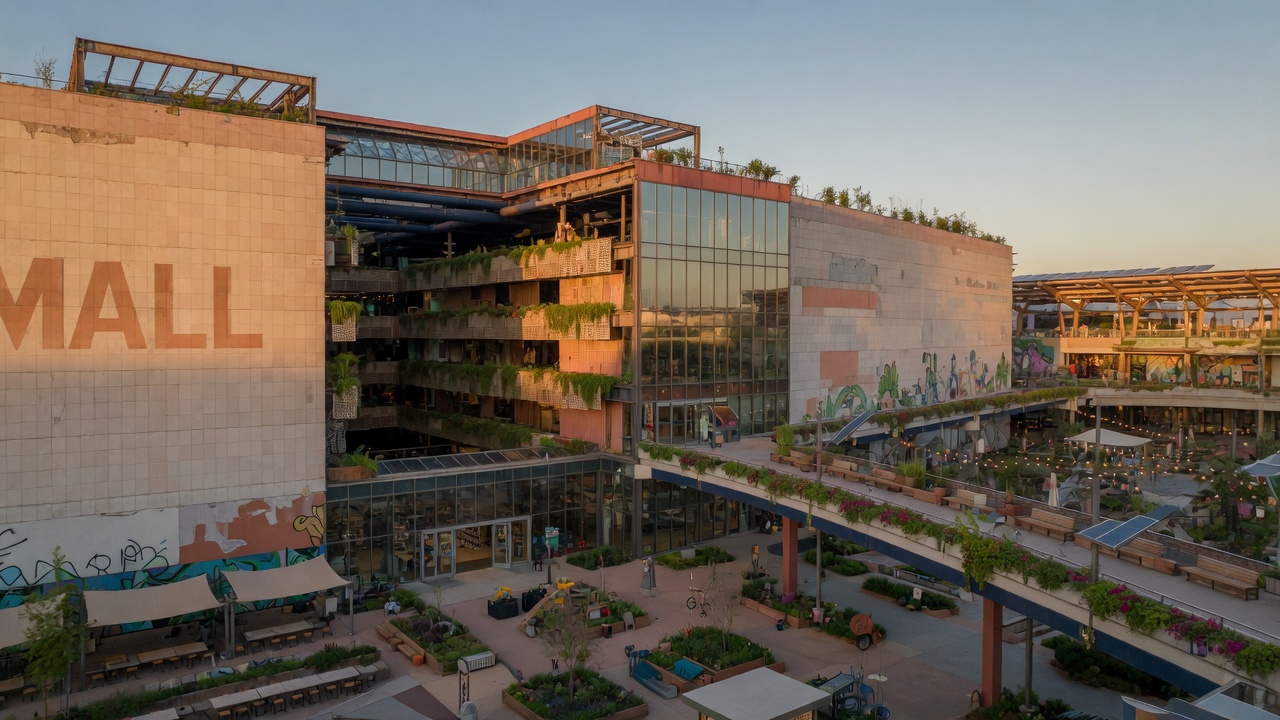
In the flat light of a midwestern afternoon, the skylights of an aging mall once scattered a uniform glow across polished tile. Now those same panels frame glimpses of new upper windows and planted rooftops, turning the old atrium into a vertical street where residents cross paths on their way to ground-floor workshops.
The shift begins at the perimeter. Acres of asphalt are broken into smaller courts edged with row houses whose front doors open directly onto what were once service lanes. Where delivery trucks idled, children now ride bicycles beneath the shade of newly installed pergolas. The concrete decks remain, but thin soil beds allow trees to root, their canopies softening the echo that once carried only the hum of escalators.
Inside, former anchor stores are subdivided with light-frame partitions that stop short of the original roof deck. Natural light still pours through the central clerestory, yet the space below has been zoned for mixed tenancy: a bakery occupies the old cosmetics counter, its ovens venting through former HVAC shafts, while apartments line the upper mezzanine. Hallways retain their terrazzo floors, though the reflective surface now registers the slower cadence of daily life rather than weekend crowds.
Materials are reused where possible. Glass storefronts become interior partitions that preserve borrowed light between units. The heavy steel trusses, once hidden behind dropped ceilings, are exposed and painted to mark circulation routes. Even the old fountains have been retained as shared basins, their basins now holding rainwater collected from the roof.
In one converted wing in Ohio, a former food court serves as a covered market three mornings a week; stainless-steel counters that once held fast-food trays now display produce from nearby farms. Residents descend from their apartments via the original escalators, whose motors have been recalibrated for quieter, slower travel. The transformation is not total erasure but a recalibration of pace and use, allowing the building’s generous volume to absorb new rhythms without requiring complete demolition.
The result is neither pure nostalgia nor abrupt reinvention. It is the slow recognition that a structure built for one kind of gathering can, with modest adjustment, support another.