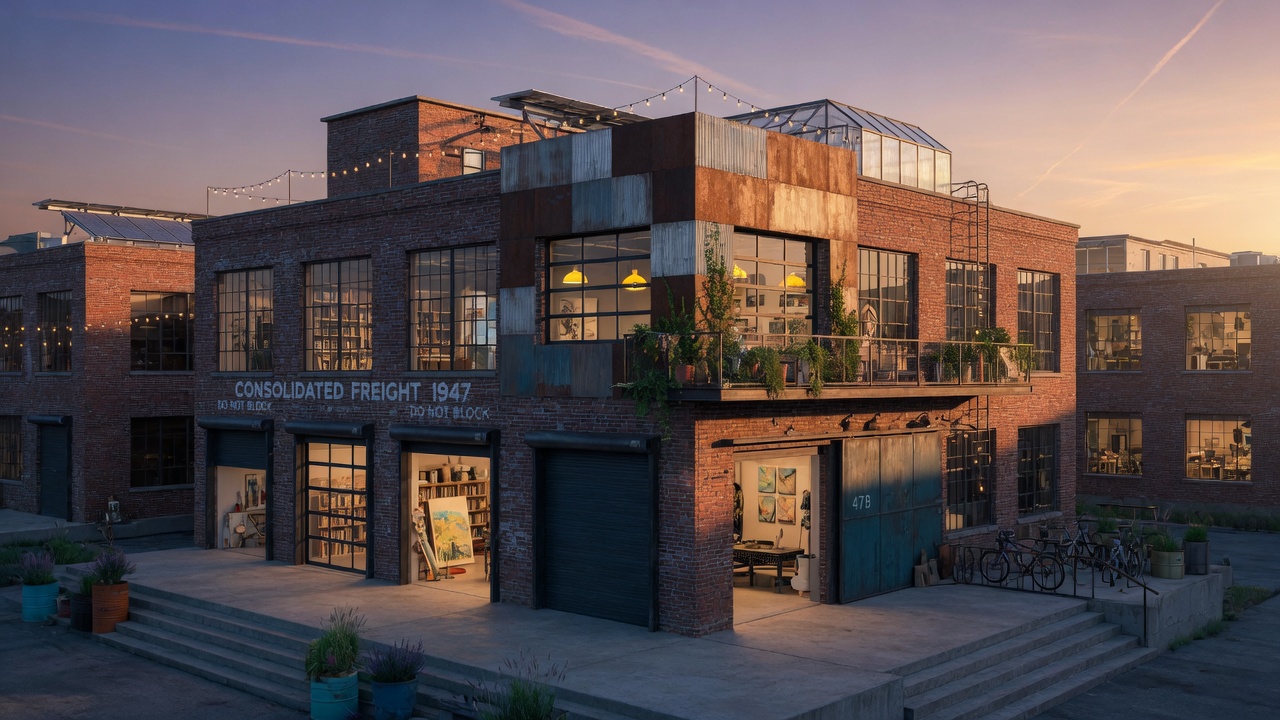
Along the canal in East London, a row of late-Victorian brick sheds still carries the faint outline of railway sidings on its rear wall. Inside, the original timber trusses remain exposed, their undersides darkened by a century of coal smoke, while new gypsum partitions stop short of the ceiling so that sound travels freely between a painter’s bench and a sculptor’s welding station two bays away.
The appeal lies less in novelty than in the sheer volume of air and the way northern light slides across unfinished surfaces. A single clerestory band, left uncleaned, throws a cool, even wash over worktables without the glare that modern skylights often produce. Artists notice this immediately; the eye rests longer on a canvas when the light source stays constant through the afternoon. Concrete floors, scored by decades of pallet trucks, accept spilled paint and plaster without complaint and transmit warmth upward once underfloor heating is threaded through the existing slab.
Such conversions rarely erase the building’s former purpose. Loading doors are kept operable, their counterweights still audible when raised, and the faint mineral smell of the original floor seeps through new rugs. In one Manchester complex, residents have left the overhead crane rails in place; the hooks now hold lighting rigs rather than bales of cotton. The machinery becomes furniture rather than ornament, a reminder that movement and weight once defined the room.
Cultural patterns follow the same logic. Because the envelopes were built for bulk rather than comfort, rents remain lower than purpose-built live-work units. Painters, printmakers, and small theater groups can therefore occupy adjacent spaces, their different schedules producing an irregular but continuous hum of activity. The arrangement also tolerates the occasional open-flame process or solvent odor that would be restricted in residential zones.
Yet the adaptation is never frictionless. Insulation added beneath the roof deck reduces the original stack effect, and some studios now require mechanical ventilation that hums beneath the trusses. Where original sash windows have been retained, winter drafts persist; residents compensate with heavy curtains rather than sealed units, accepting the seasonal variation as part of the space’s character.
In these buildings the distinction between production and living stays deliberately thin. A canvas may dry on the same wall that holds a coat rack; welding sparks are swept from the kitchen threshold at the end of the day. The warehouse keeps its industrial cadence even as new rhythms settle inside it.