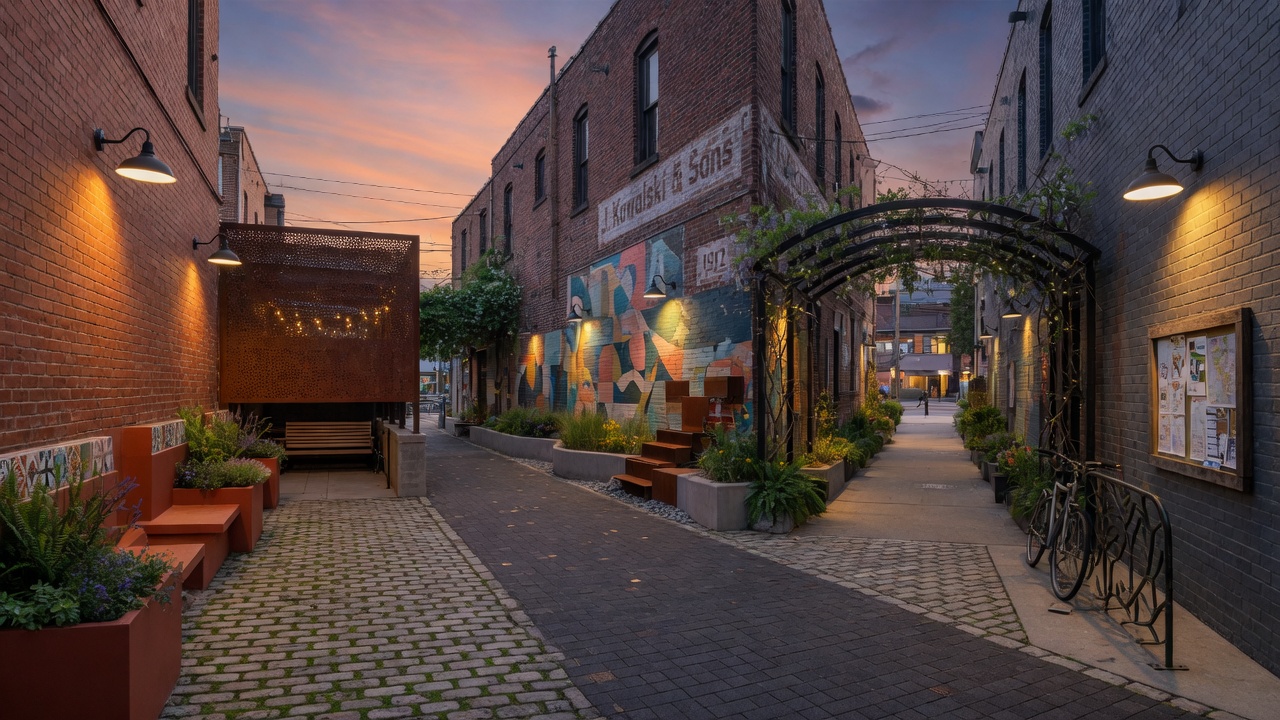
In many cities the alley still begins as a line of shadow between loading docks and rear walls, its surface marked by oil stains and the faint ridges of old brick. Yet once a few residents set out chairs or string a line of bulbs overhead, the same passage begins to hold a different rhythm—footsteps slow, voices carry less sharply, and the light that filters down seems to settle rather than merely pass through.
Consider the network of lanes behind Melbourne’s older commercial blocks. Here the asphalt has been scored with shallow channels that direct rainwater toward planted beds of ferns and native grasses. The ferns release a cool, mineral scent after rain, while the low brick walls retain warmth into the evening. Benches made from salvaged floor joists sit at slight angles so that two people can sit without facing each other directly, allowing conversation to remain optional. At midday the sun reaches only the upper courses of brick, leaving the pavement itself in cool shade; by late afternoon the same walls act as reflectors, warming the air enough that diners linger without coats.
A similar shift has occurred along the service lanes of central Kyoto. Sliding wooden doors once used for deliveries now open onto small platforms where tea is served on low stools. The original stone drainage channels remain, their edges worn smooth by generations of cart wheels; new timber planks rest across them so that visitors can cross without disturbing the flow of water. The sound of water beneath the planks mixes with the low murmur of conversation, creating an acoustic layer distinct from the traffic on the main street only twenty paces away.
Materials matter in these transformations because they already belong to the place. When new paving is required, it is often laid in the same running bond as the surrounding walls, so that the eye registers continuity rather than contrast. Lighting is kept low and warm, mounted on existing downpipes rather than new poles, preserving the sense that the alley remains a secondary space even while it is inhabited. Plantings are chosen for root systems that will not lift the pavement, and seating is anchored lightly so that it can be moved when a delivery truck still needs passage.
Such changes do not require the alley to become a destination. They allow it to absorb the small pauses of a neighborhood—someone waiting for a friend, a child testing the echo of a metal door, a cyclist pausing to adjust a strap. The passage stays narrow, still defined by its original walls, yet the air within it now carries the scent of wet stone and brewed tea rather than only exhaust and damp cardboard.