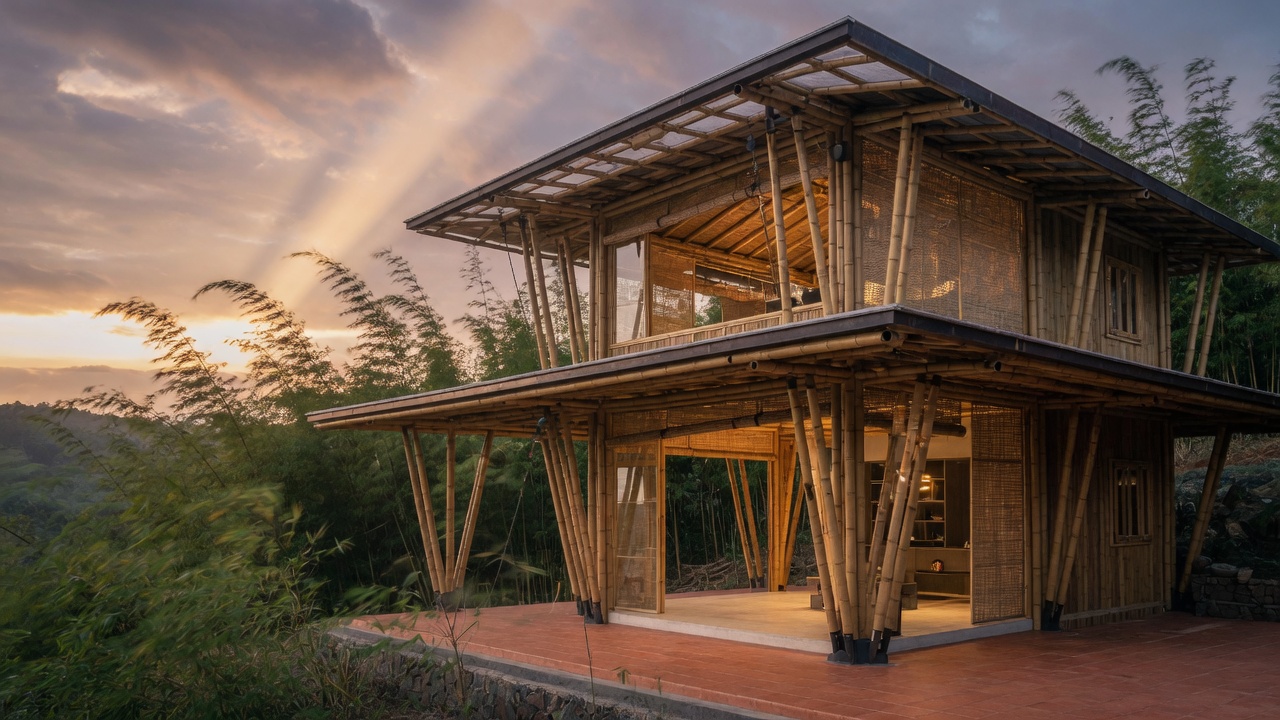
In a narrow house set into a hillside outside Da Nang, the main living space rests on a grid of whole bamboo poles rather than milled timber. Each pole keeps its original diameter and slight taper, so the eye follows a gentle rise from one joint to the next. Morning light slips between the poles and lands on the concrete floor as a moving lattice; by afternoon the pattern has stretched and softened.
The joints themselves carry most of the character. Traditional lashings of rattan have been replaced with thin steel straps that sit flush against the cane, yet the builder still leaves a small gap at each crossing so air can move. When a storm arrives, the frame gives a few millimeters at every node. The movement is visible only in the way a hanging lamp sways, never enough to disturb the plaster walls that hang from the upper chords.
Inside, the material registers through temperature as much as sight. Bamboo stays cooler than the surrounding concrete because its hollow sections allow a slow exchange of air. On humid days the surface feels almost damp to the touch; after a dry wind it warms quickly and releases a faint grassy scent when brushed by a sleeve. Residents learn to read these changes without instruments.
A second house, this one in the hills above Chiang Mai, uses split bamboo for interior partitions. The halves are planed smooth on the outer face and left rough inside the cavity, so sound from one room reaches the next as a soft rustle rather than a sharp echo. The same split members form sliding screens that can be drawn across the main space at night. Their edges catch the low sun and throw thin lines of shadow across the bedding.
Both projects rely on local growers who harvest poles at seven years, when the silica content has hardened the outer skin. No chemical treatment is applied beyond a simple borate soak; the builders accept that the surface will darken over a decade and that occasional replacement of a single pole will be part of ordinary maintenance. The structure is therefore understood as a living assembly rather than a finished object.
What remains striking is how little the bamboo needs to be disguised. Its nodes stay visible, its slight irregularities become part of the measured rhythm of the rooms, and the house continues to register the weather through the frame long after the builders have left.