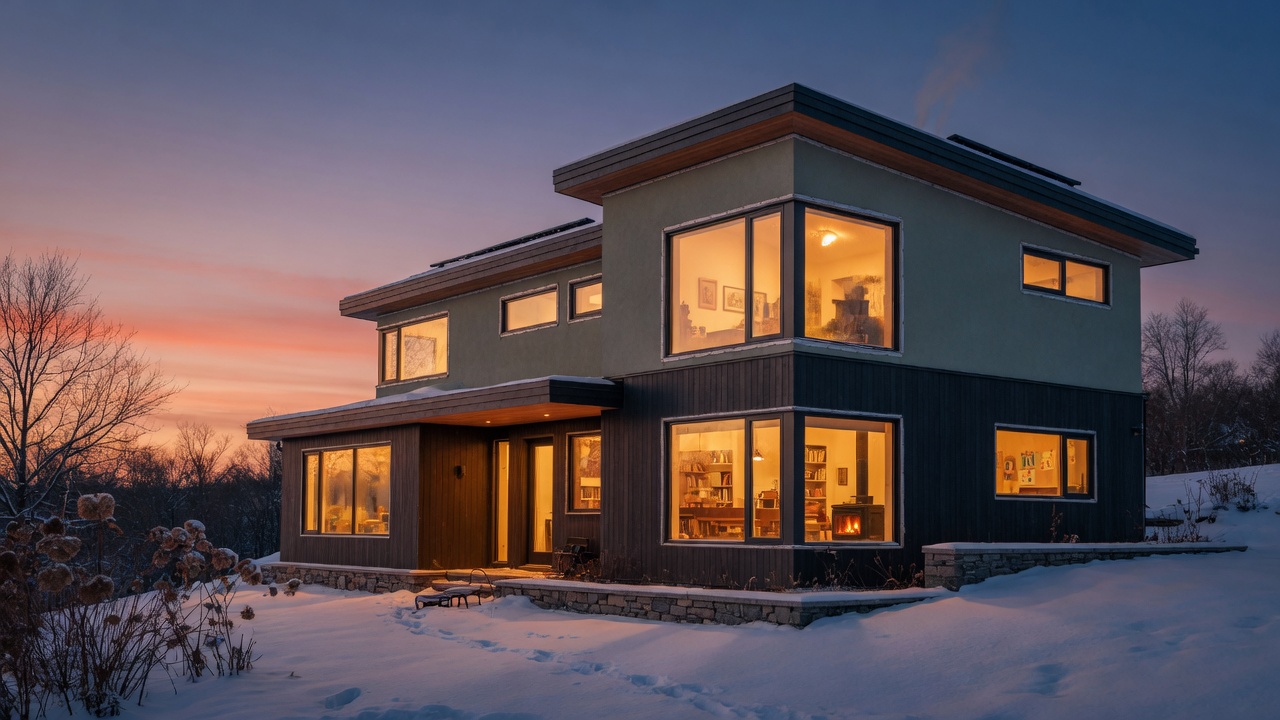
In a new subdivision outside Heidelberg, a young family opens the front door of their house on a January afternoon and feels nothing change. No rush of cold air meets them at the threshold. The air inside stays still and even, as if the rooms have already decided what temperature they will keep.
Passive House standards shape this steadiness through layers that rarely show on the surface. Walls reach forty centimeters thick, filled with dense wood-fiber boards and mineral wool that trap heat the way heavy wool blankets trap body warmth. Triple-glazed windows sit deep within the insulation plane so that winter light still reaches the kitchen table while the glass itself remains free of condensation. The roof, likewise thickened, carries the same continuous blanket across every joint and corner.
Inside, the family moves through spaces that never develop cold corners. Children leave bedroom doors open at night without creating drafts that travel down the hallway. The ventilation unit, tucked in a utility closet, draws fresh air through a heat exchanger that captures warmth from the air leaving the kitchen and bathrooms. Cooking smells travel outward, yet the temperature in the living room hardly shifts. On sunny days the south-facing windows admit enough light to raise the indoor temperature a degree or two without any mechanical help.
Materials matter at every joint. The builders avoided foam boards that off-gas and chose instead cellulose blown into closed cavities, a material that also moderates moisture when someone boils pasta or takes a long shower. Window frames are wood-aluminum composites that feel warm to the touch even when frost covers the glass outside. These choices add weight and depth to the walls, so the house feels solid under hand and foot rather than thin and resonant.
Over time the family notices smaller patterns. The dog stops seeking the radiator because no radiator ever turns on. Laundry dries on a rack in the utility room because the steady ventilation prevents damp pockets. In summer the same thick envelope and external shading keep rooms cool well into the evening, so the windows stay closed against pollen and traffic noise. The house does not announce its performance; it simply removes the small frictions that once shaped daily routines.
The standards themselves remain invisible once the plaster is painted and the furniture arranged. Only the thickness at the window reveals and the quiet of the air suggest that something deliberate has been built into the ordinary fabric of the rooms.