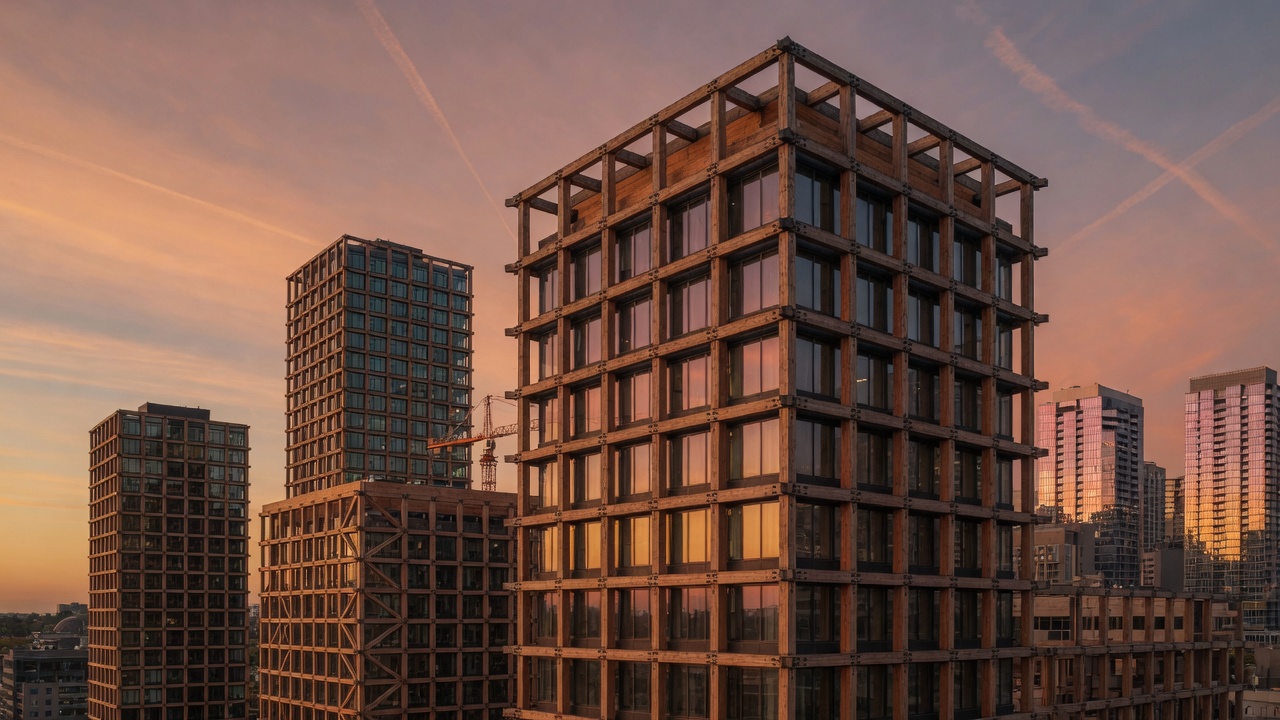
In the late afternoon, when light slides low across Vancouver’s False Creek, the Brock Commons residence hall reveals its structure in ways few tall buildings allow. The cross-laminated timber panels catch the sun in warm bands, their edges casting fine shadows that shift with each passing cloud. The effect is quieter than glass or steel, yet it registers clearly against the surrounding concrete frames.
Mass timber changes how a tower meets the ground and how it meets the air. Because the material is roughly one-fifth the weight of reinforced concrete, foundations can remain shallower and street-level spaces open more generously. At the Mjøstårnet in Brumunddal, Norway, the eighteen-story structure rises from a modest concrete base directly into a forested hillside; the transition feels continuous rather than abrupt. Inside the upper floors, the wood surfaces retain a faint resin scent months after completion, softening the acoustics of corridors that would otherwise echo.
The visual rhythm of the skyline also shifts. Traditional high-rises present long, unbroken verticals. Timber buildings expose horizontal layers every few meters where floor plates meet columns. From street level these lines read as a measured stack rather than a single extruded shaft. In Milwaukee’s Ascent tower, the exposed CLT edges create a textured surface that registers differently at dusk, when artificial light from within glows through the wood rather than reflecting off metal.
Wind and seismic loads behave differently as well. Engineers can use the natural flexibility of the panels to absorb movement, reducing the need for heavy damping systems that add mass and cost. This allows taller timber structures in regions once considered unsuitable. Yet the material still demands careful detailing at joints; each connection must manage both compression and the slow moisture exchange that wood continues after installation.
Observers on upper floors notice another change. The thinner floor assemblies permit slightly higher ceiling heights without increasing overall building mass. Daylight reaches deeper into apartments, and the warmth of the ceiling plane alters how artificial lighting is perceived at night. These adjustments accumulate across a skyline, replacing the uniform coolness of concrete soffits with a material that registers seasonal light more directly.
The result is not a new icon so much as a different kind of presence—one measured in grain, in shadow depth, and in the quiet accumulation of stories rather than in reflective height alone.