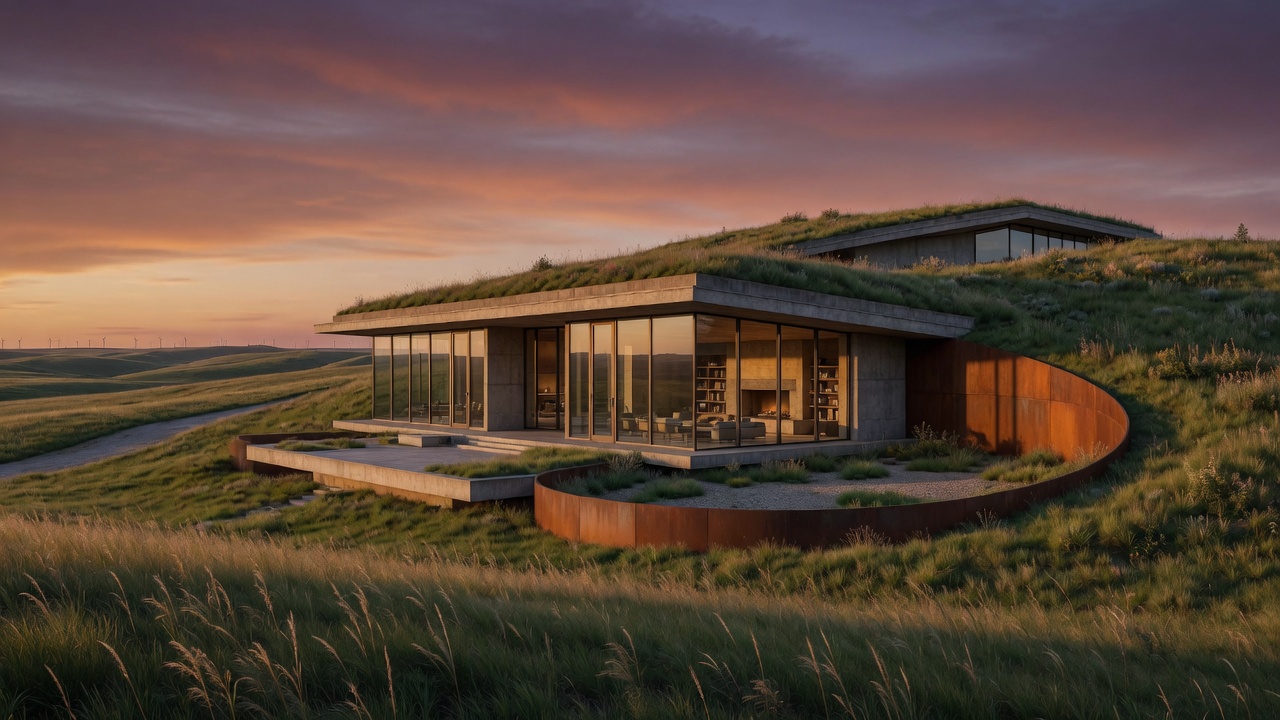
In the flinty light of the Great Plains, a few houses still disappear into the land instead of standing against it. Their roofs carry a shallow layer of native grasses and soil, no deeper than a plow blade, yet thick enough to blunt the worst swings of heat and cold. Walk inside one on a July afternoon and the air arrives already cooled, drawn from the mass of earth that presses against three sides of the room.
The principle is older than insulation boards. Prairie settlers built with blocks of sod because lumber was scarce and the ground itself offered a barrier against wind and frost. Contemporary versions use the same logic but with better waterproofing and concrete. A berm of compacted earth rises against the north and east walls, while the roof slopes gently south to catch winter sun. Windows sit low on the south face so light reaches deep without letting the summer glare dominate the interior. The result is not darkness but a steady half-light that changes little between noon and dusk.
Materials matter at the joint where wall meets soil. A continuous drainage plane keeps moisture from reaching the concrete, while the earth itself supplies the thermal mass. On cold nights the stored warmth moves inward; on hot days it absorbs excess heat before the air inside can rise. Occupants notice the change most in spring and fall, when the house requires almost no mechanical tempering. The sound changes too. Traffic or wind that would normally travel through frame walls arrives muffled, filtered through layers of mineral and root.
Examples appear wherever builders have accepted the ground as a partner rather than an obstacle. In New Mexico, clusters of rammed-earth homes sit half below grade, their south glazing shaded by deep overhangs cut into the berm. In England, a small development near Nottingham buries its living spaces beneath a single planted roof that reads, from a distance, as meadow rather than dwelling. Each project adjusts the depth of cover and the angle of the slope to local soils and sun angles, yet the underlying exchange remains the same: the building yields surface area to the earth in return for slower temperature movement.
The limit appears where the land refuses to cooperate. Steep slopes or shallow bedrock make the necessary excavation impractical, and high water tables can turn the berm into a liability rather than a buffer. Where conditions allow, however, the house and the ground begin to share a single surface, and the daily work of staying comfortable shifts from equipment to the simple weight of soil.