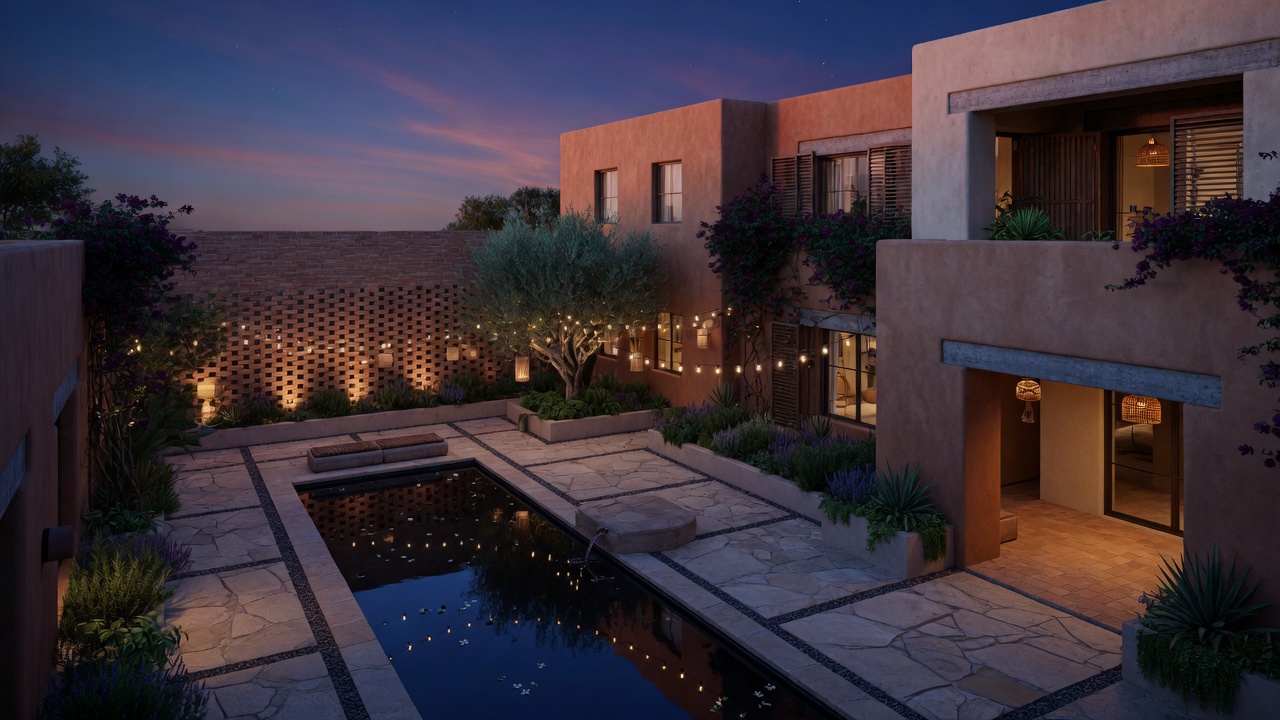
In the old quarters of Marrakech, thick walls of rammed earth rise around a central court where the air stays damp from a fountain even as the sun climbs. The rooms open through arched doors onto this space, their shutters adjusted to catch or deflect the moving light. Heat that has gathered in the masonry during the day radiates outward at night, yet the open sky above the court allows the stored warmth to escape upward while cooler air settles in from above.
This arrangement works through simple physics made tangible. The courtyard floor, often paved in stone or tile, absorbs little heat when shaded by a tree or pergola. Water in a shallow basin or channel evaporates slowly, drawing warmth from the surrounding air. When doors and windows on opposite sides of the court are left ajar, the slight pressure difference created by the temperature gradient pulls a steady current through the house. Residents learn to read these movements: a curtain lifted at one end signals that the evening breeze has arrived.
Traditional examples in Rajasthan show similar intelligence. Havelis place deep verandas around the court so that family members can sit in the moving shade without stepping fully into the sun. Lattice screens of carved sandstone filter the light into patterns that shift across the floor, reducing glare while still allowing enough illumination for daily tasks. The same screens slow the wind just enough to carry away moisture without creating drafts that chill sleeping children.
Modern houses in arid regions continue the pattern with updated materials. Rammed-earth walls thirty centimeters thick now contain thin layers of insulation, yet the thermal mass remains. In one house near Tucson, a narrow court runs the length of the living spaces. At midday the concrete pavers stay cool underfoot because the surrounding rooms cast continuous shadow; by evening the stored coolness has begun to temper the air inside. Sliding glass doors allow the court to function as an extra room when the temperature drops.
Light and sound also change inside these enclosures. The sky seen from within the court appears deeper because the walls cut off the horizon. Footsteps on stone echo softly against the surrounding rooms rather than dissipating into open landscape. These sensory qualities are not decorative additions; they arise directly from the geometry required for passive cooling. The house and its occupants remain in constant, quiet conversation with the daily cycle of heat and release.