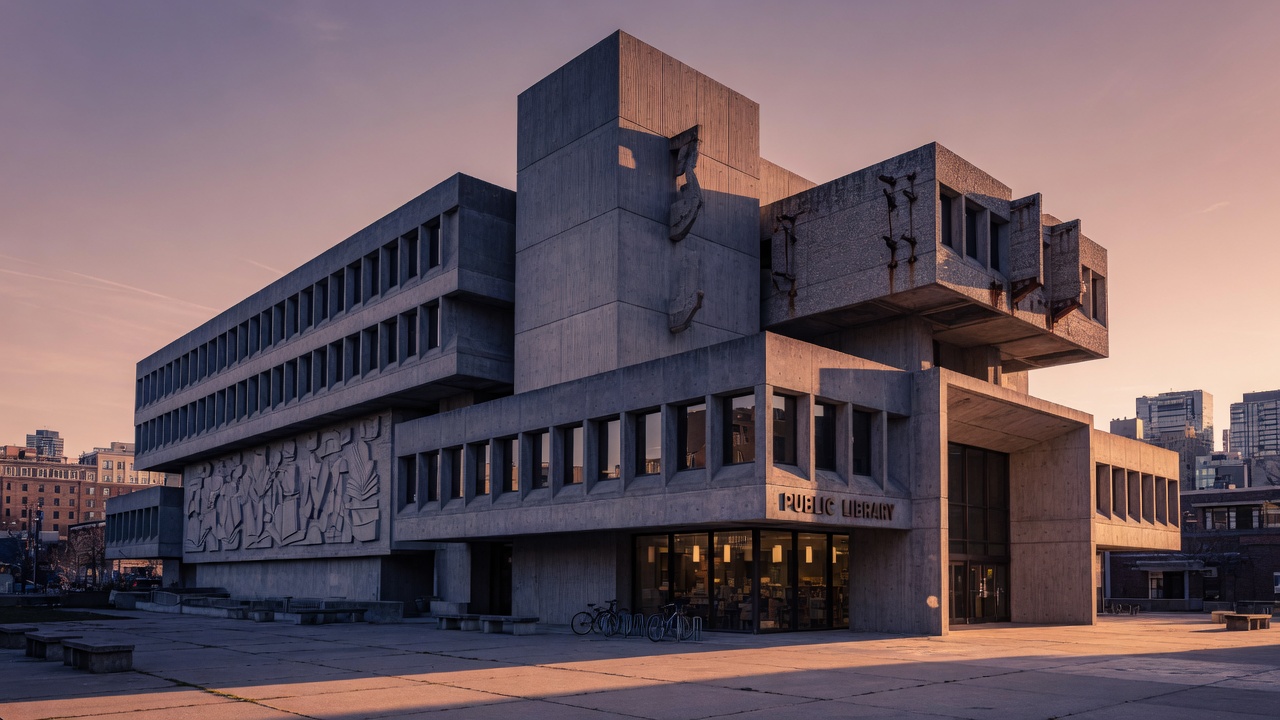
In several recent public libraries, board-marked concrete has reappeared as the primary surface, its weight and grain set against the lighter demands of open stacks and digital access. The material registers immediately on entry: cool to the touch, faintly alkaline in scent, and absorbent of sound in a way that carpets and acoustic ceilings never quite achieve.
One example stands in a northern city where the main reading room is formed by a single pour of concrete that continues from floor to ceiling. Deep reveals around the clerestory windows keep direct sun off the books while allowing a steady wash of light across the aggregate. The texture varies slightly where the formwork boards met, leaving faint ridges that catch dust and, over time, the oil from countless hands resting against them. Readers notice these small differences without being told to look.
Another project, completed two years ago in a midwestern American town, uses precast panels whose exposed stone mix includes local granite. The panels are thick enough to carry their own thermal load, reducing the need for additional insulation layers. Inside, the same panels define the perimeter of the children's area; low benches cast as part of the wall invite sitting without separate furniture. The concrete here is not polished. Its surface remains slightly rough, so that dropped crayons or small shoes leave marks that are accepted rather than cleaned away at once.
These choices carry an idea about duration. Concrete suggests a public institution meant to outlast shifts in media or funding cycles. It records use directly: a scuff from a delivery cart, a faint darkening where shoulders lean during long afternoons. Such marks do not read as damage but as evidence that the room is occupied. Light plays across them differently than across drywall or resin panels, revealing the depth of each recess and the slight color shift between batches of mix.
The revival also changes how circulation is experienced. Column grids left exposed create natural pauses between sections. A person walking the perimeter feels the rhythm of the structure rather than an abstract plan. In winter, the mass holds a steady temperature that makes the space feel sheltered even when mechanical systems are set low. In summer, the same mass delays heat gain, so that the interior stays comfortable longer into the afternoon.
Craft enters the work at the level of formwork joints and lift lines. Builders now use rubber gaskets and tighter tolerances than mid-century practice allowed, yet the material still refuses perfect uniformity. The result is a building that registers the labor of its making without theatrical display. Patrons sense this stability when they place a book on a concrete ledge or rest an elbow against a pier. The surface answers back with resistance rather than give.
Such libraries do not announce themselves as monuments. They simply remain present, their concrete surfaces holding light, sound, and the ordinary pressure of daily use.