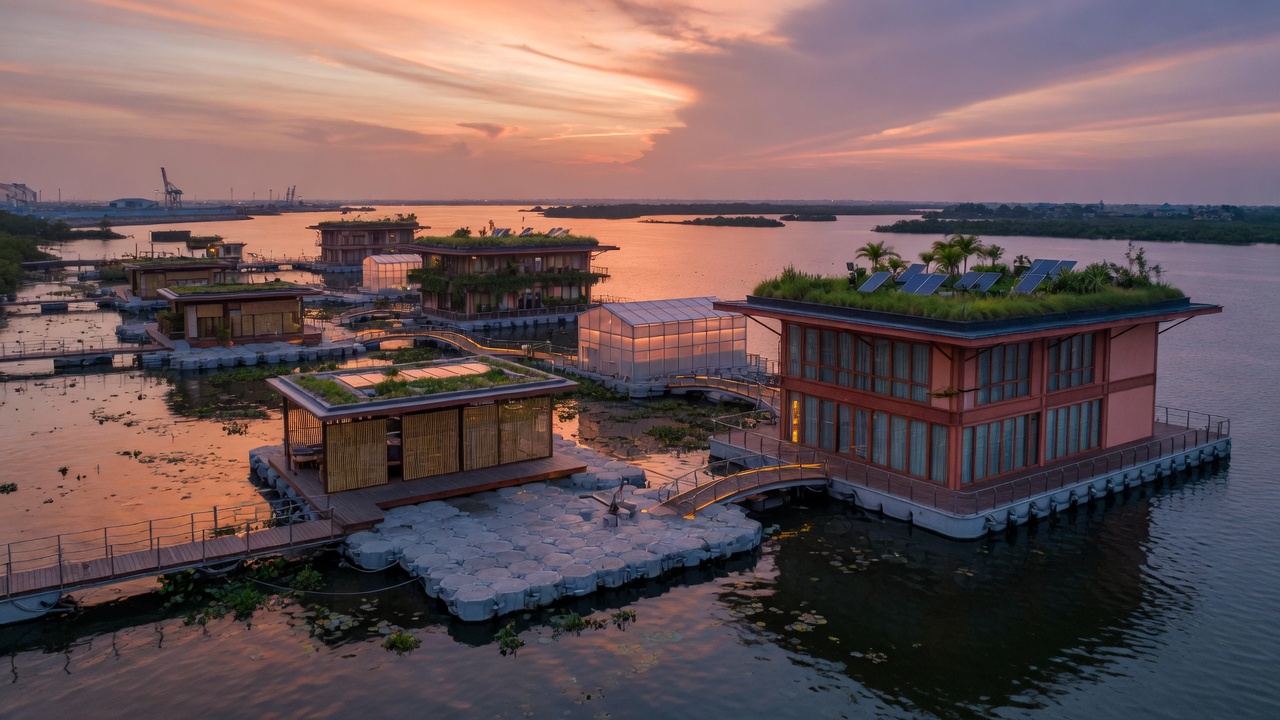
In the lowlands east of Dhaka, clusters of timber-framed dwellings rest on plastic drums and bamboo poles, rising and falling with the monsoon waters that once turned streets into canals each season. Their decks creak softly underfoot, and the underside of each floor catches the pale green reflection of the river below.
These structures draw from older practices of boat-building rather than from any single engineered prototype. Local carpenters lash together lengths of sal wood and recycled drums, then anchor the platforms with flexible ropes that allow lateral movement during strong currents. When flood levels drop, the same ropes let residents pull the platforms closer to the bank so children can step directly onto dry ground. The arrangement keeps kitchens and sleeping areas just above the waterline, where breezes move more freely and mosquitoes find fewer places to settle.
Further upstream, near the confluence of the Brahmaputra and Meghna, a newer project replaces drums with sealed concrete pontoons cast in shallow molds on site. Each pontoon carries a single-story house whose walls are clad in woven bamboo screens. Inside, the light changes constantly: shafts of sun angle through the lattice and shift across the floor as the platform rotates a few degrees on its moorings. Residents report that the gentle motion becomes familiar within days, much like the sway of a ferry they once used to reach market.
The choice of materials matters less than the joint between them. Where timber meets concrete, builders leave a small gap filled with rubber strips salvaged from old tires. The gap allows each material to expand at its own rate without cracking the deck, and it also lets small amounts of water drain away rather than pool. Over time the rubber darkens to the same silt color as the riverbed, so the joint nearly disappears from view.
Electricity reaches these platforms through cables suspended from tall poles on shore; the cables include enough slack to accommodate a two-meter rise. At night the glow from a single bulb inside a bamboo screen falls onto the water and creates a moving patch of light that follows the platform’s slow drift. Neighbors recognize one another by the pattern of that light as much as by the sound of voices.
In these places the boundary between house and river remains deliberately thin. A bucket lowered through a hinged panel in the floor brings up water for washing; the same panel serves as a trapdoor when fish are plentiful. The arrangement does not eliminate seasonal flooding so much as accept its rhythm, turning what once arrived as disaster into a predictable adjustment of daily height.