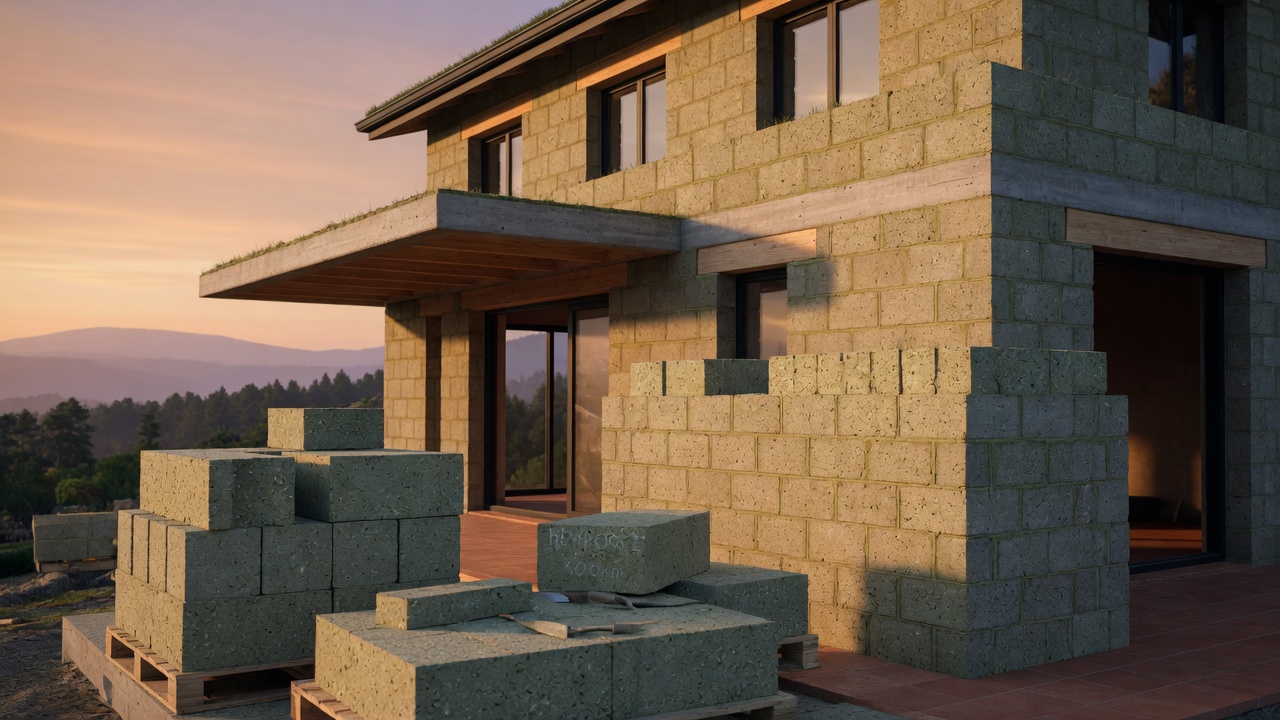
In certain rural houses of northern France, the walls made from pressed hempcrete blocks register first as a slight give beneath the palm, a surface neither hard nor soft but alive to the touch. The blocks, formed from the woody core of hemp mixed with hydraulic lime, sit stacked without mortar joints in some recent builds, their pale gray faces catching light in a muted, even way that softens the edges of a room.
The material’s porosity shapes daily life more directly than its thermal numbers suggest. A family in one such house near Caen notices that condensation never gathers on the inner face during winter rains, even when the wood stove burns low. Moisture moves through the wall rather than collecting against a vapor barrier, and the air inside stays drier without mechanical dehumidification. The same blocks also store heat from the afternoon sun and release it after dark, so the kitchen stays warm enough for evening meals without extra fuel.
Builders who work with these blocks speak of the sequence of laying them. Each piece weighs less than a conventional concrete block yet requires careful handling so the lime binder does not crack during placement. Once the wall is finished and lime-plastered, the surface takes on a slight tooth that holds paint or whitewash without primer. In one converted barn, the plaster was left unpainted; over three winters the wall color has shifted from cool gray to a warmer tone where hands and sunlight have touched it most often.
The blocks also alter acoustics inside the house. Footsteps on the floor above arrive muffled, and voices carry less sharply across a room because the hemp particles scatter sound rather than reflect it. This effect appears most clearly in open-plan living spaces where conversations remain intelligible without rising to a shout. At the same time, the wall thickness—usually 300 millimeters—pushes window reveals deeper, creating a recessed frame that changes how daylight enters at different hours.
Craftsmen continue to test variations in block density for different climates, yet the basic composition remains the same: hemp hurds that once grew in the same fields now form the quiet envelope of the house itself.