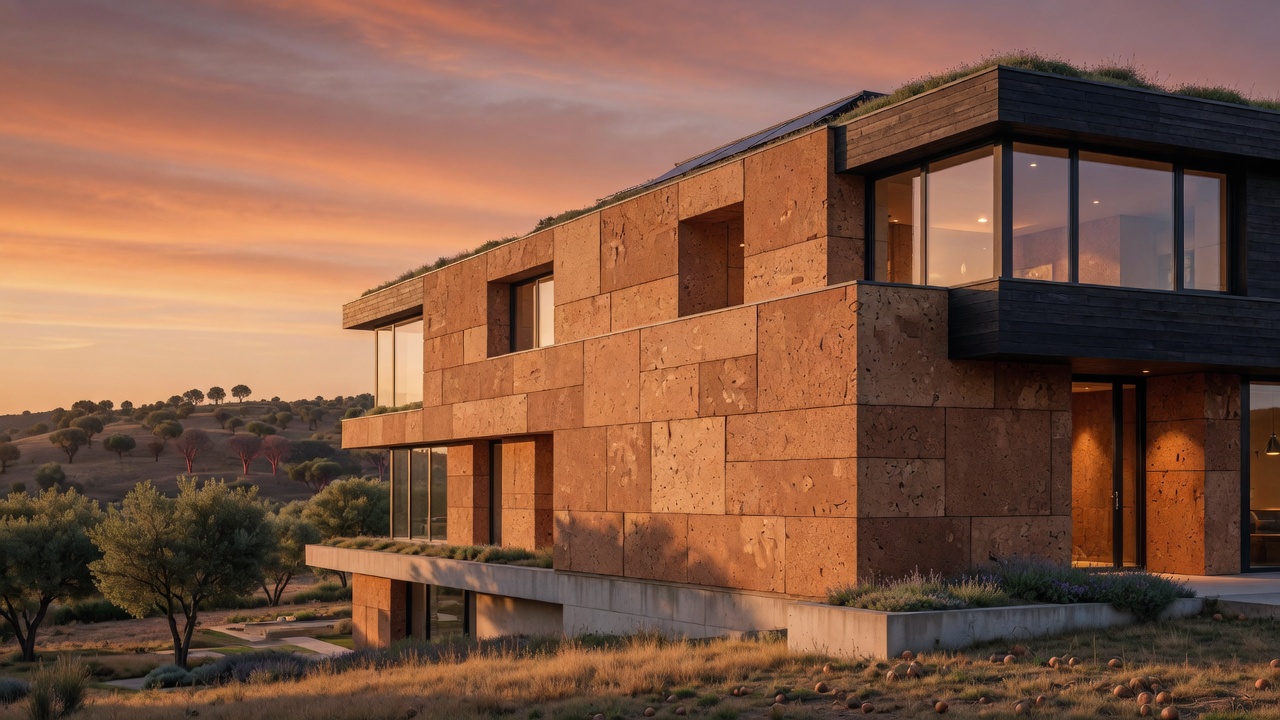
In the south of Portugal, where cork oaks are stripped of their outer bark every nine years, the harvested sheets travel north to be steamed, ground, and pressed into panels that builders now slide between timber studs. The material arrives with a faint, resinous smell that lingers for weeks after installation.
Cork’s closed-cell structure traps pockets of air so small that heat moves through them slowly. In a house near Évora, the owners left the cork exposed on the north wall of the living room rather than cladding it with plasterboard. On winter mornings the surface stays a few degrees warmer than the surrounding stone; in summer it absorbs excess moisture from cooking and breathing, then releases it again when the air dries. No mechanical ventilation is required to keep the room comfortable.
The same panels reduce impact noise when laid beneath a floating timber floor. Footsteps register as a soft thud rather than a sharp tap, an effect noticed most clearly in the evening when children run from the kitchen to the stairs. Because cork expands and contracts with humidity rather than temperature, joints remain tight even after several seasons of radiant-floor heating.
Builders sometimes combine cork with lime render on the exterior, creating a rainscreen that allows vapor to pass outward while the cork itself stays dry. In one such wall the cork layer is only 120 millimeters thick, yet measured heat loss through that plane matches the performance of twice the thickness of mineral wool. The difference appears not in the numbers but in the way condensation never forms on the inner face during cold snaps.
The material also records time. After five or six years the pale surface darkens where sunlight reaches it through south-facing windows, turning the insulation into a quiet record of daily occupation.