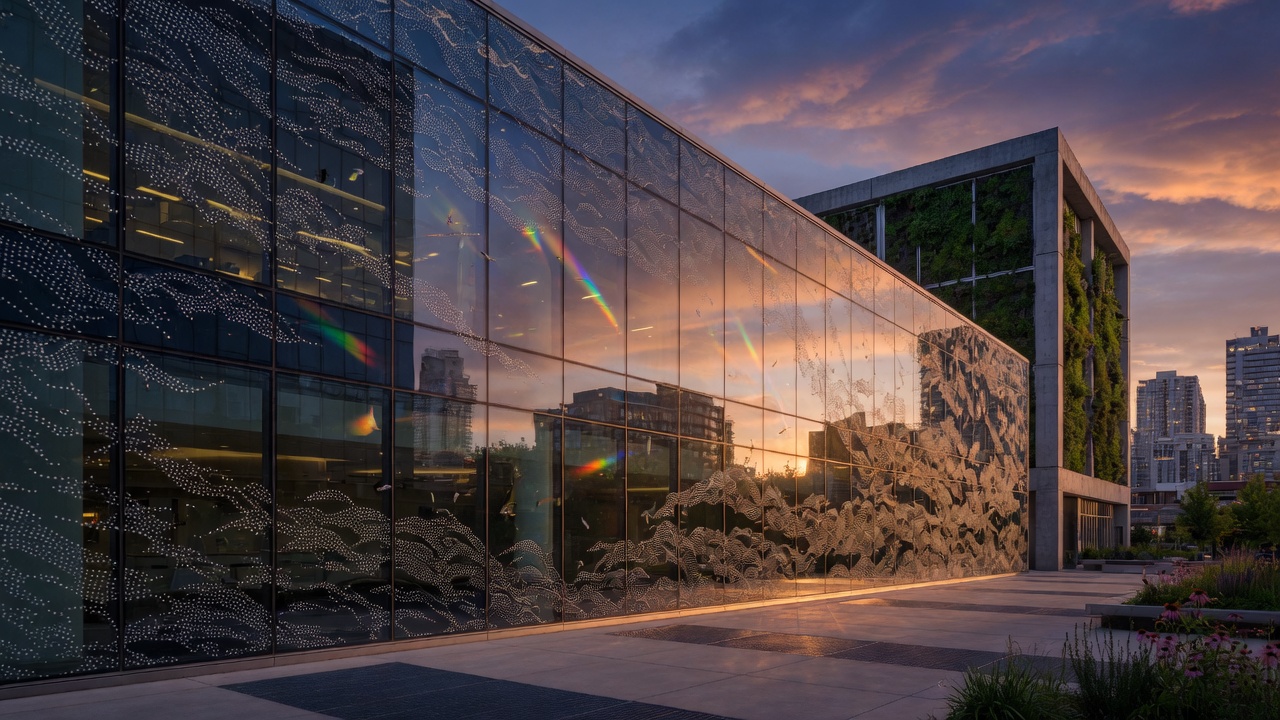
On certain mornings the sun strikes the upper stories of a downtown building at just the right angle to reveal a grid of pale dots across each pane, faint as water spots yet deliberate. The pattern is not decoration. It interrupts the mirror that otherwise doubles the sky and pulls birds into collision.
Architects have long treated glass as weightless and transparent, a material that dissolves the boundary between inside and out. For birds the same surface remains invisible until the moment of impact. In older towers the reflections of nearby trees or clouds create an illusion of open flight, while the actual glass stops the motion. The result is measured each spring and fall when workers find small bodies on the pavement below.
Some recent facades address this directly. Ceramic frit applied during manufacture leaves a regular field of dots or lines, usually spaced no more than two inches apart. From inside the building the pattern is barely noticeable; from outside it registers as a visible screen against the reflected surroundings. On the Edith Green/Wendell Wyatt Federal Building in Portland, vertical ceramic lines run the full height of the curtain wall, catching light at different times of day and giving the surface a slight texture that changes with the weather. The same approach appears on sections of the Jacob K. Javits Convention Center in New York, where the frit also reduces solar gain.
Other strategies rely on external elements rather than the glass itself. Perforated metal screens set a few inches in front of windows break the reflection while allowing views and ventilation. In Toronto, several mid-rise residential buildings use such screens on the lower stories where bird traffic is heaviest. The metal casts shifting shadows across the interior during the day and glows softly from within at night, turning what could have been a flat plane into a layered surface.
Light itself can be managed. Dimming interior lighting after dark reduces the glow that draws nocturnal migrants toward glass. Exterior fixtures directed downward and shielded at the top limit the halo that disorients birds flying at low altitude. These adjustments require coordination between lighting designers and facade engineers, yet they leave the architectural form largely unchanged.
The cumulative effect of such details is quiet. A pedestrian may notice only that the building surface seems more present, less like a slice of borrowed sky. For the birds the difference registers as an obstacle rather than an opening, altering the path of flight without announcing the change to human eyes.