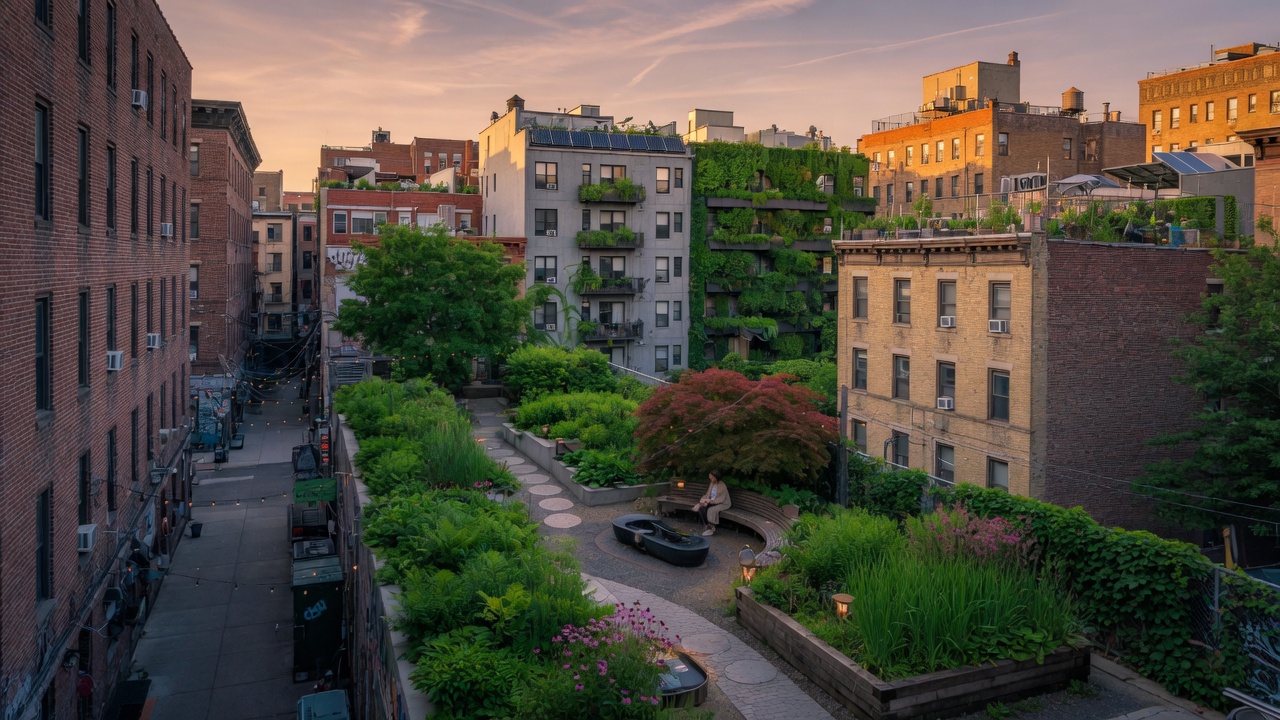
In a narrow lot wedged between two brick warehouses in Brooklyn’s Red Hook, a single row of honey locusts casts dappled shade across a gravel clearing. The trees stand no taller than the surrounding walls, yet their leaves alter the sound of passing trucks and soften the glare that bounces off metal roll-down doors. Such places are not grand civic gestures; they are modest intervals carved from leftover pavement, and they change how residents move through the heat of an afternoon.
The materials matter. Reclaimed granite curbs form low seating edges that absorb warmth slowly and release it after sunset. Permeable gravel underfoot lets rain soak away rather than pool against building foundations. A thin screen of climbing hydrangea on one party wall reduces the reflected heat that once made the sidewalk feel like an oven. These choices are quiet, but they register in the body before they register as design.
Walk through similar interventions in Tokyo’s dense residential lanes and the effect repeats in different materials. There, pocket gardens often use cedar decking and stone basins fed by a slow drip from a shared tap. The sound of water on stone travels only a few meters, yet it marks a threshold between the street’s constant motion and a place where a person can stand still without apology. Children pause to watch koi beneath the surface; older residents rest on stools placed at the precise angle that catches the last shaft of western light.
In both cities the parks succeed because they remain open to the street rather than enclosed. A low gate or simply an absence of fencing allows the eye to enter first, then the feet. The result is not isolation but a brief recalibration of pace. Someone carrying groceries may set the bags down for a moment; a delivery rider may remove a helmet and lean against a tree trunk. These small pauses accumulate across a day and across a block.
Light behaves differently inside these slivers. Morning sun reaches the ground in narrow bands that shift with the seasons, while afternoon shade arrives earlier than on the open sidewalk. The temperature drop is measurable on a warm day, though residents describe it more often as a change in the air’s weight. The parks do not claim to solve larger problems of density or climate, yet they alter the immediate conditions under which people inhabit the city.
In one such space in Lisbon, a former service alley now holds a line of olive trees in large terra-cotta pots. Their silvery leaves catch the wind that funnels between the buildings, producing a faint rustle that competes with the traffic two streets away. The paving is simply the original cobblestones, swept clean and left exposed. No sign identifies the place, and none is needed; the difference in surface and sound is enough to signal that the alley has become something else.