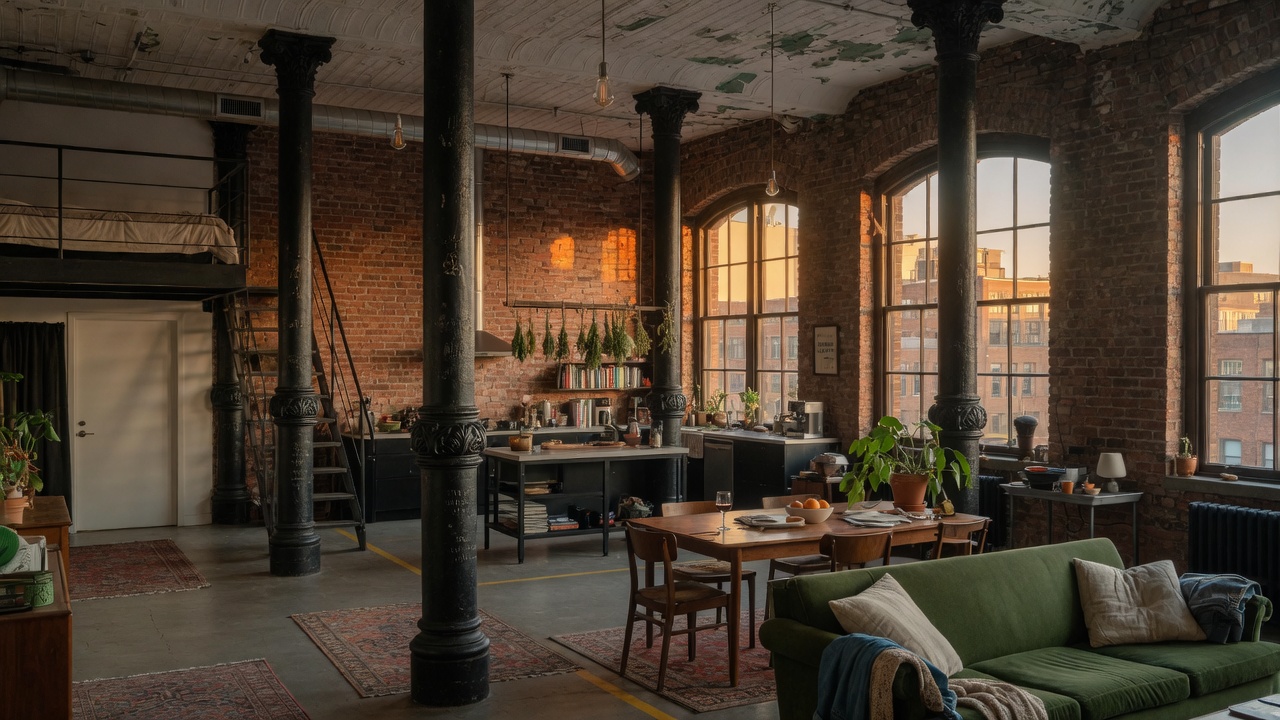
In the old brick warehouse along the canal, the loading doors still slide on their original iron tracks, now framing views of bicycles and potted fig trees instead of crates of goods. The conversion leaves these details intact, letting the building’s industrial past shape how light moves through the new rooms and how bodies settle into daily rhythms.
Thick timber posts, marked by decades of rope burns and forklift scrapes, divide the open floor without walls. Residents place worktables against one side and a reading chair on the other, the wood grain carrying the same wear patterns that once absorbed the weight of stacked barrels. Above, the original steel beams remain exposed, their rivets catching the low winter sun that enters through clerestory windows left untouched during renovation.
Concrete floors keep the faint oil stains from former machinery. Underfoot they feel cool in summer and hold warmth from underfloor heating in winter, a quiet record of use that new finishes would erase. Where the floor meets the brick perimeter, the transition stays abrupt; no baseboards soften the joint, so the eye follows the wall upward to the point where daylight meets soot-darkened masonry.
Mezzanines inserted for sleeping quarters sit lightly on the existing structure, their steel frames bolted rather than welded so the original columns continue uninterrupted to the roof. From the lower level the underside of these platforms shows the same riveted plates that once supported conveyor belts. Morning light filters through the gaps between new floorboards, casting thin lines across the concrete below.
In one converted textile mill, the freight elevator still operates, its wooden cage now carrying groceries and canvases instead of bolts of cloth. The operator’s call button remains beside the door, its enamel worn to metal at the center. Residents use the slow ride to notice the changing quality of light on each landing, the building’s height turning a simple vertical journey into a sequence of material encounters.
These adaptations keep the warehouse’s scale legible while allowing ordinary domestic life to take place inside its volume. The result is not a polished interior but a space where the memory of heavy work persists in the surfaces that now support lighter, quieter routines.