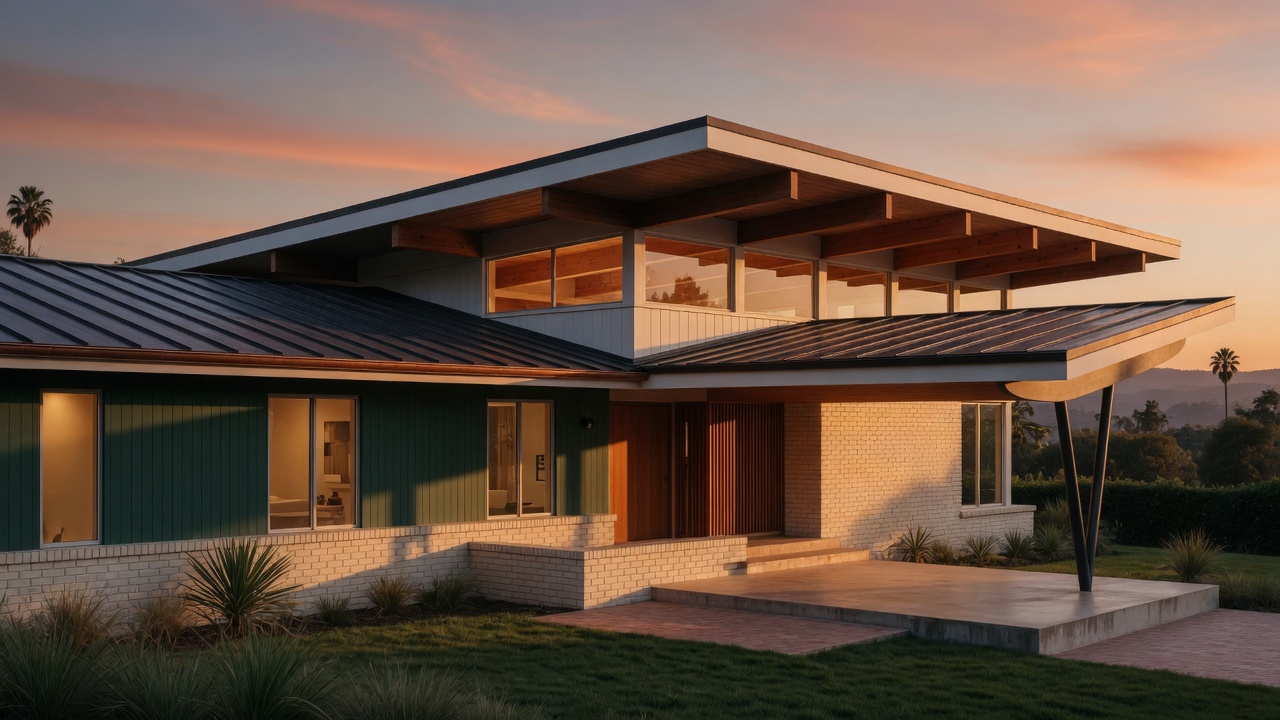
In a 1958 ranch house outside Los Angeles, the original roof still projects eight feet beyond the glass wall, its underside painted a matte white that catches the afternoon light and returns it softly to the concrete floor. Renovations that keep this overhang intact tend to succeed where others falter, because they preserve the single gesture that once made the house feel larger than its footprint.
Owners and architects now spend considerable time on the roof edge itself. They replace rotted fascia with new cedar milled to the same profile, then conceal modern insulation and flashing so the line remains thin and uninterrupted. Inside, the ceiling plane continues without a break, so the eye travels outward even when the glass is closed against heat. The result is less about style than about the continued experience of distance.
Wood plays a quieter role than it once did. Where postwar builders used solid redwood or fir, current work often substitutes thermally modified ash or reclaimed Douglas fir treated to resist warping. The grain still registers under the hand, yet the material now performs against expansion and contraction that older stock could not withstand. Joints are cut with the same half-lap details found in the original drawings, so the eye registers continuity rather than repair.
Concrete surfaces receive similar attention. Original slab floors, once covered by carpet, are ground and sealed to reveal aggregate that matches the exterior walkways. Where radiant heating is added, the new tubing runs in a thin topping layer rather than a full replacement slab, keeping the thermal mass and the cool touch underfoot that residents remember from the house’s first decades.
Mechanical systems are threaded through existing chases or placed in low cabinets that double as window seats. The goal is never invisibility but rather a kind of quiet presence that does not compete with the long horizontal sightlines. When a new vent or outlet must appear, it is set flush and finished in the same paint as the surrounding wall, so the interruption registers only as a small, necessary pause.
These choices accumulate into a house that still registers the original proportions even after the kitchen has been enlarged and the wiring updated. The roof continues to throw its measured shadow, the wood keeps its measured warmth, and the floor still cools the air that moves across it at dusk.