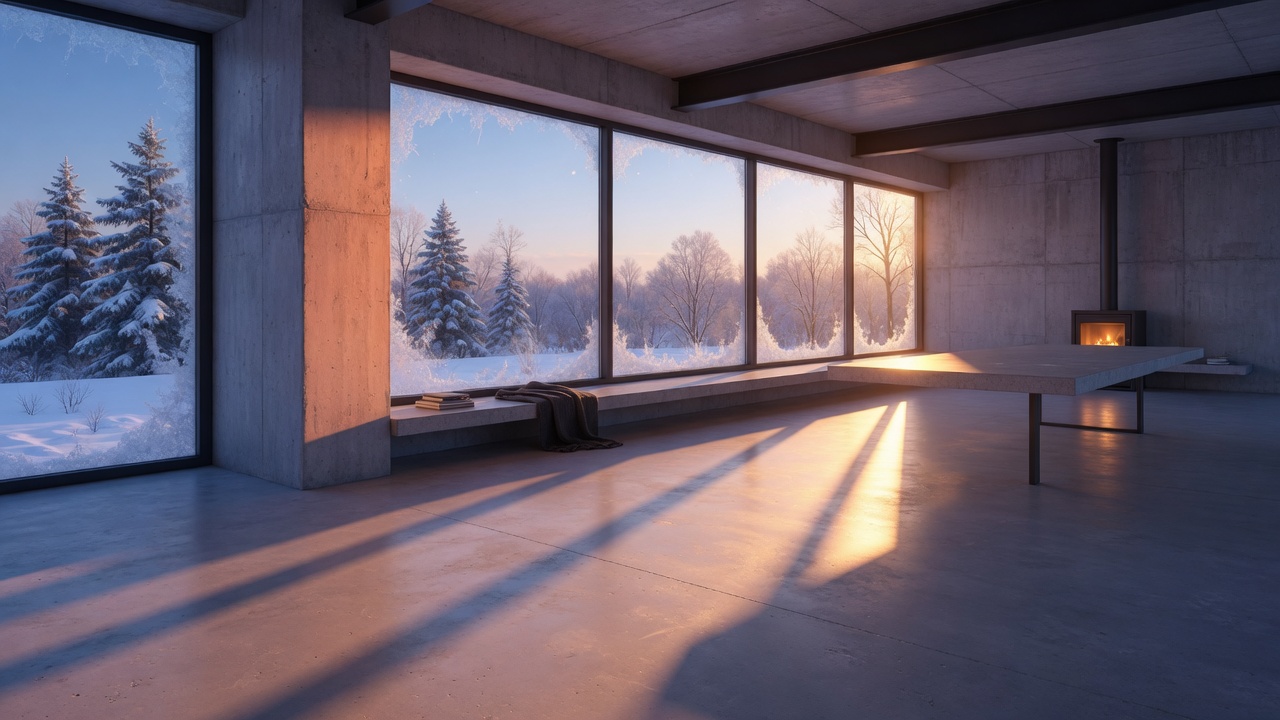
In a recent house near Santa Fe, the living room floor is poured concrete dyed a deep charcoal. Low winter sun crosses the south windows and lands directly on that surface, warming it through the middle of the day. By evening the stone gives the stored heat back without any furnace running. The effect is quiet and steady, noticeable mainly when someone steps barefoot across the room after sunset.
This approach treats sunlight as a measurable resource rather than an effect to be added later. The architect set the glazing at roughly twelve percent of the floor area and placed the mass where the light would reach it most directly. Interior partitions stay low so warmth can move through the open plan. At night the same concrete continues to temper the air while the occupants sleep under blankets that feel only slightly cooler than the floor itself.
In a different climate, a home outside Portland uses a similar principle but with different materials. Here the south wall incorporates a thick layer of rammed earth behind the glass. The earth absorbs heat during short winter days and releases it gradually after dark. Window frames are set deep into the wall so summer sun is blocked by the overhang while winter light still reaches the mass. Residents describe the rooms as holding an even temperature even when outdoor swings are sharp.
The sensory result appears in small, repeated moments. Morning light strikes the wall and the surface temperature rises just enough that a hand resting against it feels warmer than the surrounding air. In summer the same wall stays cool to the touch because the overhang keeps direct rays away. Light moves across the rooms in predictable patterns that change with the seasons rather than with switches or timers.
Such houses ask builders to coordinate window placement, shading, and mass early in the design process. Once those decisions are fixed, the building itself manages much of the daily comfort without further intervention.