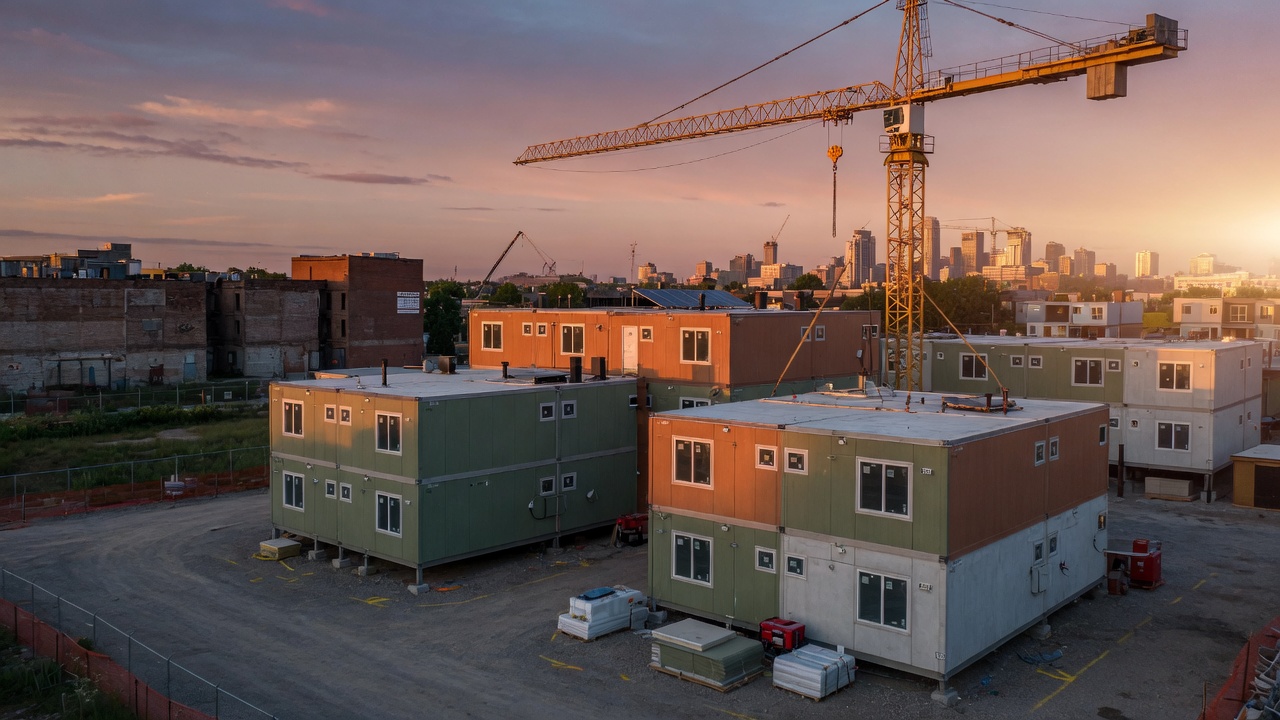
A crane lowers a finished timber module onto a concrete pad at dawn, its edges already planed and sealed so that the joint closes with a soft, final sound rather than the usual chorus of hammering. The panel carries its own insulation, wiring, and two windows; inside, the grain of the spruce still smells faintly of resin. Within hours the next module arrives, and by evening the house has a roof and a door that actually locks.
This method of building grew out of necessity after the Second World War, when governments in Britain and Scandinavia commissioned factories to produce complete rooms rather than stacks of lumber. The same logic now reappears wherever land is scarce and labor is expensive. In Helsinki, a cooperative recently erected a four-story block of cross-laminated timber apartments in eleven weeks; each floor arrived as two large cassettes that a single crane could set in place. Residents moved in while the neighboring site was still clearing rubble.
The material itself shapes daily life. Because the walls are finished in the factory, the interior surfaces remain flat and the corners square; there is none of the slight waviness that plasterboard often shows after site work. Light falls evenly across the pale wood, and the thermal mass of the timber keeps rooms cooler in summer without extra mechanical equipment. Outside, the joints between modules are expressed as narrow shadow lines rather than hidden behind cladding, giving the elevations a measured rhythm that recalls traditional timber framing without copying its details.
Yet the speed of assembly does not remove the need for careful siting. A module placed too close to a mature oak will lose its southern light within a decade; one set on a slope without proper drainage will collect moisture at the base plate. Architects working with prefab therefore spend more time on the ground plane and the orientation of openings than on the invention of novel forms. The repetition of the factory product becomes an advantage once the modules are arranged around a shared courtyard or staggered to create small private terraces.
In dense European cities the same approach has produced infill houses on lots no wider than a single parking space. Each house arrives in three or four pieces, is bolted together in a weekend, and leaves the surrounding pavement almost untouched. The result is not a temporary shelter but a permanent addition whose walls already carry the marks of daily use: a scuff on the birch plywood near the coat hooks, a small shelf added later by the owner above the kitchen counter. The factory supplies the frame and the finish; the life inside still unfolds at its own pace.