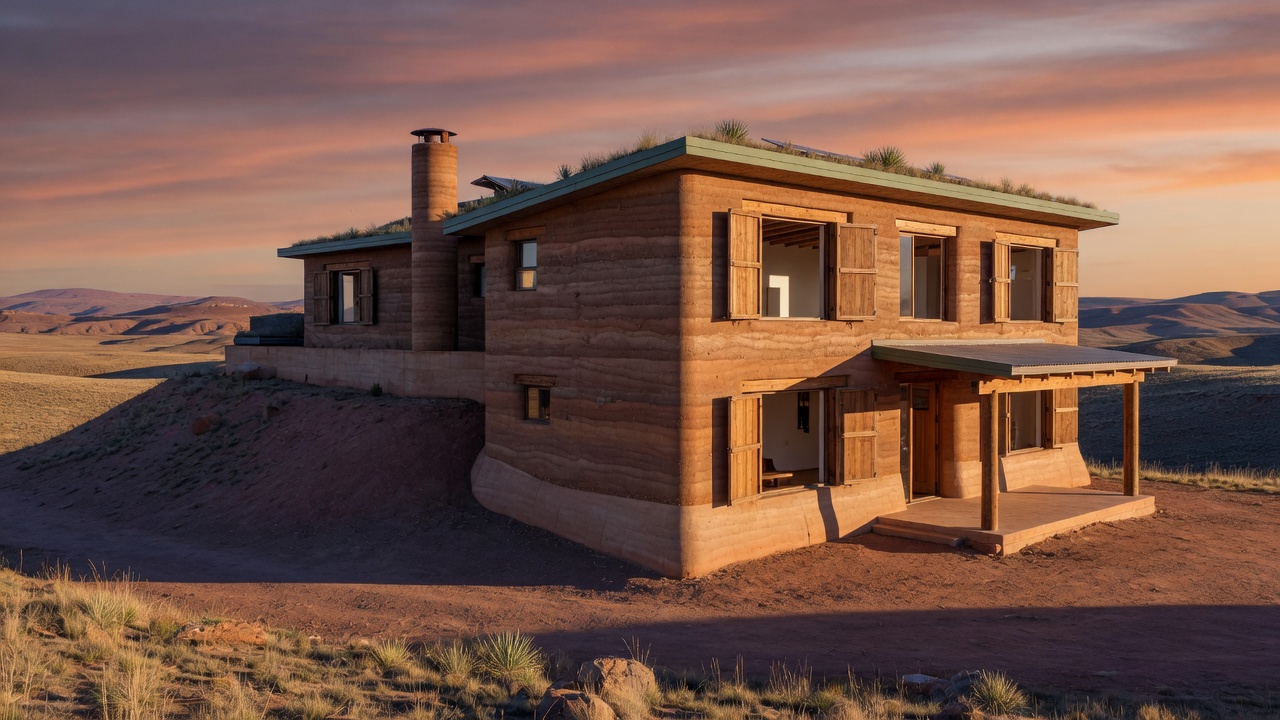
In the dry valleys of southern Arizona, a house rises in horizontal bands of pale red soil, each layer packed by hand until the wall rings solid under a mallet. The surface carries faint impressions from the wooden forms, small ridges that catch low light and turn the interior into a slow calendar of sun movement.
These walls draw their strength from the same ground they rest on. Subsoil is screened, moistened, and compacted in lifts of ten to fifteen centimeters. Once cured, the material reaches compressive strengths suitable for load-bearing construction without additional reinforcement in many climates. The mass stores daytime heat and releases it gradually after dark, flattening temperature swings inside to a narrow range even when outdoor air varies by thirty degrees.
Light behaves differently against rammed earth than against painted drywall. Morning sun skims across the textured face and reveals the aggregate—bits of quartz, flecks of mica—turning the wall into a quiet reflector rather than a blank surface. In the evening the same wall absorbs artificial light and returns it softly, reducing the need for multiple fixtures.
A house completed near Tucson in 2017 demonstrates the effect clearly. Its south-facing living room stays comfortable through June afternoons while neighboring stucco homes require constant air conditioning. The owners note that the interior humidity remains stable without mechanical humidifiers; the clay fraction in the walls moderates moisture naturally. Rainwater collected from the roof is used to irrigate a small garden whose clippings later amend the soil mix for an adjacent studio addition.
Construction demands patience more than heavy machinery. Crews work in sequence, allowing each lift to set before the next is placed. The resulting rhythm leaves visible joints that record the building process itself. Over time, the surface develops a fine patina from handling and occasional dust, deepening rather than eroding the sense of age.
Such buildings ask for attention to local soil chemistry and seasonal rainfall patterns before the first form is set. When those conditions are respected, the finished rooms carry the temperature and light of their particular site long after the forms are stripped away.