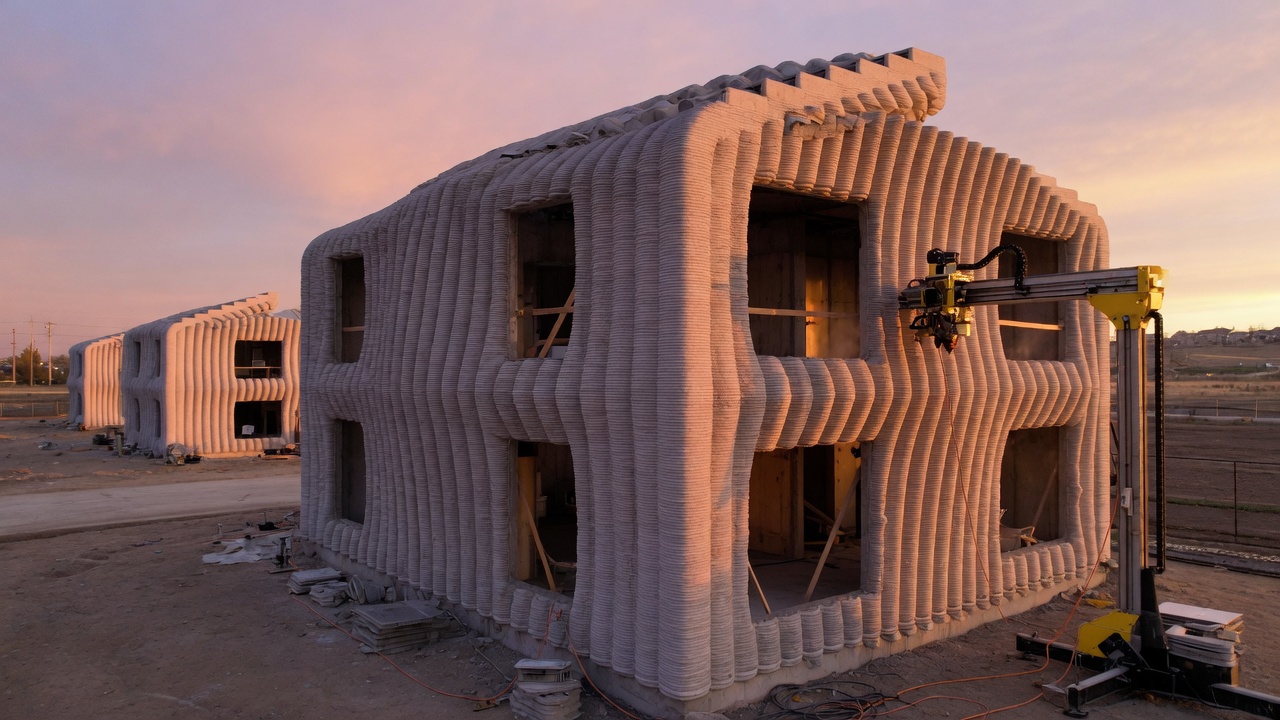
In a dusty field north of Austin, a gantry crane moves with deliberate slowness while a thick nozzle extrudes a continuous bead of cementitious mix, tracing the outline of a bedroom wall before dawn. The material leaves the hose warm and settles into soft ridges that harden within minutes, each pass stacking directly on the one below like a geological stratum formed in a single night.
These printed walls carry a distinct texture. Run a hand along the finished surface and the fingers catch on the faint horizontal lines left by the nozzle, a record of the machine’s pace rather than any mason’s trowel. The ridges catch morning light at low angles and cast narrow shadows that shift across the room as the sun climbs, giving even a modest interior a quiet depth. Inside, the mass of the material holds temperature steady; evenings feel cooler without mechanical cooling because the printed concrete absorbs heat during the day and releases it slowly after dark.
Projects in Texas and Tabasco have used this method to produce complete single-story houses in under twenty-four hours of active printing. The mix often incorporates local sand and fly ash, reducing transport and giving each region a slightly different color and thermal behavior. In one Austin prototype the walls were left exposed on the interior, their layered surface left as the only finish. Residents described the space as feeling more like carved earth than assembled panels, though the same surface can prove difficult to mount shelves or pictures without special anchors.
The speed of construction changes the economics of small sites. A foundation and four walls can rise before weather turns, cutting weeks of labor and the need for multiple trades. Yet the method still demands precise foundation work and careful sequencing for windows, plumbing, and roofs that the printer cannot yet address. In places where skilled framers are scarce, the reduction in on-site coordination matters more than the raw speed.
Cultural fit varies. In rural Mexico the printed forms echo the monolithic quality of older adobe compounds, while in American subdivisions the same geometry reads as deliberately modern. The layered surface can be coated or left raw, allowing builders to tune appearance without changing the structural process. What remains consistent is the way the material records its own making, turning the wall into both shelter and visible log of the hours required to stand it up.