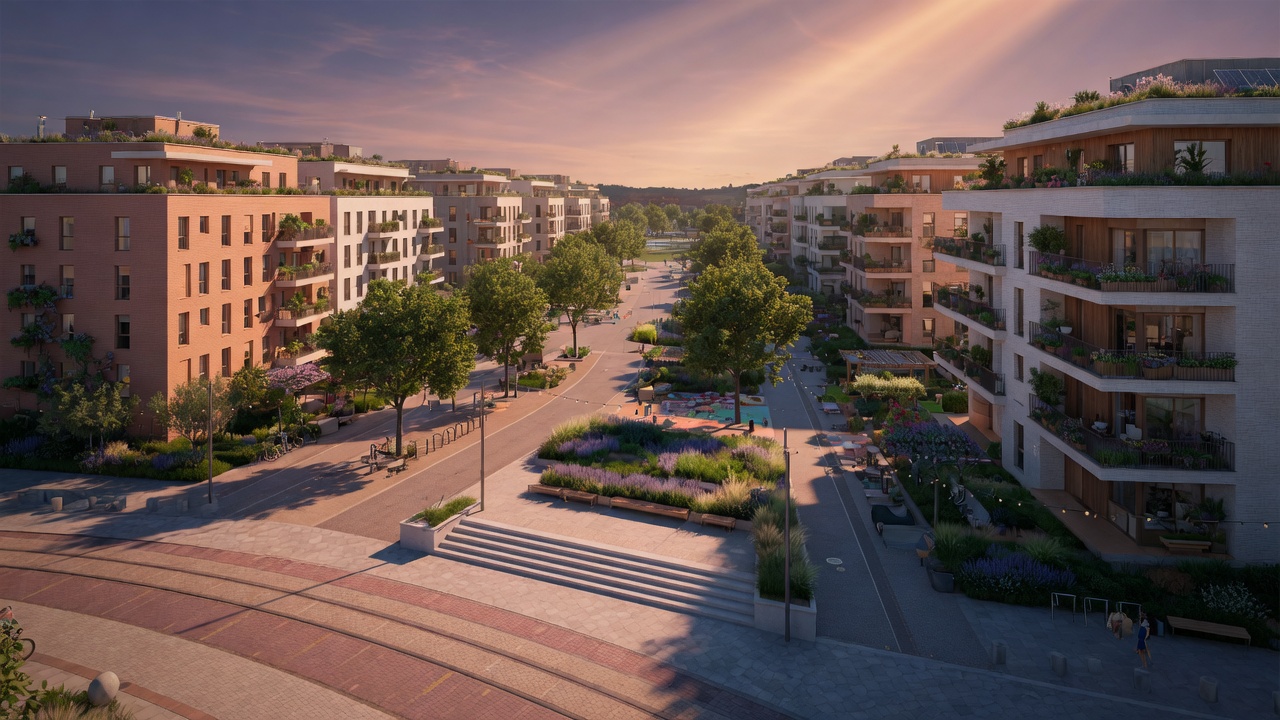
In certain districts the first thing one notices is how sound travels. Without engines idling at intersections or tires rolling across asphalt, voices carry farther, and the scrape of a chair on paving stones registers as a distinct event rather than background noise. Light also behaves differently when pavement does not dominate the ground plane; low morning sun reaches deeper into ground-floor rooms, and the texture of brick or gravel underfoot replaces the uniform glare of sealed roads.
Vauban, on the edge of Freiburg, shows one version of this arrangement. Long, narrow residential courts run between rows of townhouses, each court wide enough for two people to walk abreast yet too tight for ordinary vehicles. Residents park once at the perimeter and continue on foot or by cargo bicycle. Plane trees planted at regular intervals throw dappled shade across the shared surface; in summer the leaves muffle footsteps, while in winter the bare branches allow low sun to warm the south-facing façades. Children leave toys on the paving because nothing larger than a wheelbarrow will pass through during the day.
A similar logic appears, at larger scale, in the superilles of Barcelona’s Eixample. Interior streets have been narrowed to single lanes for local access only, their former carriageway space given over to benches, play structures, and lines of plane trees set in continuous soil trenches. The buildings themselves remain unchanged, yet their ground floors now open directly onto spaces where conversation replaces the drone of traffic. Window sills sit at the height of a seated adult rather than the height of a passing car roof, altering the rhythm of glances exchanged between interior and exterior.
Such neighborhoods require adjustments in section as well as plan. Service access for deliveries and emergency vehicles is routed along the edges or through covered passages beneath buildings, keeping the central courts free of curb cuts. Stormwater is managed in shallow swales that double as seating edges; the sound of water moving after rain becomes another seasonal marker. Because mechanical ventilation is less necessary when windows can stay open without traffic noise, mechanical plant rooms shrink and roof terraces gain usable depth.
The daily pattern that results is modest but consistent. People move at the speed of conversation rather than the speed of a gearbox, and the buildings register that change through the placement of doors, the depth of thresholds, and the orientation of windows toward shared ground rather than toward distant traffic.