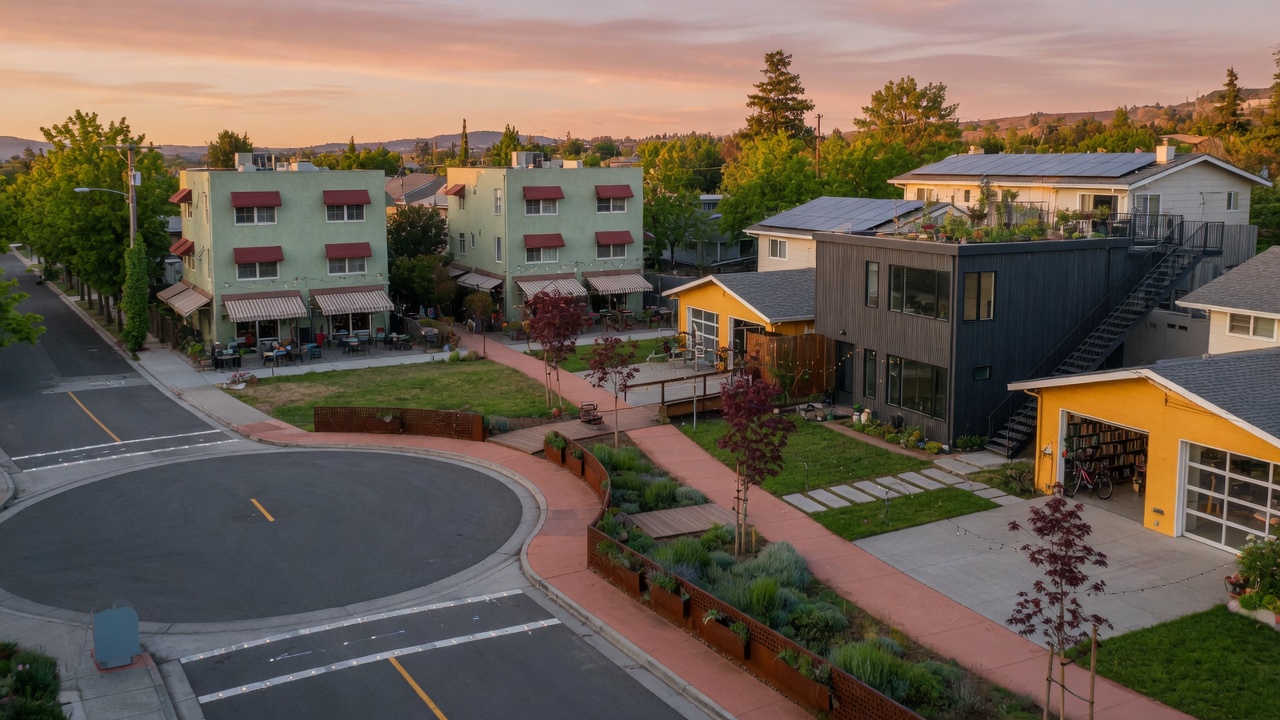
In the looping streets of midcentury subdivisions, where each house once turned its back to the road, new paths are beginning to cut through fences and former driveways. These interventions do not announce themselves with master plans. They arrive as single added buildings, a widened sidewalk, a line of townhouses slipped behind a strip mall’s parking lot.
The change registers first in the feet. Where residents once drove three blocks for milk, they now cross a narrowed pavement that feels almost like a village lane. The asphalt has been pulled back on one side to make room for a row of two-story apartments whose ground floors hold small workshops and a bakery. Morning light falls differently here, no longer reflected off acres of empty asphalt but caught by brick walls and the undersides of wooden awnings. The smell of bread reaches the sidewalk before the shop door opens.
Further along the same corridor, a former gas station has become a pocket of courtyard housing. Four modest units face inward around a shared garden; their rear walls form a continuous edge along the street, giving the passing pedestrian a sense of enclosure that the original suburban pattern never provided. At dusk the windows glow at eye level rather than behind deep setbacks and high hedges. Children ride bicycles on the new shared surface without needing to watch for through traffic.
Density arrives in increments that respect the existing grain. Garages are converted to studio apartments above, and the driveways become narrow pedestrian mews planted with trees whose canopies will eventually meet overhead. Corner lots, once occupied by single houses on oversized parcels, now support four or five dwellings arranged around a small common green. The original ranch roofs remain visible from certain angles, so the older pattern is still legible even as new massing fills the gaps.
These adjustments alter movement more than skyline. A person walking can now reach the library branch without crossing a six-lane arterial. Buses stop closer to front doors because the curb line itself has been redrawn. The same blocks that once emptied at five o’clock begin to hold activity into the evening, not because density was imposed from above but because the ground plane was allowed to become continuous again.