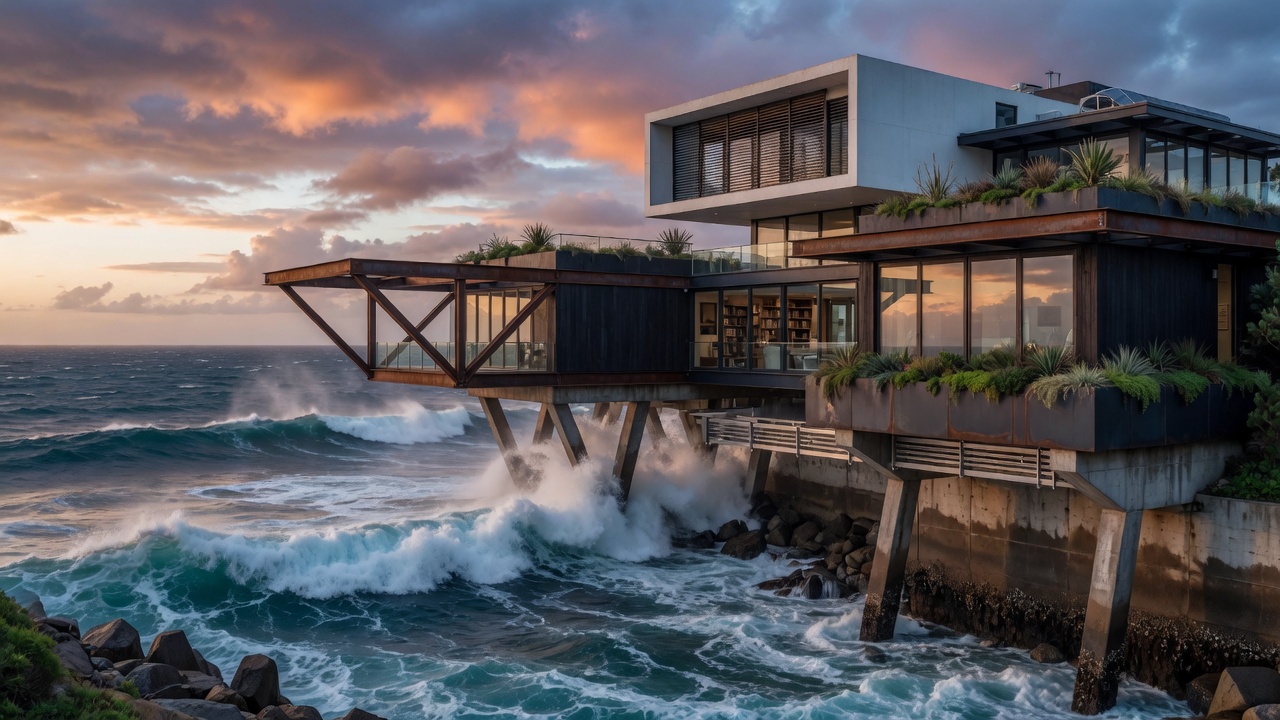
Along the low barrier islands of the Gulf, some houses do not fight the water so much as keep their distance from it. They rest on slender pilings driven through loose sand into firmer strata below, their floors held eight or ten feet above the highest recorded tide. From the ground, the arrangement looks precarious; from inside, the view opens across dune grass and breaking waves without the usual obstruction of a solid wall at eye level.
Cypress, still cut from nearby swamps, forms the primary frame. Its natural oils resist both rot and the constant salt spray that turns ordinary pine gray within a season. The boards are left unfinished on the exterior so the wood can darken and silver at its own pace. Metal roofs, usually standing-seam zinc, slope steeply enough to shed both rain and the occasional sheet of wind-driven water. When a hurricane approaches, the same roof panels can be unlatched at one edge and allowed to vent pressure rather than lift entire sections of the structure.
Inside, the rooms are arranged in a single loaded corridor that runs parallel to the shore. Cross ventilation is constant; even on still afternoons the air moves because the house is raised and the floor is open beneath. Operable wooden shutters, cut with narrow vertical slots, close across the large windows yet still admit enough light to read by. The slots also prevent the interior from heating like a closed box during the long, humid days after a storm when power may be out.
Below the living level, the space remains largely empty except for a lattice screen that breaks the force of waves without trapping debris. During extreme events the water passes through rather than against the house. After the water recedes, the underside can be hosed clean and the lattice replaced in sections. This approach accepts that the ground plane will shift and that the building’s relationship to that ground will change over time.
The same principle appears in older fishing camps farther north along the Atlantic, where entire structures were once mounted on skids and dragged inland after each major nor’easter. The modern versions keep the same willingness to move, only now the movement is vertical rather than horizontal. What remains is the recognition that a coastal house succeeds not by sealing itself against the sea but by letting the sea pass beneath it while the inhabitants stay dry a few feet higher.