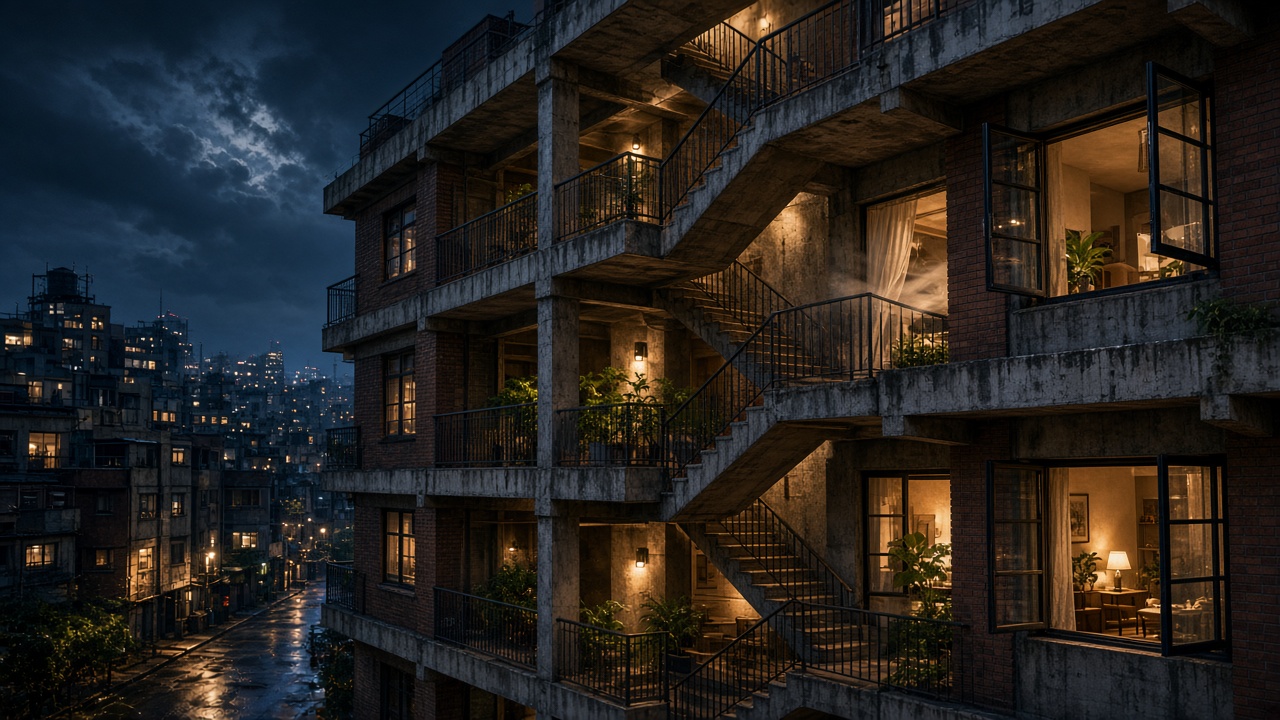
Dense apartments are unkind to passive cooling because they share walls, stack people, and face noise, soot, and locked windows. The old remedies still work if you treat the building as a slow thermal machine rather than a sealed box. Mass first. Brick, stone, and thick plaster store heat through the afternoon and give it back after midnight, but only if you let night air strip the surplus. That is the night flush: open high and low, create a path, and let the stack of the stair or the light well pull. A single-loaded corridor with operable transoms beats a double-loaded one that traps yesterday’s warmth like a closed oven.
Shading is not decoration. A deep balcony, a brise-soleil of terracotta, or even a well-placed plane tree can keep the west wall from becoming a radiator. In Havana the jalousie is a climate instrument: slats that admit breeze and deny glare, a grammar of wood that you adjust by hand as the sun moves. Mashrabiya screens in older Cairo houses do the same with lattice and shadow, turning the street’s heat into a dim, moving pattern on the floor. You do not need those exact forms; you need the principle—filter light, keep the envelope from cooking, leave a gap the air can use.
Courtyards and airshafts are the city’s lungs if they are not reduced to trash chutes. A narrow court that is open at the top and shaded at the sides can set up a chimney of cooler air. The New York tenement airshaft was often a failure of hygiene, but the idea was not stupid: vertical volume, pressure difference, a place for heat to rise. When the shaft is too tight and too dark it becomes a stagnant well. When it has a bit of width, a pale wall, and openings at more than one level, it begins to breathe.
Operable windows matter more than glass area. A hopper at the top of a high ceiling, a casement that can catch a corner breeze, a night latch that stays cracked without inviting the street in—these are small permissions. Ceiling height itself is a cooling device: heat rises; a twelve-foot parlor in an old brownstone is not nostalgia, it is stratification. Fans help only if the air has somewhere to go. A closed room with a fan is a mixer of the same stale warmth.
Materials that stay cool to the touch—tile, terrazzo, lime plaster—change how a body reads a room. You sit on the floor at dusk and the surface has not yet given up. In Singapore’s shophouses the five-foot way and the internal air well were urban manners: shade the walk, vent the plan, keep the apartment from becoming a kiln. We can still learn that courtesy without copying the ornament.
The constraint of density is also an advantage if neighbors share a court or a roof that is pale and uncluttered. Night air is a commons. The building that opens to it at the right hour, that shades by day and mass-stores without trapping, does not shout about climate. It simply lets the brick and the stair do what they have always done when we remember to unlatch the transom.