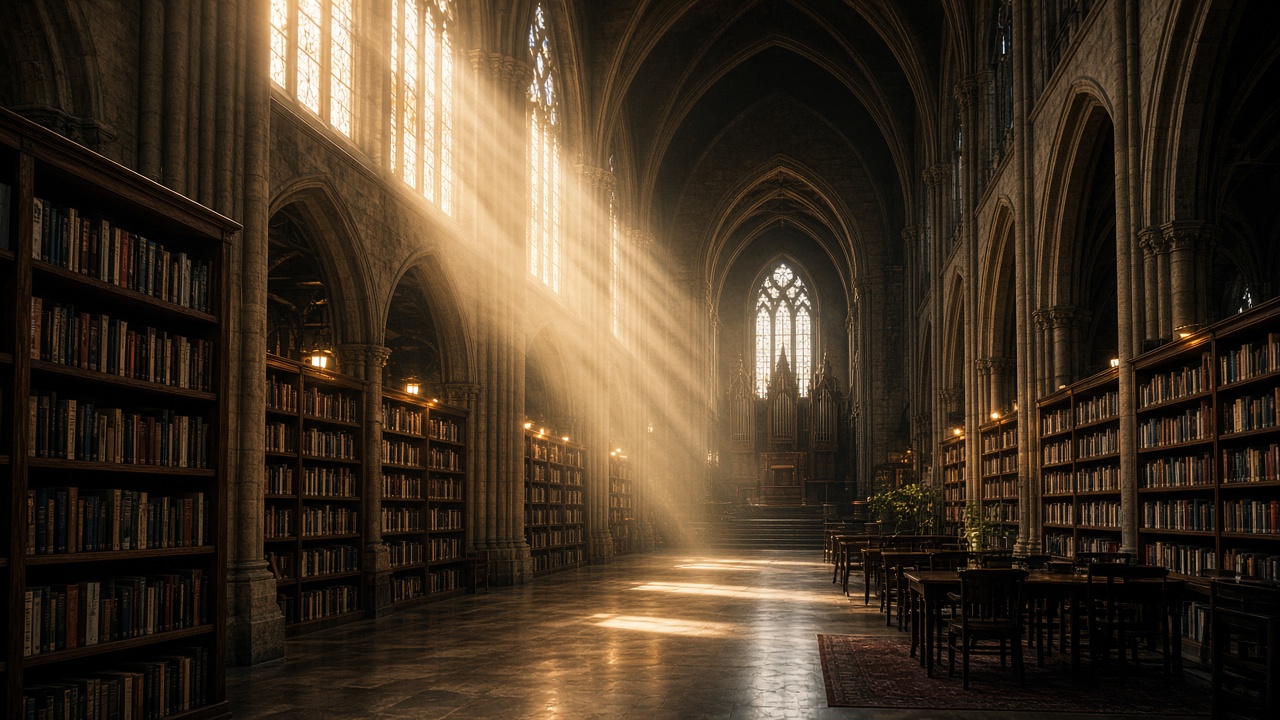
A nave that once held standing congregants now holds silence of a different kind: the small scrape of a chair, the dry turn of paper, a cough swallowed by stone. You feel it first in the volume of air. Churches were built to lift the voice; libraries ask the same space to hold it down.
Adaptive reuse of churches as libraries is not a clever trick of zoning. It is a negotiation between two kinds of attention. Worship asked people to look up and listen together. Reading asks them to look down and go inward, side by side. The architecture already knows how to do both. The height remains. The light remains. What changes is the grain of use.
In Maastricht, the former Dominican church became a hall of books. Gothic ribs still climb; the stacks sit in the former choir like a second architecture, a timber nave inside the stone one. You walk the aisle and the old procession is still there, only the destination is a spine, not an altar. Elsewhere the conversions are quieter: a clapboard church in a small American town, white paint flaking at the eaves, the steeple still catching the last sun. Inside, the pews are gone. Long tables occupy the former nave. A children’s corner occupies the baptistry, where the floor is cooler and the light lower. The stained glass does not illustrate scripture so much as stain the page: a red wash across a novel, a blue stripe on a newspaper.
Material honesty matters here. You do not hide the plaster cracks or the unevenness of handmade brick. You do not drop a flat acoustic ceiling to “improve” the room. The echo is part of the program. A librarian learns to speak more softly; a child learns that a building can have a voice of its own. Stone and timber absorb the heat of afternoon and give it back after closing. The thick walls, once a theology of permanence, become a practical thermal mass.
There is an ethical tightness to this work. A church emptied of congregation is not a blank box. The orientation, the west door, the residual smell of wax and damp hymnals—these are not obstacles. They are constraints that keep the conversion from becoming a mall of knowledge. Shelving should not march through the crossing as if it were a warehouse. Circulation should still feel like a path. The former pulpit, if it remains, can hold a catalog terminal or a reading lamp; it should not be mocked.
Light is the true program. Clerestory windows, designed to make dust visible in a shaft of morning, now make the edges of books visible. In late afternoon the rose window throws a slow clock across the floor. Readers move with it without noticing. That is the gift of these rooms: they were never meant to be efficient, and so they refuse the fluorescent evenness of a typical stack. You remember where you sat because of the color on the page, not because of a call number.
The best of these libraries do not pretend the building has been baptized into a new faith. They let the old volume remain slightly too large, slightly too quiet, slightly too much. A person comes in from rain, shakes a coat, and the vault answers with a long, low note. Then they sit. The books wait. The stone does not care what is being read.