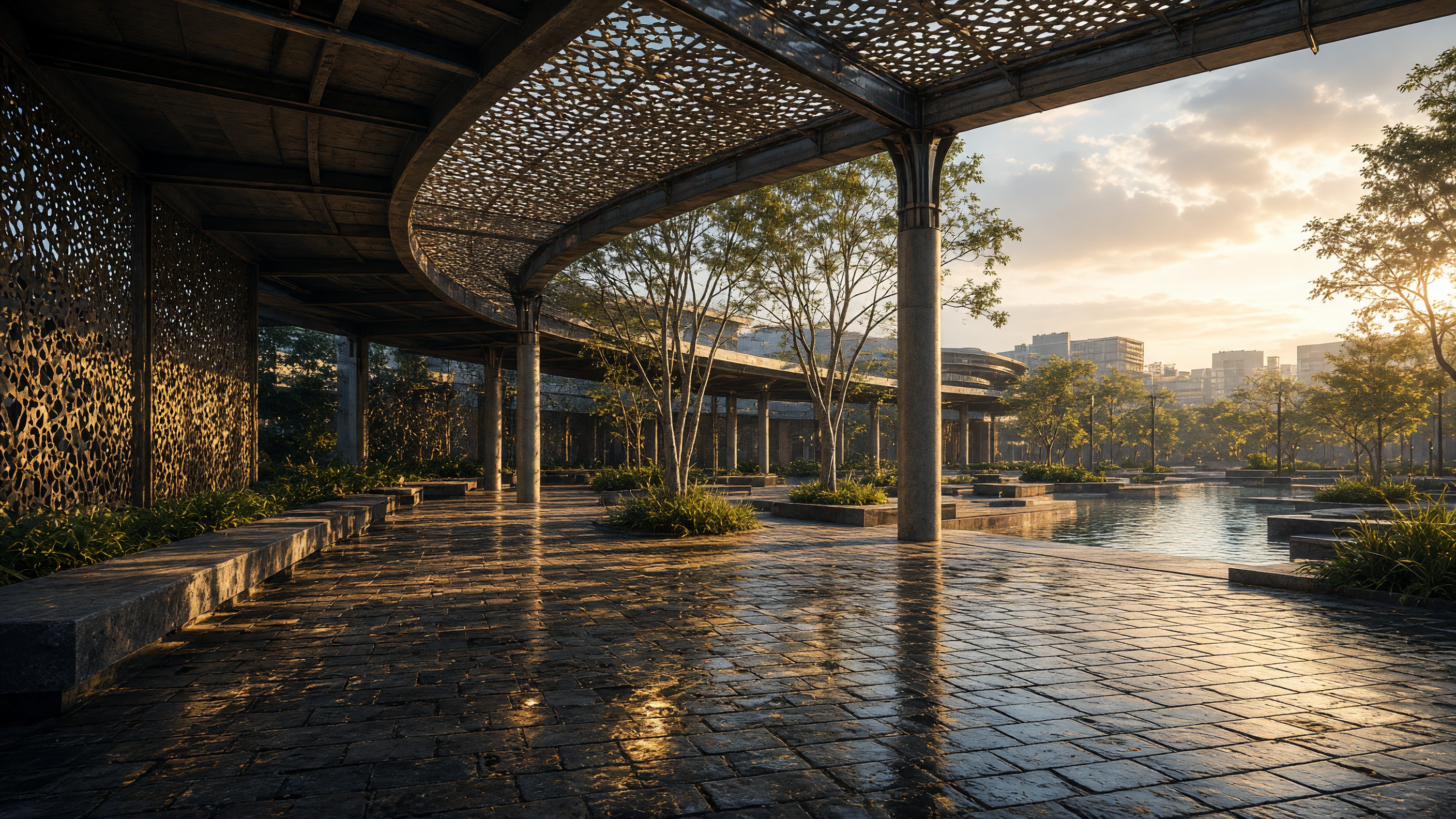
In Seville, before the worst of the afternoon, workers still hose the streets. Water darkens the cobbles, raises a brief mineral smell, and cools the air by a degree you can feel on the forearm. The plaza, in that moment, is not a picture. It is a device.
Extreme heat makes this obvious. A square of dark asphalt in Phoenix or Tucson at two o’clock is not a gathering place. It is an oven with benches. People cross it the way they cross a parking lot: heads down, as fast as possible. The civic claim of the plaza—that we might linger, talk, watch one another—collapses when the ground stores the sun and gives it back through the soles of the shoes.
Older cities already knew this. The Andalusian patio, the sahn of a mosque, the Court of the Myrtles at the Alhambra: long water, high walls, a strip of sky. The pool is not decoration. It is evaporative cooling you can hear. Porticoes do the same work with shadow. Bologna’s miles of arcade, the soportales of a Spanish plaza, the portales around a Mexican zócalo—these are public rooms without quite being indoors. You walk in shade while the square itself remains open to the light. The building becomes a brim.
Trees are architecture in this climate, not amenities. A vault of plane trees over a Mediterranean square drops the temperature the way a ceiling does. Ficus in a Mexican plaza does it denser, darker, with that heavy green smell after watering. The canopy has to be high enough to walk under and continuous enough to matter. A single ornamental tree in a sea of pavers is a gesture. A grove is a room.
Materials decide the rest. Light stone, terracotta, pale concrete: they refuse some of the sun. Dark asphalt drinks it. You feel the difference before you name it—the white glare of marble versus the matte of limestone, the way wet brick stays cool longer than dry granite. Permeable ground helps, not as a slogan but as sensation: less stored heat, a little dampness in the joints, the possibility that a fountain’s overflow has somewhere to go.
Seville tried a more theatrical version of shade with Jürgen Mayer’s Metropol Parasol, that timber lattice rising over Plaza de la Encarnación like a fungal ceiling. Whatever one thinks of its silhouette, it takes the problem seriously: a public space in Andalusia needs a roof that is not a roof. Phoenix’s Civic Space Park works in a harsher register—steel canopies, grass, the canal nearby—accepting that without cover, the square will empty from May to September.
Heat also rearranges the clock. In many hot cities the true plaza hours are evening. The paseo begins when the stone finally lets go of the day. Fountains get louder in the mind. People sit on steps that were untouchable at noon. A plaza designed only for postcard light at midday has misunderstood the life it claims to serve.
The best of these places still feel like rooms: a drop in temperature at the threshold of shade, water you can sit beside, a floor that does not burn.